

 DE
DE ES
ES RU
RU FR
FR ZH
ZH HI
HI GR
GR


Neuro-Linguistic Programming
Living More Successfully with NLP
Dear Reader,
Twenty years ago, I reached a point in my life where I no longer found it worth living. I was in the middle of my first serious crisis, questioning the meaning behind this experience as a human being on planet Earth. I was shy, lacking clear goals, and life no longer brought me any joy. At that time, I came across a book about Neuro-Linguistic Programming (NLP). Reading this book and applying its methods changed my life forever. Initially, hope glimmered like a thin ray of light, and over the years, it turned into bright, radiant sunlight. Gradually, I underwent a transformation. I became more confident, my goals and visions grew stronger, and my persuasive power steadily increased. Looking back, I’m deeply grateful that NLP entered my life. First, it transformed me on the inside; then my environment changed too. I created a setting in which I can live with fun, joy, and passion. It’s immensely rewarding for me to see our seminar participants evolve toward their dreams, growing into the kind of personality that can attract whatever they want into their life. And if things turn out differently sometimes, they don’t give up—they keep developing. They learn from their supposed setbacks and mistakes. NLP helped me become more empathetic, better able to meet other people’s needs. At the same time, it dramatically refined my own sense of feeling and perception. Being able to communicate effectively with others is, to me, one of the most crucial core competencies of our time. The world grows increasingly interconnected, business and social activities are ever more global. Unfortunately, we often lack the time for deeper connections, even though we have more possibilities than ever before. Yet many people are beginning to refocus on values such as friendship, family, and love—things that are a meaningful part of our life experience as humans. NLP can help us shape our relationships, understand others better, keep enhancing ourselves, and live with more abundant resources. NLP is a key tool to live more autonomously and freely. It lets us take charge of our circumstances instead of feeling victimized, becoming the director who pulls the strings.
Your
Stephan Landsiedel
What Is NLP
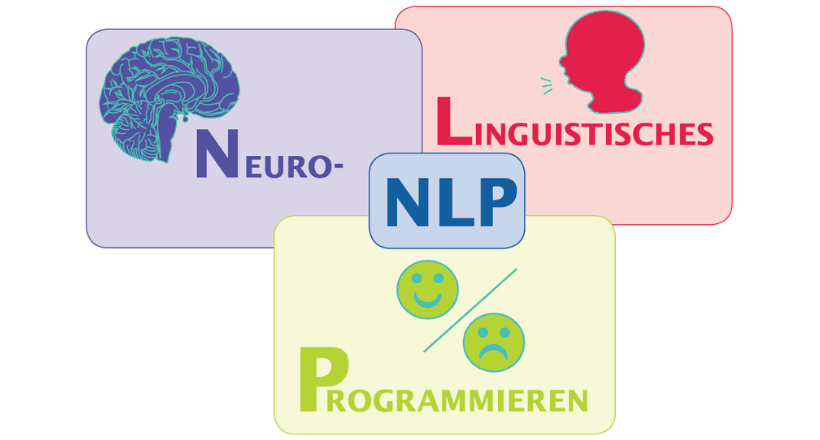
NLP stands for Neuro-Linguistic Programming, a communication and motivation model developed in the 1970s in the US. It came from a detailed analysis of outstanding psychotherapists and, in its modern form, can be used in almost any life context—for instance, therapy, sales, leadership, relationships, working with children, education, and more. In NLP, talk-based, behavioral, hypnotic, and body-oriented approaches converge. Our thinking, feeling, and behaving (Neuro) is systematically changed (programmed) via language (Linguistic).
Alternative Interpretations of NLP
Because the name “Neuro-Linguistic Programming” has often frightened newcomers, many practitioners have reimagined the three letters with new meanings, such as: Neue-Lebens-Perspektiven (New Life Perspectives), Neues Lebendiges Praktizieren (New Lively Practices), Neue Lebens-Pfade (New Life Paths), Neurolinguistische Prozessarbeit (Neuro-Linguistic Process Work), etc. Please do not confuse NLP with Natural Language Processing—different field entirely.
The Prince and the Magician
Once upon a time, there was a young prince who believed in everything except for three things. He did not believe in islands, he did not believe in princesses, and he did not believe in God. His father, the king, told him these things didn’t exist. And since in his father’s kingdom there were no princesses, no islands, and no sign of God, the prince trusted his father. But one day the prince fled the royal palace. He went to the neighboring land. There he saw, to his amazement, islands off every shore, and on those islands were strange and bewildering creatures he didn’t dare name. As he searched for a boat, a man in a tuxedo approached him on the beach. “Are these real islands?” asked the young prince. “Of course they’re real islands,” the man in the tux replied. “And these peculiar, confusing creatures?” “They are absolutely princesses.” “Then God must exist as well!” cried the prince. “I am God,” replied the man in the tux, bowing. The young prince hurried home. “I saw islands, I saw princesses, I saw God,” the prince told his father reproachfully. The king was unmoved. “There are neither real islands, nor real princesses, nor a real God.” “But I saw them!” “Tell me, how was God dressed?” “He was in formal attire—a tuxedo.” “Were the cuffs of his jacket turned back?” The prince recalled that indeed they were. The king smiled. “That’s the uniform of a magician. You’ve been tricked.” Back the prince went to that neighboring land, arriving at the same shore, where once more the man in a tux approached him. “My father, the king, told me who you are,” said the young prince indignantly. “You fooled me last time, but not now. I know these aren’t real islands or princesses, because you’re a magician.” The man on the shore smiled. “No, my boy, you’ve been deceived this time as well. In your father’s kingdom, there are many islands and many princesses. But your father cast a spell on you, so you cannot see them.” The prince returned home, contemplative. Upon seeing his father, he looked him in the eye: “Father, is it true that you are not a real king, but only a magician?” “Yes, my son, I’m just a magician.” “Then that man on the shore was God?” “That man on the shore was another magician.” “But I need the real truth, the truth beyond all magic.” “There is no truth beyond magic,” said the king. The prince fell into sadness and said, “Then I will kill myself.” The king conjured up Death. Death stood in the doorway, beckoning. The prince shuddered, recalling the enchanting yet unreal islands and the unreal yet marvelous princesses. “All right,” he said. “I can bear it.” “You see, my son,” said the king, “you’re about to become a magician yourself.” (From: John Fowles, The Magus, 1969)
The History of NLP
The history of NLP began in the 1970s when Richard Bandler, John Grinder, and Frank Pucelik joined forces at the University of California in Santa Cruz. John Grinder was then an assistant professor of linguistics, while Richard Bandler was a mathematician, Gestalt therapist, and computer specialist. Together with Frank Pucelik, they were always striving to learn and grow.
They finally decided to discover how certain experts manage truly remarkable achievements in their fields while others fail. So they started modeling successful people, identifying the patterns they used to achieve their goals. They became famous for modeling Dr. Milton Erickson, likely the most influential hypnotherapist, Virginia Satir, an extraordinary family therapist, and Fritz Perls, the father of Gestalt therapy.
After identifying these masters’ communication patterns, they taught them in workshops and seminars for students, continuing to refine the techniques. By now, NLP has spread worldwide, used in various fields by a growing number of people.
“Before I leave this world, one of the things I want the whole world to know is that human contact arises through the connection of skin, eyes, and the sound of the voice.”
—Virginia Satir
1972 Richard Bandler transcribes Fritz Perls’ therapy sessions. Then he himself runs Gestalt groups, with John Grinder as his supervisor.
1975 They develop the Meta Model of language and publish NLP’s first book, “The Structure of Magic.”
1977 Inspired by Milton Erickson’s work, they create the Milton Model.
1980 Bandler, Grinder, and Robert Dilts develop the concept of strategies, analyzing how we think and process information.
1982 The reframing concept is introduced, enabling communication with unconscious parts responsible for unwanted behaviors or symptoms.
1984 Richard Bandler discovers submodalities, among the most powerful and impressive techniques in NLP.
1988 Tad James develops TimeLine Therapy, an approach especially helpful for gently healing past traumas.
1990 Robert Dilts creates Reimprinting and processes for transforming limiting beliefs.
Historical Overview Graphic
Gregory Bateson (1904–1980) is considered one of the intellectual forerunners of NLP. The Anglo-American anthropologist, biologist, cyberneticist, and philosopher introduced Bandler and Grinder to Milton Erickson. Many NLP methods were at least inspired by his work, including Logical Levels (after Dilts), Perceptual Positions, and the Ecology Check.
Dr. Milton Erickson (1901–1980) was an American psychotherapist who greatly influenced modern hypnosis and its therapeutic uses. His life was defined by health issues, starting with polio in high school. In 1957, he founded the American Society for Clinical Hypnosis.
Virginia Satir (1916–1988) was the oldest of many siblings. Because of her parents’ problems, she decided at age nine to become a “family detective.” She first trained as a social worker, then studied psychoanalysis. She is recognized as a co-founder of systemic family therapy and later lectured worldwide.
Fritz Perls (1893–1970) was a German-Jewish psychotherapist. Fleeing with his family to South Africa in 1934, he eventually arrived in the US in 1946. Considered the founder of Gestalt therapy, his workshops at Esalen Institute became famous. Bandler came into contact with Perls’ work via transcripts of his therapy sessions.
NLP Presuppositions
There are certain basic assumptions, or “presuppositions,” in NLP that form key foundations. They’re neither definitively true nor false. Treating them as if true supports effective NLP practice. It’s akin to how mathematics depends on fundamental axioms. They offer shared ground so you can proceed usefully.
Practical Example
Imagine you have a cold and need medication from a pharmacy. You drive there and luckily spot a free parking space. Just as you figure out how to pull in, a red Porsche speeds up from behind. “Wow, he’s in a hurry,” you think, pulling over to let him pass. He apparently wants the pharmacy too, because he nabs your parking spot. You move on and find another spot. By the time you reach the pharmacy, that red Porsche is gone. Inside, the pharmacist tells you, “One moment, please.” How do you feel about that Porsche driver? Maybe you complain that he got served quickly while you have to wait. Then the pharmacist says: “He told me his son’s having an acute attack and desperately needs this medicine—every minute counts.” What do you think about the driver now?
The Map Is Not the Territory
- The map is not the territory. We each have different models (maps) of the world. None of them fully or precisely reflects the actual territory. People act upon their own maps, not on reality itself.
- Within their worldview, people choose what, for them, is the best option they see at that moment. Under great stress, we too may behave less than ideally, simply because we don’t see a better choice at that instant.
- Behind every seemingly problematic behavior or symptom lies a positive intention. Every behavior serves a positive function in that person’s life, whatever its unwanted side effects. E.g., an illness can be viewed as a positive signal from the body.
- For each behavior, there’s a context in which it’s useful or logical. Once you’ve learned something, it’s in your repertoire. Perhaps it once worked well. The goal is to add more options, not remove one.
- People already have all the resources they need for any desired change. NLP aims to activate one’s resources at the right time, in the right way.
- In communication, there are no mistakes—only feedback. Every response or result is feedback, a chance to learn whether your chosen approach works and to try something else if it doesn’t.
- The meaning of communication is the response you get. We communicate in pursuit of a certain reaction from the other party. If it isn’t achieved, maybe our message didn’t land. Instead of reacting negatively, it’s better to modify our approach.
- If something isn’t working, do something else. Flexibility helps us treat every reaction as a result, a valuable piece of information.
- Resistance in a client indicates a lack of flexibility in the communicator. The other person isn’t malicious; you likely lack rapport. Re-establish rapport to remedy the resistance.
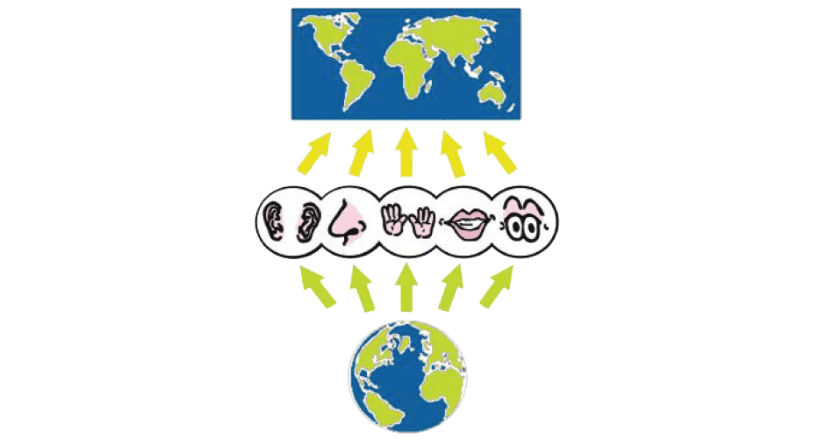
- There are no right or wrong models of the world. Everyone sees life through a different lens. We take in the world through our senses, filtering out many signals, then forming our own “map.” We often forget that’s merely an illustration, not reality.
Picasso and Reality
A man asked Picasso why he didn’t paint things as they “really” are. Picasso asked him to explain what “really” meant. The man took out a picture of his wife: “That’s my wife—this is what she really looks like.” Picasso gave a playful smile: “She’s quite small and flat—isn’t she?”
Sharpening Perception
Perception is crucial in NLP. Only if we can notice subtle body-language cues from the other person can we respond effectively, shaping the interaction based on what our senses gather. Nothing replaces open sensory channels. Calibration is the fine-tuning of sensory awareness to the other’s behaviors. Certain inner states correspond to certain observable outward cues. When guiding someone through a process, it’s helpful to identify these cues so we know where they stand. By calibrating precisely, we get feedback on whether our interventions are succeeding, letting us adjust communication. For example, after establishing good rapport, a slight change in someone’s facial expression might indicate how well they receive a proposal—or whether they need more convincing. Calibration is the skill of repeatedly recognizing visible indicators and matching them to a particular state.
Exercise: Guessing People
Groups of three: A, B, C. 10 minutes each, then rotate roles.
1) A thinks (about 45 seconds) of a person they like (=Person X). B helps A visualize or recall that person vividly. Meanwhile, B and C calibrate posture, breathing, facial expression, skin color, etc.
2) A then thinks (about 45 seconds) of someone they dislike (=Person Y). B and C again note breathing, expression, etc.
3) B asks A questions about X and Y without A replying in words—A only thinks of the relevant person. B & C track the physiology to tell if it’s X or Y. E.g.:
- Which person is taller?
- Which is older?
- Which do you see more often?
- Who lives farther away?
- etc.
4) B & C keep asking until they can reliably read A’s nonverbal cues. If you’re always wrong, repeat from steps 1) and 2) to recalibrate.
Building Rapport
The Secret of Rapport
Rapport means meeting others at their level, using their language to persuade them to new ideas they wouldn’t grasp otherwise. It’s the art of entering someone’s world and building a bridge, earning their support or cooperation to reach a shared goal. Rapport is a relationship marked by agreement, alignment, or similarity. Once rapport is in place, resistance fades. It’s a deep connection to the other’s unconscious—sometimes called “being on the same wavelength,” “having a good connection,” or “liking each other.” Rapport is central to trust-building. A doctor needs a patient’s trust. A salesperson needs a customer’s trust. A mother needs her child’s trust. Much of our daily interaction revolves around trust. NLP investigates exactly how this trust is formed and how we can help it deepen and strengthen.
How Sympathy Emerges
We like people who are like us. Once we find shared ground, conversation flows on its own. NLP discovered it’s not only content-based commonalities but also body language that matters. People who like each other naturally align their nonverbal expressions. Conversely, we can use that: by matching your partner’s expressions, you intensify rapport. NLP calls this mirroring.
Mirroring and Pacing
“Mirroring” is a physical method of aligning yourself to someone’s posture, gestures, breathing, expressions, movements, muscle tension, etc.—like being a mirror. “Pacing” means syncing the other’s visual/auditory expressions, meeting them where they stand. For instance, you can match voice tempo, rhythm, pitch. This also includes all we do in mirroring.

A special form of mirroring is “cross-over mirroring,” matching one of your partner’s traits with a different trait in yourself—e.g., matching their breathing rhythm with your finger movements, or crossing your arms if they cross their legs, etc.
The Importance of Body Language
From Matching to Leading
After matching the partner for a while to establish rapport, you can transition to Leading—guiding the interaction and changing its direction. Leading means leading someone based on rapport and a win-win aim toward a certain outcome. It also tests whether we really have a trusting bond. If so, the other person unconsciously follows my lead after a short while. If not, I revert to matching. This technique might, for example, help guide someone from a negative state to a more positive one.
Congruence and Incongruence
When all three channels (words, tone, body language) align, we’re said to be congruent. If they conflict, we’re incongruent. In that case, we trust body language over tone, and tone over words—likely because we’ve often heard people lie verbally. Hence some body-language experts say, “The body never lies.”
“To be nobody but yourself in a world which is doing its best, night and day, to make you everybody else—means to fight the hardest battle which any human being can fight; and never stop fighting.”
– E.E. Cummings
55-38-7 Rule
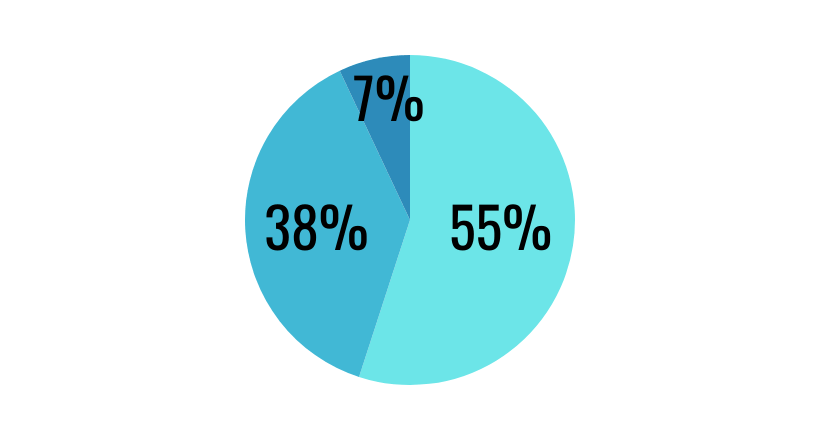
A famous study by Albert Mehrabian (The Journal of Counseling Psychology 31, pp. 248–252, 1967) found that in group presentations, 55% of impact stems from body language—posture, gesture, facial expression, eye contact, etc.
Another 38% of impact comes from voice modulation and tonal qualities.
Only 7% is due to content.
Some interesting conclusions arise: we’re most persuasive when we convey consistent messages through all three channels—body language and voice are often underestimated.
The Secret of Mirror Neurons
In 1995, Italian neurophysiologist Giacomo Rizzolatti discovered during monkey experiments that a certain area of the brain responded when the animals carried out a hand-object action. The same area fired when they only watched others do it. The responsible cells are called mirror neurons.
Mirror neurons are nerve cells in the brain that, upon seeing someone else performing an action, cause the same impulses that would arise if the observer performed the action themselves. This double-function phenomenon captured scientists’ imaginations and helped them better explain everyday phenomena.
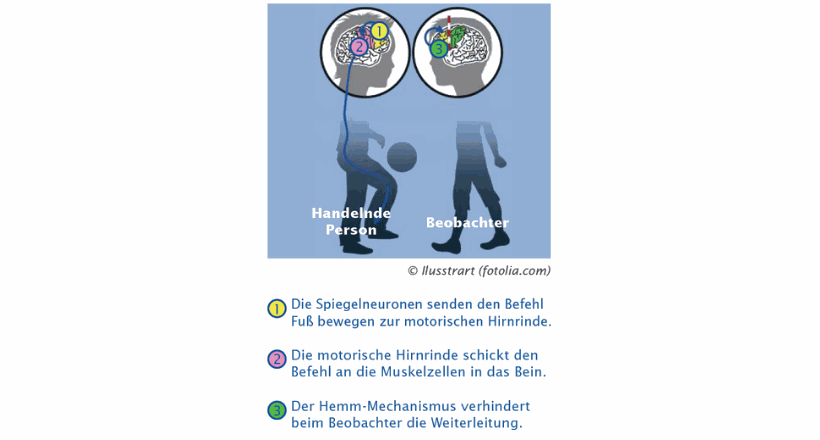
Rizzolatti further found that humans constantly communicate via mirror neurons, consciously or not, imitating each other. Researchers recently identified an “imitation inhibition” process that can block mirror neurons from transmitting impulses to muscles.
Scientists believe that understanding intentions—i.e., predicting another’s actions—may also involve mirror neurons. Franz Mechsner from the Max Planck Institute for Psychological Research in Munich offers an example: “When someone stands at a crosswalk, we don’t think: ‘He has one foot slightly forward, his head turned to the side.’ We see: ‘He wants to cross the street.’” This skill could support learning complex movements.
In humans, these cells were found in the so-called Broca’s area (speech center). Thus, mirror neurons might have let us learn language. Research shows that these cells function inadequately in children with autism (a deep developmental disorder described as an inborn, incurable perception and info-processing disturbance). This could explain their social and verbal problems.
Though more proof is needed, many link mirror neurons to empathy. In NLP, we often use “physiological empathizing” to sense what someone else might be thinking.
Our Sensory Modalities
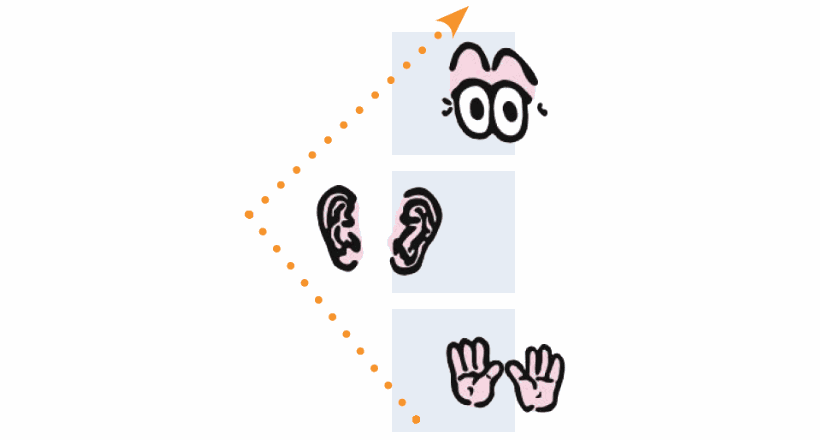
We experience the world through our senses. Any external stimulus, such as a ray of sunlight or a friend’s voice, is processed into electrical or chemical signals, then sent to our brain, creating images, sounds, or other sensations representing the outside stimulus.
NLP suggests that people use these five modalities (V, A, K, O, G) to different degrees. Some rely heavily on visuals, others on feelings, others on sounds. Misunderstandings arise when people with different dominant channels meet.
We can identify someone’s favored channel through their word choices or body-language cues like speaking speed or breathing.
Linguistic Access Cues
A person’s language reveals their channel preference. Each approach might shift across contexts for the same individual.
Visual Expressions:
see, look, watch, observe, stare, eye, glare, bright, appear, visible, clear, overshadow, overshadowed, shining, perspective, wide-ranging, clarity gained, shining a light on something, looking ahead, etc.
Auditory Expressions:
loud, soft, “that sounds good,” “fall on deaf ears,” “unmistakable,” shrill, squeaky, deep, “they don’t listen to me,” “I can’t stand it,” “I hear you,” “pin-drop silence,” “being in tune.”
Kinesthetic Expressions:
my stomach churns, cold feet, floating on cloud nine, falling into a hole, letting go, grounded, feeling comfortable, hugging, tension, goosebumps, etc.
Olfactory Expressions:
turning up one’s nose, the scent of the wide world, feeling sniffly, runny nose, “sniff out,” “follow your nose,” etc.
Gustatory Expressions:
taste, flavor, lick, drool, munch, sample, succulent, luscious, tangy, biting off more than you can chew, etc.
Possible Applications
VAKOG in Sales
If you identify your counterpart’s preferred channel, you can build rapport by talking in that channel.
As a salesperson, you mainly address the client’s favorite channel:
Visually oriented clients appreciate pictures or a demonstration. Ask them to imagine using the product.
Auditory clients respond well to articulate descriptions, a pleasant voice, thoroughly explaining features.
Kinesthetic clients want to hold or test an item physically so they can “grasp” it, quite literally.
VAKOG in Relationships
As a lover, offer your beloved experiences in her favored channel: - If she’s auditory, pay compliments with a lovely voice, set a nice mood with candlelight dinners, enjoy engaging conversation. - If she’s visual, bring her something visually appealing, keep your environment tidy (like the car if you’ll be driving). - If she’s kinesthetic, frequently offer gentle touches or hugs. Provide massages. Use warm, emotional language.
Also ensure you smell nice, maybe pair it with a tasty wine. We often say love goes through the stomach. A large part of falling in love involves the rich sensory experiences we share with or provide each other.
VAKOG and Learning
Knowing your learning style helps, too. Are you a visual learner, do you use mind maps, prefer images, graphs? Then you likely lean heavily on visuals. If you’re auditory, maybe you like learning via audiobooks, podcasts, or speaking notes aloud. Kinesthetic learners prefer hands-on experiences, physically grasping new ideas.
If you’re unsure of your group’s channels (e.g., leading a workshop), mix the channels so everyone gets something from it.
Managing Emotions
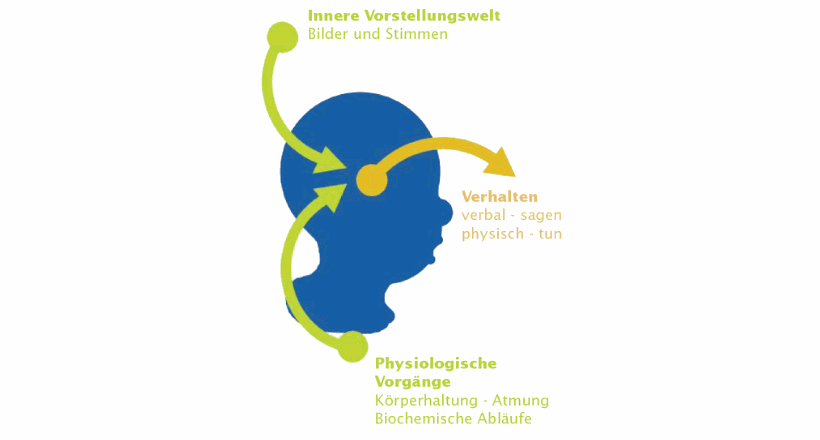
What Matters to You?
Whenever I ask participants in my seminars about what matters most to them, they list: happiness, success, love, health, recognition, contentment, trust, etc.
Looking closer, many nominalized values revolve around emotional states we want to experience. Most people do a lot to attain positive feelings. If that’s so crucial, why didn’t we learn to regulate them in school? Usually, we didn’t.
NLP offers numerous ways to shape our emotional states—and those of others—positively.
Changing Feelings
Our behavior strongly depends on our state, which is influenced by our internal imagery and our physiology. That means you can alter your state by visualizing differently or changing your body. If you shuffle around slowly, depressed, you’ll feel that way. If you want to feel energized, carry yourself accordingly: straighten your posture, breathe deeply, tense your muscles for a dynamic vibe.
Essentially, sports achieves the same effect long-term. Sometimes simply changing your breathing helps relax or shift your state.
Charlie Brown Technique
Charlie Brown explains to his friend Lucy: “If you want to feel depressed, hang your head and shoulders, stare at the ground, and think sad thoughts. Do it three times a day, and you stand a good chance of being depressed.” Try it yourself! Of course, you can also use this principle the other way. Stand with feet shoulder-width apart, raise your arms, breathe deeply, and say: “This is a wonderful day! I love my life.”
Types of Physiology
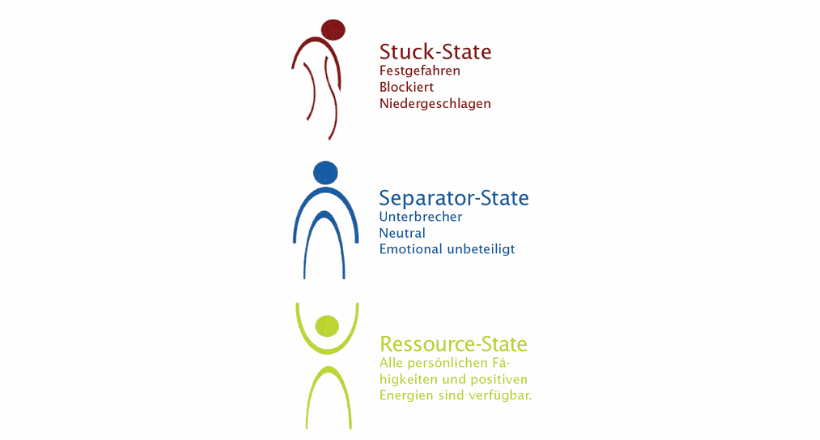
In the so-called “stuck-state,” we feel stuck and blocked. We lack access to our resources. Examples might be dejection, fear, shock, or exam/presentation stress. Sometimes people also call this a “problem physiology.”
To escape a stuck-state, a separator is crucial. We break out of the current state and move at least to neutral, which then provides the foundation for building a resourceful state. A natural separator can be distracting ourselves, doing something completely different, or going for a quick walk. In training or coaching, we often ask the other person to think about something completely unrelated—by posing a “crazy” question that forces them to shift their thoughts. Alternatively, or in addition, we might invite them to alter their posture.
In a resource state, we possess all our positive energy and resources, feeling richly blessed with everything we need to live. This is the best condition in which to set goals, make decisions, or conduct crucial conversations. The more time we spend in this state, the better our lives become. We feel powerful and happy here. We have choices and can shape our future.
In discussions or coaching, we encounter people currently in a stuck-state, serving as a starting point for a desire to change. We disrupt that stuck-state and then build a positive state by adding resources.
I first fell in love in Hungary at Lake Balaton. It was a girl from Berlin, and we met via a vacation clique. I had no idea why I felt those intense emotions; it was wonderful. We’d meet on the beach by day, hang out in the evenings, and dance at a club at night. That summer, one particular reggae song—UB40’s “Kingston Town”—dominated the airwaves by day on boom boxes and by night in the disco. I was head over heels in love, and that song was always playing.
The romance ended quickly after the vacation; I received only one letter from her. Yet two years later, something remarkable happened: I was at a bistro, Balaton completely forgotten, when suddenly that wonderful feeling from back then washed over me again. I saw her in my mind, remembered the lake, heard her voice, felt that first kiss—and wondered why it had come back. I looked around; only then did I realize: “Kingston Town” was playing in the background.
You’ve probably had songs like that, which instantly revive long-buried memories and emotions. And even now, it still works. While writing these lines, I played that track and once again see those images in my mind’s eye. You can try it too: listen to a piece of music that brings you back in touch with the most wonderful, vivid moments of your life!
What Is an Anchor in NLP?
An anchor is a stimulus (a trigger) that reliably brings about a specific reaction in a person. Unlike a reflex, this reaction is learned, not innate. An anchor is thus a learned stimulus-response association.
The principle was discovered by Russian physiologist Ivan Pavlov’s dog experiments and is known as classical conditioning. Pavlov was awarded the Nobel Prize in 1904 for his research.
Anchors shape our emotional states constantly. Particularly significant are those linked with intense emotions, both good and bad. Identifying negative anchors and replacing them with positive ones can be a vital step toward improved wellbeing.
Anchors can appear in every sensory channel, e.g., a telephone ring or a favorite tune, vacation photos, specific scents, a certain facial expression, a company logo or tagline (“Just do it!”), notable voices, gestures like clenching a fist, words with special impact, places that recall a specific experience, gifts, clothing, medals, etc.
“I believe that imagination is stronger than knowledge, that myth is more compelling than history, that dreams are more powerful than facts, that hope always triumphs over experience, and I believe that love is stronger than death.”
— Robert Fulgham
Techniques for Anchoring
Components in Setting an Anchor
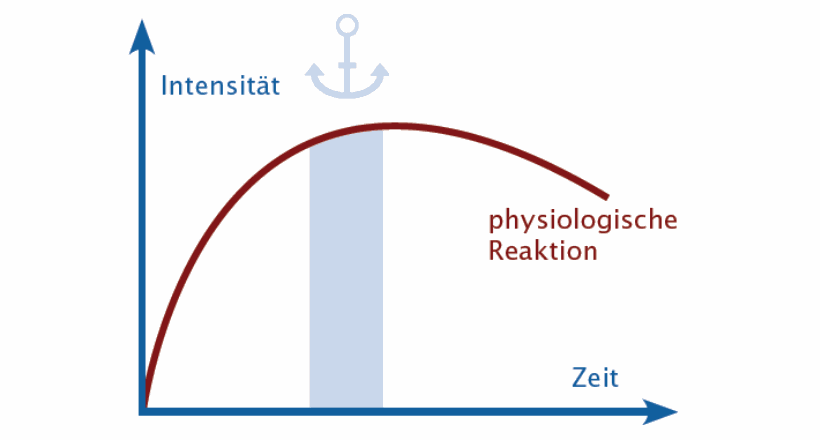
Timing of the Anchor: A good anchor correlates 1:1 with the emotional intensity curve. Ideally, you anchor just before the emotional peak.
State Intensity: To set a really strong anchor, you need a strongly felt emotion.
Accuracy of Repetition: If you fail to replicate the anchor’s position precisely each time, it won’t work as intended or with the same strength.
Uniqueness of the Anchor: Choose an anchor that’s unique and not likely to be triggered unintentionally in daily life.
State Purity: If someone remembers a positive experience but simultaneously thinks about how it ended too soon, that tinge of regret is inevitably included in the anchor.
Four Steps to Anchoring
Besides reactivating existing anchors, you can create new ones. Whenever you’re in an especially uplifting state, anchor it with a physical gesture, a word, or an image.
1. Intensely Associated Experience
There must be a powerful feeling. You can strengthen that feeling by asking: What do I see? hear? feel?
2. Anchor at the Peak
When the emotion peaks, apply the anchor, say by clenching your fist.
3. Interrupt the State
Briefly step out and do something else to distract yourself.
4. Test the Anchor
Trigger it again and see if that earlier emotion returns. If it does, the test is successful. If not, repeat the procedure, taking more time to intensify the positive state.
Become the Director of Your Life!
Sometimes pictures pop into your mind and shift your mood. Perhaps you occasionally imagine the future, or your negative recollections from the past keep you awake. Maybe you hear an inner voice scolding or making demands: “You’re not good enough,” “You have to do more,” “Try harder, or you’ll fail.”
No such voices? Then consider yourself lucky! Because they can strongly shape your life. But that ends now. Today you’ll seize control and become the director of your “inner cinema.”
Let’s try a short exercise that demonstrates how you can reframe your inner experience.
Think of a goal you want to achieve. Visualize the best moment—maybe the moment you realize you’ve just reached your goal, exclaiming: “I did it!”
Focus carefully on what you’re imagining: Do you see images? Hear sounds? What do you feel? Next, examine each detail of that mental scene.
Now be the director in your “internal home cinema.” Alter this imagery. Make it bigger, so it’s like a huge movie screen. Make the colors more vivid, choose a helpful camera angle.
Working with Submodalities
Notice any difference? Feel more motivated about your goal? You, as the star director, can finalize these thoughts, exploring different camera angles or speeds (faster or slower). Notice how each shift alters your feelings. Continue refining until you can barely contain your excitement, as if your toes are itching to turn your goal into reality.
The key is not just what you imagine but also how you do it. Large, colorful images usually motivate more than small, black-and-white ones. These finer distinctions are known in NLP as submodalities. Identify your favorites and apply them to your dreams and goals.
Destroying Internal Images
Sometimes you want to discard negative mental images. First ask whether you’ve taken any lessons from it. Sometimes it’s good to remember a negative image so you don’t repeat a mistake. Once you’ve extracted all the learning, you can get rid of it. Imagine that picture as if it’s on a mirror; pick up an imaginary hammer, and smash it in your mind. Caution: This is purely mental! Watch the image shatter into a thousand pieces.
It’s destroyed! If you like, do it again. You might even have fun smashing it. Then gather the shards mentally and visualize a garbage truck’s compactor until there’s nothing left. This may sound trivial, but it’s incredibly potent.
Submodalities
Our main modalities are vision, hearing, feeling, smell, taste. Submodalities are their subcategories—for sight: color, size, clarity; for hearing: speed, volume, pitch; for feeling: warmth, pressure, texture, etc. Changing them can heighten or reduce emotional intensity.
Thus, the strength of your emotions depends on working with these submodalities. Enhance positive imagery, dampen negative imagery.
Modalities:
Seeing, Hearing, Feeling, Smelling, Tasting
Submodalities:
Fine distinctions within these modalities.
Changing the Feeling
Dreams and Desires
You are a unique person—one of a kind. You can live as you wish. Start now by focusing on your dreams and desires, and you’ll attract them. By realizing your inherent dreams, you’ll feel boundless zest for life. Identify your life’s dream, let it be your guiding light, fueling you. It’ll empower you and give you strength.
It takes courage to embark on this journey and do what you really want. But it’s worth being honest with yourself! Follow your heart’s desire to enjoy a happy, fulfilling life. You can only grow as tall as the dreams you dare to pursue. So go ahead, start dreaming and begin living your dreams. Each journey begins with a single step beyond your door. Dream your life in bright colors and imagine it in your wildest fantasy.
Animals live by instinct, not pondering life’s bigger meaning. They just live it. People, however, are different: we become whatever we make of ourselves. Regrettably, many people are overwhelmed by that freedom. Freedom means making decisions, thus owning the consequences—something many fear, so they forego the life they truly desire. Dare to be different.
The Yearning for Life
Listen to your heart. What’s your deepest longing? Within that longing lies your true identity. Find it, follow it. It brings you to the core of your being and the fulfillment of your true purpose. We’re all born with that yearning, but many bury it so deeply that they can no longer sense it. Then one day it resurfaces and we get another chance to pursue it. It carries a secret: the reason we exist. Ignoring it leaves an empty place in our life, a gap we try to fill with entertainment, but it remains hollow. No TV show, no drugs—nothing except fulfilling your life’s dream can fill that space. Failing to live your life’s dream is missing your life. So let’s go—start dreaming, recreate yourself.
“Within each of us sounds a delicate melody. If we listen and follow it, it will fulfill our deepest dreams.”
Siegfried and Roy
Find Your Life’s Dream
Be a Lighthouse
When you live your life’s dream, you become like a lighthouse, drawing people who’ll help you achieve it. By day, it towers over the ocean, and by night, it guides the way. It’s firmly grounded yet close to the sky. You can be that lighthouse, following your destiny. Shine your light, so others can navigate by you.
Do What You Love
It’s vital to do as much as possible of what you truly enjoy. Many never consider that someone might pay them for doing something they love. But if you love what you do, you’ll do it passionately and quickly excel.
Dream Collage
Set aside two hours. Gather old magazines. Or find images on Google. Flip through them, noticing which pictures spark your longing. Cut them out or print them, then paste them onto a large sheet. Gradually, it’ll fill up with your dreams and desires. Feel free to draw or write notes. When done, hang the collage in your home or room. It’ll remind you daily of your dreams.
“Do not go where the path may lead, go instead where there is no path and leave a trail.”
Jean Paul
Flow State
Recall a time in your life when you felt immense joy and thought, “Yes, this is it!” You felt satisfaction and motivation. Identify at least three such moments. Reflect on them individually, recalling what you saw, heard, felt. Note them down.
The Dream Workshop
This is one of the most significant exercises in my life—fun, inspiring, stirring creative energies from your unconscious. What would you do if you knew you’d definitely succeed? Why don’t you do it now? Because you fear you can’t, or maybe you wouldn’t enjoy it. Put that fear aside, adopting a childlike mindset just before Christmas. Imagine anything is possible. No time, money, or health limits. How would you want to live?
Now list your dreams/goals for each life area. They can be large or small. Just write what comes to mind—don’t censor. Keep your pen moving, conjuring the feeling that you’ve already achieved those items. As if you can see, hear, feel them. Involve all your senses. Enjoy it, let your wildest imagination flow.
Think about what an exciting, inspiring, energetic, fulfilling life looks like for you. Outline your life’s dream in each category; the questions on the right might help. Write short, medium, and long-term goals. Again, note anything that appears. Be as detailed as possible. Recognize you needn’t achieve them all at once. Realize you have many years to do what you want.
When done, review your list and assign rough times: By when you’d like each one accomplished (e.g., 10 years = “10,” 2 months = “2 Mo,” etc.).
Please consider all these aspects:
1. Personality
2. Education and Career
3. Family and Partnership
4. Social Responsibility
5. Leisure and Luxuries
Dream Workshop
Again, this workshop is a vital exercise in my life—fun, inspiring, and stirring your inner creative force. Visualize what you’d do if success were certain. Let your fear subside, imagine you have no time or money restrictions—who would you be? List your dreams in each area. Big or small, just note everything. You can rationalize later. Keep writing, feeling as though you already have it. See, hear, feel it. Write until you’re brimming with excitement. The side questions can guide you if needed. Write short-, mid-, and long-term goals. The more you engage your senses, the deeper your motivation. If you check your list and only feel so-so, toss it out and try again later. Your plan should thrill you enough to get up early and stay up late in pursuit—full of energy. Revisit it regularly. The goal isn’t always new ambitions but submerging yourself anew in your existing ones. Whenever you want, add more. The deeper you immerse yourself in them, the better they’ll come to life.
Inspiring Questions
1. Personality
Which traits do you want to develop?
What kind of person do you aspire to be?
How do you want others to perceive you?
What do you most want to learn?
Which books do you want to read?
Which seminars do you plan to attend?
2. Education and Career
What job/career do you want?
Where, when, how, and with whom do you want to work?
What clients or colleagues would you like to have?
Which tasks or projects do you want to take on?
How much money do you want to earn?
3. Family and Partnership
Who do you want as a partner?
What do you do with them?
How do you show love?
What kind of parent do you want to be?
How do you raise your kids?
4. Social Responsibility
How will you contribute to society and environmental protection?
Will you join a parent-teacher group, donate blood, or support a charity?
Sponsor a child abroad?
5. Leisure and Luxuries
What do you want to do purely for fun?
Which new or old hobby do you want to delve into?
What nice things might you buy?
Which events will you attend?
Maybe indulge in a spa or massage?
Did you enjoy this? Could you plunge yourself into your dream life? Review it again. If that vision only leaves you lukewarm, toss it out and try later. The design for your life should excite you so much, you’d leap out of bed early, go to bed late, full of energy. Keep returning to it. Not about always dreaming up brand-new aims, but about tapping into their energy. Add more goals anytime. The more you work with them and use the methods introduced, the stronger they’ll become.
Setting Goals
Few people jump in their car and just drive aimlessly. But that’s often how we treat our lives—hoping we’ll somehow arrive at “happiness.” Where is that? We don’t know. The ancient philosopher Seneca once said: “If you have no idea which port you want to sail to, no wind is favorable.” What’s your port? Where are you heading?
Goals lend our lives direction and purpose. Imagine wanting to buy a train ticket and telling the clerk, “I’d like a ticket.” He’ll ask, “Where to?” You answer, “I don’t care, anywhere.” He can’t sell you a ticket at all—he needs a clear destination. The same goes for our mind. It needs a precise target, or it can’t help you at all. If you can’t picture it, you won’t achieve it. Without a defined direction, any piece of information or random event is equally relevant—or irrelevant. You’re like a rudderless boat at the mercy of wind and tide. When you have a clear goal, you’re a ship with rudder, sails, and engine heading straight for your destination. The main reasons for failure or slow progress are vagueness, confusion, and indecision about what we want or how to get it. If you go about your day with no priorities, no idea of your next target, you’ll stall. You’ll drift from one task to another, finishing nothing some days, your actions driven by external factors. Setting personal goals and choosing autonomously are essential for professional success and life quality.
Goals are vital because they:
- Exert a powerful pull
- Operate unconsciously as well
- Boost creativity
- Reorient our perception
The Impact of Goals
Goals’ Pull
Once you pick a goal, it exerts strong magnetism, calling you toward it. And it most effectively captivates you if it’s challenging yet feasible.
Goals Operate Unconsciously
Our goals work not just consciously but unconsciously, too. Our unconscious heavily shapes our success. Let it help by frequently imagining the goal achieved: seeing, hearing, feeling it. By painting a vivid mental picture, you prime your unconscious to guide you.
Goals Shift Perception
When you focus on a specific aim, you notice more details, resources, and people relevant to achieving it, and filter out the rest. Clear goals influence how we see the world, directing us toward relevant signals and potential steps.
Goals Boost Creativity
Our creativity needs a spark. Once we set a concrete goal, our mind hunts for solutions. After Hannibal resolved to invade Rome, he famously said: “We’ll either find a way, or make one.” His vision spurred him to lead 50,000 men and 39 elephants over the Alps in 218 BCE. © Wikimedia Commons (Heinrich Leutemann, public domain)
Perception Experiment:
Look around the room you’re in and note everything green. Do that now—and don’t keep reading until you’ve done so. Then close your eyes and list all the red objects. Did you recall more green than red? That’s selective perception at work. Having a concrete focus (green) means we see more green and less of everything else.
Goal-Formulation
PABSBRAGÖR
Use this mnemonic to recall the elements of a well-formed outcome in NLP:
- Positive: Focus on what you want, not on what you don’t want. Avoid “I want to stop having headaches” and say “My head is clear and pain-free. I feel healthy and fit.”
- Active Involvement: What’s your personal role in this? A well-formed goal implies your personal contribution, rather than others doing it all for you.
- Specific: Visualize your goal in detail. What do you see, hear, feel when it’s accomplished? Ask who, where, when, how specifically. Only then is it truly specific.
- Evidence: Which sensory evidence lets you know you reached the goal? How will you confirm success? A tangible sign is essential.
New Year’s Resolutions
Every New Year, people vow to lose weight, spend more time with family, earn more money, etc. But these remain fuzzy, unstructured wishes. Often, they’re forgotten or undone by old habits. Our discipline gets overwhelmed, we find excuses. No surprise: “I want to lose weight” is too vague to guide us. Setting precise, measurable targets is crucial for directing both conscious and unconscious effort toward success.
Clear goals are among the chief drivers of success.
“The clearer the goal, the clearer the success.”
Specific Goals
To harness a goal’s potential, we must phrase it precisely and explicitly.
The SMART Method
This is another way to ensure well-formed outcomes using the acronym SMART.
Alice in Wonderland
“Would you tell me, please, which way I ought to go from here?” Alice asked.
“That depends a good deal on where you want to get to,” said the Cheshire Cat.
“Oh, I don’t much care where…” said Alice.
“Then it doesn’t matter which way you go,” the Cat replied.
Lewis Carroll
Resources:
Which resources do you need for your goal? Which do you already have? What might you still have to learn or acquire? Who can help you? Resources might be money, time, skill sets, or other people.
Appropriate Scope:
Some folks are only driven by big, ambitious goals; too small a target doesn’t excite them. Others need modest interim goals to avoid giving up. They must do it “one step at a time.” Link small goals to bigger objectives for more motivation. Ask: “What does achieving this goal get me?”
Ecology Check:
What positive or negative consequences might reaching this goal have? Who else is affected? What impact might this have on a broader system? What’s the price you pay for attaining it? Example: A father decides to work longer for more money. A downside is less time with family. How can he lessen that effect?
Your Identity
You Are an Original
Everyone is born an original—unique. Yet many die as copies. Don’t let your surroundings or the media steer you astray. Your individuality shines through your life’s dream. You won’t succeed by imitating everyone else, but by contributing what only you can give the world. Have the courage to stand by your uniqueness and trust yourself.
Who Am I?
How would you describe yourself? Which traits, strengths, quirks define you? What self-image do you hold? We can define ourselves by emotional traits (“I’m caring”), occupation (“I’m a doctor”), rank (“I’m CEO”), financial status (“I’m a millionaire”), roles (“I’m the mother of three”), behaviors (“I’m an athlete”), possessions (“I’m a Porsche driver”), metaphors (“I’m just a cog in the machine”), faith (“I’m a Christian”), nationality (“I’m German”), achievements (“I’m a world-record holder”), past failures (“I’m a loser”), etc.
Adopt a mood of curiosity and relaxation, then ask yourself one of philosophy’s key questions: Who am I?
“The world is a reflection of ourselves.”
“When we hate ourselves, we end up hating everyone else. If we appreciate who we are, the rest of the world feels wonderful. Our self-image is the blueprint that dictates how we act, who we spend time with, what we attempt or avoid. Every thought and behavior flows from how we see ourselves. That image is shaped by our experiences, successes, failures, what we think about ourselves, and how we interpret others’ responses. If we treat this picture as fact, we live wholly within the constraints it sets. Hence, our self-image decides how much we love the world, how comfortable we feel in it, and precisely how much we’ll accomplish in life.”
(by Andrew Matthews)
Your Identity Statement
Exercise: Creating Your Identity Statement
In the next exercise, create a personal statement about your ideal identity. It’s simple, fun, and quite powerful. Imagine you can recreate yourself exactly as you’d like, choosing the character traits you desire. What if you could design yourself?
- List some adjectives that would describe you if you fully realized your potential. Examples: energetic, enthusiastic, attractive, persuasive, charismatic, strong, passionate, caring, motivated, determined, self-confident, silly, creative, etc.
- Describe yourself with nouns. Examples: Leader, motivator, mentor, supporter, lover, lucky charm, innovator, doer, trainer, free thinker.
- Decide what this person does; name some verbs or short phrases. E.g. leading, inspiring, spreading joy, igniting passion, showing love, uplifting others, handing out compliments, bringing light into darkness, living, loving, leaving a legacy.
- Form a sentence starting with “I am …” using words from your lists. Take your time choosing carefully. You could tailor the statement to your relationships or personal life, or make multiple statements. When reading it gives you “chills,” you’ve got it. Otherwise, keep experimenting. Then write or print it multiple times. Place these notes around so you see them often. It’s your Identity Statement—every time you read it, you cultivate that identity.
Examples:
“I’m a powerful, dynamic, driven motivator, doer, and free thinker who inspires others, leads, gives love, and leaves a great legacy.”
“I’m a confident, dedicated entrepreneur who nurtures people, fosters a harmonious atmosphere, and never loses sight of the big picture. I’m a force for good.”
“I’m an attractive, sensual, romantic, and passionate lover who fulfills my partner’s deepest desires, and together we share ecstatic pleasure.”
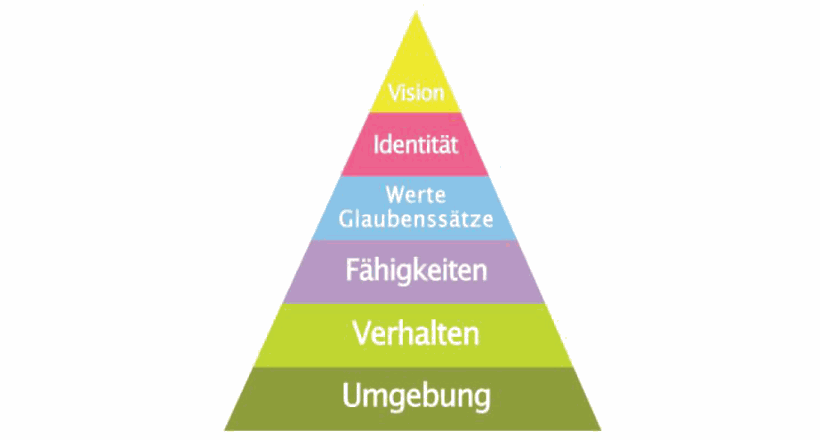
The Dilts Pyramid
Robert Dilts created a wonderful model in NLP used for personal development and describing change processes: the Dilts Pyramid. It’s especially helpful for dealing with goals and personal growth.
Let’s briefly outline each level of this model, then explore an exercise:
- Environment: All that we respond to—our surroundings, other people. Our life is shaped by these outside influences. We’re constantly processing external stimuli.
- Behavior: We react to environmental stimuli through our actions or speech, or unconscious responses. This includes gestures, expressions—anything we do.
- Capabilities: Our abilities and knowledge, enabling us to act. Cognitive strategies and physical skills are part of it.
- Beliefs and Values: Foundational ideas we hold true, fueling our everyday behavior. Values are abstract motivators behind our actions—deciding what’s important.
- Identity: Our sense of who we are. How we see ourselves, the role we take. We explored this more thoroughly before.
- Vision: Why are we here? What’s life’s purpose? This shapes and guides our existence, giving us a framework. Changes on this level profoundly affect the rest. It encompasses everything we do but is more than the sum of its parts.
Exercise with the Dilts Pyramid
Guiding a Goal through Dilts’ Levels
This exercise is among the most powerful NLP tools, particularly in goal- or life-coaching contexts.
Select one of your goals from your Goal Workshop list. Check its well-formedness via PABSBRAGÖR or SMART.
Then imagine you’ve already achieved it and move mentally through each level of the Dilts Pyramid, writing down what you notice on each level. The questions on the side can help.
After going bottom-to-top, reverse the process top-to-bottom (Vision to Environment).
Observe how your sense of the goal expands—how higher levels enrich lower ones with meaning, wholeness, motivation. Many participants find this quite a lovely sensation.
Once back at Environment, review your notes. If you’re missing anything, add it. You can do another pass. This approach can be further enhanced by physically “floor anchoring” the positions and stepping from one to the next. Many people find that more effective than doing it just in thought.
Questions for Each Level
- Environment
Where are you here?
Whom are you with?
What do you see?
What do you hear?
What do you smell or taste? - Behavior
What are you doing here?
How are you acting? - Capabilities
How are you doing what you do?
Which special abilities are present? - Beliefs and Values
What’s important here?
Why do you do what you do?
What do you believe about yourself and others?
What motivates you? - Identity
How do you understand yourself?
Who are you? - Vision
What mission or purpose do you serve?
What’s the bigger goal?
Disney Creativity Strategy
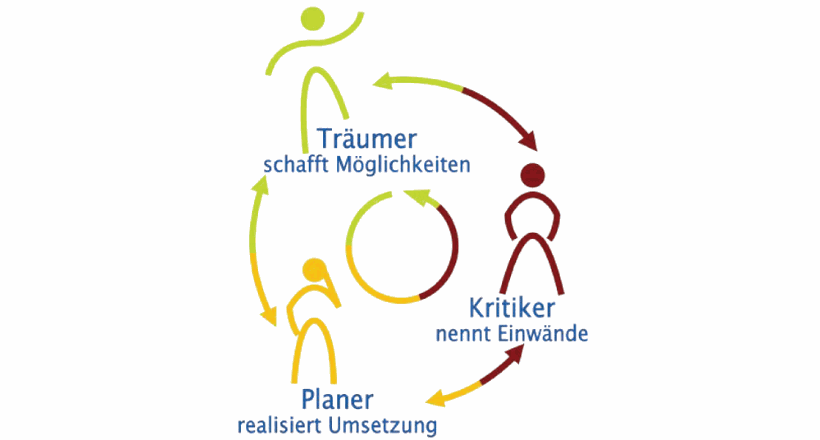
Walt Disney was known for his extensive dreams and visions. His creativity strategy is famous and widely used in NLP. It divides goal-setting into three distinct phases (the Dreamer, the Realist, and the Critic), separated spatially and temporally. Let’s briefly outline the approach in six steps, though you can adapt or expand as needed:
- Mark three areas on the floor. Make sure the space suits each type.
- Take the Dreamer position. Recall a time when you felt creative, imaginative. Step into that feeling.
- Leave the Dreamer position, do a separator (see p.17), i.e., break state.
- Go to the Realistic Planner position. Choose one Dreamer idea to plan. Think it through: implementation, timeline, budgeting, etc.
- Leave Planner position, do another separator.
- Now occupy the Constructive Critic position. Experience the plan from that vantage, feeling it out:
- What’s missing?
- What’s not accounted for?
- Will this plan really achieve the objective?
Go around these positions until the Critic signs off on the idea. You might skip steps or reorder them. End at the Dreamer position to soak in renewed motivation.
Walt Disney Biography
Walt Disney was born December 5, 1901, in Chicago. Three older brothers soon left home due to their father’s temperament, so Walt learned to keep himself busy, drawing imaginary friends. In school, he was art director of the school paper and later worked as a commercial illustrator.
Over time, he developed a passion for animated cartoons, founding “Laugh-O-gram” in 1922 with Ubbe Iwerks. Here they created “Oswald the Lucky Rabbit” and “Alice in Wonderland” with the idea of mixing live actors and cartoon characters. Just before finishing “Alice,” the company ran out of money, and Walt moved to Hollywood. There, “Alice in Wonderland” brought him some success.
Naively, in 1928, Disney lost the rights to “Oswald the Lucky Rabbit” to Charles Mintz. This was a major blow for the 26-year-old. Realizing he now needed a new character, he came up with Mickey Mouse. “Steamboot Willie” premiered that same year, becoming a hit.
Disney rose to prominence, with multiple studios wanting to buy him out, which he refused. In 1930, he signed a distribution deal with Columbia Pictures.
Walt Disney soon capitalized on Mickey Mouse’s growing fame—via books, comics, clubs, merchandise. Overwhelmed, he had a nervous breakdown. In 1932, Disney’s studio founded the first cartoonist training program. By 1934, the studio employed 187 people, introduced Donald Duck in “The Wise Little Hen,” but Mickey remained top star.
Surviving World War II, Disney opened Disneyland near Los Angeles in 1955, then started planning “Disney World” in Florida. He died of lung cancer in 1966 at age 65, before its 1971 opening.
1-2-3-META Technique
Overview
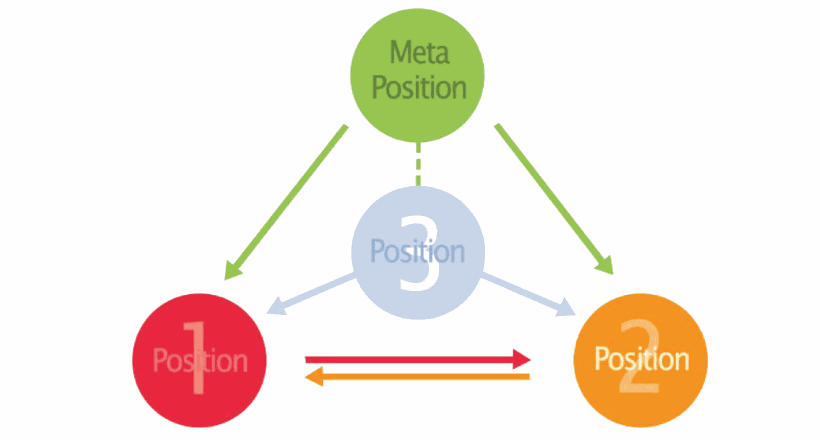
The 1-2-3-META Perceptual Positions approach is a powerful method for resolving interpersonal conflicts. Use it whenever you have a relational issue with a person. It’s remarkable how quickly it can dissolve conflict without direct interaction with that person. You’ll pass through several vantage points, gaining deeper insight into yourself and the other party.
The Positions
This technique typically involves four positions:
Position 1: Self
You fully recall the situation from your own perspective (associated). You see, hear, and feel it as you experienced it at that time. Most people operate like this in daily life, with personal wants and needs in the forefront.
Position 2: The Other Person
Step out of yourself and adopt the other person’s vantage. See yourself from their eyes, hear yourself from their ears, replicate their gestures, voice, etc. As children, we played roles—Pretending to be a superhero or some character. That’s exactly it. This new perspective helps expand your horizon.
Position 3: Neutral Observer
In the third position, be a neutral observer. Disassociated, you watch from the outside, describing the situation like a behavior researcher, without emotional involvement. You might imagine yourself as a Martian sent here for data on human interactions.
Position 4: META Position
In META, you reflect on the entire process—how did you experience each role, how did you feel, what could you learn for the future? It’s not the super-neutral observer but rather a vantage point to analyze the procedure. Some find it tricky not to revert to the viewpoint of one of the roles. That’s key: here you notice which position was easier or harder, and glean any next steps.
1-2-3-META Workflow
- Mark the three positions on the floor in a circle, with the Meta position off to the side.
- Recall a difficult interaction or conflict with a specific person.
- Stand in Position 1 (Self) and re-associate: recall precisely what you saw, heard, felt, said, and thought.
- Then shift to Position 2 (the Other). See yourself from their perspective, hear your own words from their ears, move like them. Let yourself feel how they felt.
- Next, step to Position 3 (the Neutral Observer). Watch from the outside, describing the situation in a disassociated, objective manner.
- Move to META and reflect on these experiences, analyzing how the process has played out, how each perspective contributed.
- Return to Position 1 with fresh insights about the other person and the overall system, adjusting your behavior. Then revisit Position 2, etc., repeating until you’re content.
- TEST your outcome in real life!
Why Learn With Us?
We emphasize high quality, service, and lifelong learning. Landsiedel NLP Training represents top quality at very fair prices. Our classic NLP trainings take place in small groups (usually under 18), intensively supported by co-trainers. Our motto: “Quality over Quantity.” All our trainers have a thorough, at least three-year NLP background, continually refined via internal and external trainings. They receive ongoing supervision and share knowledge actively within Landsiedel’s network. We meet or exceed the highest NLP standards. Upon finishing a Practitioner or Master course successfully, participants receive at least three certificates (DVNLP, International Association of NLP Institutes, plus the Landsiedel certificate). We only certify upon passing a test. We see our offerings as part of lifelong learning. Beyond your course, we’ll continue sending valuable info and educational offerings. Many call us the “Service World Champion in NLP” because you get a variety of additional training benefits. You’ll discover these over time. We want to delight and surprise you. Learning doesn’t stop with a seminar—it accompanies us throughout life. Our courses are both professional and human. Our trainers teach from the heart as well as the mind, and our office team is always available by phone or email. Our training materials are acclaimed in NLP circles. Two different master’s theses have studied Landsiedel’s approach, evaluating our offerings—because we won’t just claim our programs are excellent, we want them backed by credible research. Our participants’ daily success stories inspire us to keep putting time, creativity, and determination into our work. We look forward to meeting you!