

 DE
 ES
 RU
 FR
 ZH
 HI
 GR


The Inner Secrets of Meta-States
In this fascinating article, Michael Hall, Ph.D., shows how meta-states work—states above states that shape our inner level of meaning. The article reveals how we can transform patterns of thinking and feeling by "going meta" and how the true magic of NLP becomes effective at higher levels.
Of all the truly transformative ideas in NLP, state is one of the most dynamic. A state is a combo of mind, body, and emotion. It’s a mental state, a physical state, and a feeling state all at once. “Is it possible to have a state about another state?” Could you be curious about your confidence? Could you feel confident about your fear? Could you worry about your fear? Or feel ashamed of your anger? Since all these things (and a thousand more) are possible, we can actually access one state in relation to another—a meta-state.
On the surface, a meta-state seems like a really simple structure—a state about a state. But this surface view misses the richness of a meta-state and the meta-states model.
This model captures the special kind of awareness that’s unique to humans—self-reflective awareness—which is the main theme in Alfred Korzybski’s work Science and Sanity. As I explain this model, I’ll highlight some of the inner secrets of the meta-states model.
Secret #1. The first inner secret
Stacking one state on top of another creates a totally new meta-level experience. To get this, you have to let go of the idea that stacking states always makes them “collapse” into each other. That only happens if the states are radically different. Most of the time, states build new constructions on top of each other. For example, if you access calmness about your fear, you create calm fear. In the same way, you can create respectful anger, steady commitment, playful seriousness, accepting sadness, and a million other combos. Because you have self-reflective awareness, you can stack one state on another and create richly nuanced meta-states. Reflexivity means that as you react to yourself, you layer more thoughts and feelings on top.
All we have to do is ask: “What do you think or feel about state X?” “What do you think about being sad?” Whatever your answer is, that’s the state you’re stepping into about sadness.
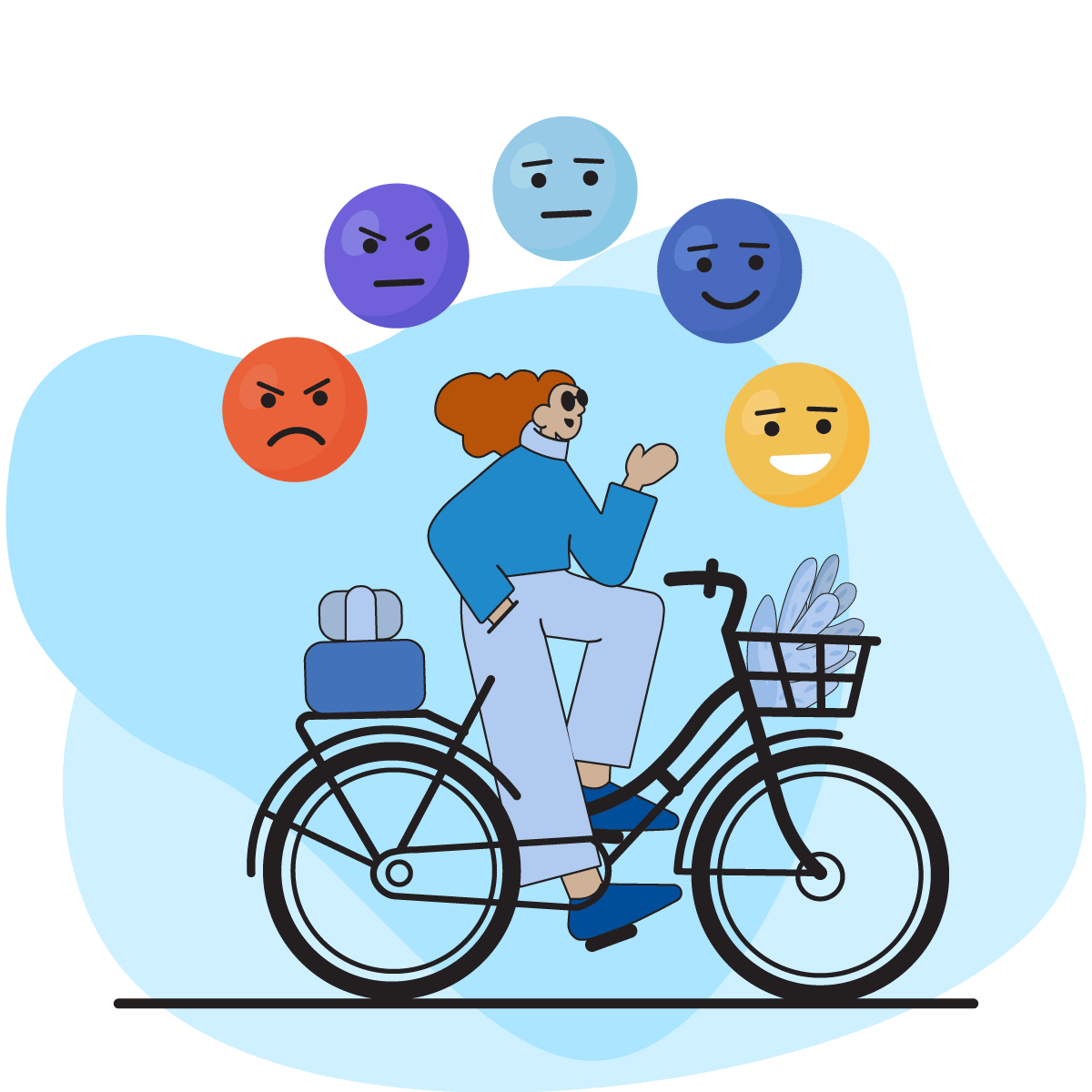
Secret #2. When you react to your own experiences, you set a frame of reference.
With calm fear, you set a frame of calmness over your fear. With respectful anger, you set respect as your frame for your anger. Now your anger belongs to the class of respectful things. Isn’t that wild? Now, with joyful learning, learning belongs to the class of joyful things.
Since reflexivity is about how you can look back at yourself, this is the process of “going meta.” When you look back at yourself, you classify what you’re thinking or feeling: your experience, emotion, memory, and so on. You put it in a category. The second state becomes the frame for the first.
Secret #3. Your meta-states reveal your self-constructs
The way you react to yourself creates your self-states. How do you react to yourself? Do you respond to your states (or experiences) with kindness and grace, or with harshness and judgment? Whatever you do, your meta-state sets the frame for that experience.
Secret #4. This opens up all kinds of new possibilities, because the process of reflexivity never ends.
Korzybski said it’s endless self-referencing. But it’s not just “an infinite regress”—it’s “an infinite progress.” No matter what frame you set that creates a limiting belief, you can always take another meta-step up and set an even stronger frame. That means you never have to get stuck again. When you meta-state, you basically step back from yourself and bring a new set of thoughts and feelings to yourself. This layering and framing never ends. Just like primary colors mix to make secondary and tertiary colors, it’s the same with states. When you mix states, you create all sorts of first-level meta-states, second-level meta-states, and more layers of states.
Reflexivity gives us a new picture of meta-levels. Meta-levels aren’t a hierarchy, but a holoarchy. As a system of interactive parts, you create rich, complex states that can make you super resourceful—or create a harmful pathology. It all depends on the quality of the state and how the states interact.

Secret #5. Stepping back or “going meta” doesn’t create dissociation, except in rare cases.
Most of the time, when you “go meta,” you actually create new, rich layers of associations. Imagine you meta-state learning with joy—now you’ve got joyful learning. Next, imagine you meta-state that with curiosity—now it’s curious, joyful learning. Then imagine passionate commitment. With each layer, you get more emotional, not less. If you go the other way, you’ll have fear of your fear, then fear of your fear of your fear. Things just get worse and more emotional.
Every time you bring one state to another (so, a meta-state), you transcend the first state and include it in the second. Every time you meta-state, you go meta, transcend your current state, and bring yourself a positive or negative frame.
By transcending a state and including it in the next higher state, you structurally assign that higher state as the ruling frame. Start with the state of learning. Go back to thoughts and feelings of pleasure and joy about learning, while you think about what learning will do for you. In transcending what you learn in joy, you notice how you include learning in the frame of joy.
That’s where the magic starts. If you’re ready for another step back, go meta to the feeling of passion about your joyful learning. Or to the love for joyful learning. That’s the process of meta-stating—transcending and including, going meta and setting higher frames. When you do that, you imply beliefs (even belief systems).
All of this supports the NLP idea of “running your own brain.” That means deciding for yourself how you frame the meaning of your states. That’s why the meta-states model really expands and enriches NLP, because it recognizes the meta-levels of our mind—the multidimensional nature of our thinking and feeling matrix. The art of learning meta-states is learning to handle the meta-levels you create by going meta, and managing them. And when you get good at this, you’ll realize that almost all the “magic” of NLP happens at the meta-levels.
Secret #6. Every logical level (meta-level) is also every other logical level at the same time.
With every meta-level, you’ve classified something, which means the members of that class are included in it. These “logical levels” come from ‘thinking’—believing, valuing, remembering, imagining, expecting, identifying, making metaphors, intentions, deciding, and so on. Each category frames meaning—what you believe is true (a belief), what you think is important (a value), what you remember (a memory), etc.
Even though each of these categories seems to refer to a different phenomenon, they’re really just different descriptions of the same thing. Take the simple Meta-state of joyful learning.
Is that a belief? Do you believe in joyful learning?
Is it a value? Do you think learning with joy is important?
Is it a decision? An expectation? An identity?
Amazingly, it’s all of those at once! Each is a facet of the same thing, just like a diamond can have many facets when you look at it from different angles. The so-called “logical levels” aren’t separate things, but a flowing and dynamic way of perceiving experience. Each meta-level (or meta-state) just describes different qualities of an experience.
This means that every logical level you can distinguish is also every other level at the same time. To really get this, think holographically, not hierarchically. If you know one belief, you can, with a probability higher than 50/50, predict a person's values, memories, decisions, identity, etc. Each of these elements is a belief structure; each is a meaning structure.
Origin of the Meta-States Model
Meta-States came out of the NLP model when I tried to model resilience (1990-1994). When I finally thought I’d figured out the strategy, I presented it at the NLP conference in Denver (1994). That’s when I discovered the linear strategy wasn’t enough and needed meta-levels. When I organized Meta-States into a formal model, it was later recognized by the International Association of NLP Trainers (IANLPT) in 1995 as “the most significant NLP contribution” of that year. Later, this was confirmed even more when we used the model to re-model most of NLP and showed how meta-levels and states actually explain how NLP works its transformative magic.
Now you know that your meta-states speak to your self-reflective mind, which creates meanings—layers of meaning. Through meta-stating, you build an inner world of meanings that you then use to navigate the world.

L. Michael Hall, Ph.D., ein visionärer Vordenker im NLP, gründete Neuro-Semantics und Meta-Coaching und hat zahlreiche Modelle, Muster und Bücher geschaffen.