 DE
 ES
 RU
 FR
 ZH
 HI
 GR


Words as Medicine or Poison

– What is the nocebo effect?
In this article, Bernadette Bruckner takes you into the quiet power of language: from the nocebo effect, which makes symptoms worse, to the Papageno effect, which brings hope and opens up new possibilities for action. You'll find out how expectations affect your body and mind, why seemingly harmless sentences can leave deep marks – and how conscious language in everyday life, coaching, leadership, and therapy can become a healing force. A piece about responsibility, mindfulness, and the question: What do your words really do?
Words can heal – but they can also make you sick.
The nocebo effect is the lesser-known but just as powerful counterpart to the placebo: While positive expectations can help healing, negative expectations do the opposite – they make symptoms worse or even trigger them in the first place.
Medicine has tons of examples of this. A patient reads the leaflet of a medication and immediately gets a headache – not because of the active ingredient, but because they expected side effects. A doctor says, "You have to expect strong side effects" – and the chances of them actually happening go up a lot. If the doctor says it, then it MUST be true! A kid keeps hearing, "You're so sensitive." – and starts to physically overreact to every little thing. If the parents say it, then it MUST be true!
Or – as Bernard Lown describes in his book "The Lost Art of Healing" – a cancer patient believes so strongly in her imminent death that she dies before the tumor could even become dangerous.
What is placebo?
Placebo (Latin for "I will please") means a fake treatment that can actually improve symptoms just because the patient expects it to. The opposite is the nocebo effect ("I will harm"): Negative expectations trigger negative physical reactions – even if there's no harmful substance involved.
Words alone don't cause illness. But they help write your inner script – your inner reality – and often play a part in whether your body opens up to healing or shuts down in shock. The field of psychoneuroimmunology clearly shows how closely thoughts, feelings, the immune system, and hormones are all connected. The body listens to what's being said. The real question is: Are we listening to how our body responds?
What is psychoneuroimmunology?
Psychoneuroimmunology (PNI) studies the interactions between the mind, nervous system, and immune system. It shows: Thoughts and emotions clearly influence biochemical processes in the body – and with that, health, healing, and the course of illnesses.
Bad news leads to bad physiology.
– Clifton Meador, US physician
NLP and language responsibility – what words can do
Language is never just a tool – it's an act of creation. It shapes our thinking, our relationships, our reality. And often, words have a bigger impact than any action. The way I learned NLP, it helps us recognize exactly this potential for impact – and to use it responsibly.
Because language isn't neutral. It doesn't just carry information, but also implications, expectations, judgments – whether we're aware of it or not. A sentence that sounds harmless like "That's hard." shapes a different experience than: "That's a challenge you can grow from." This is where the art of framing starts: How we say something helps decide how it's perceived, experienced – and processed.
In language and communication studies, we talk about:
- Loss framing: The focus is on loss ("If you don't do this, you'll lose...")
- Gain framing: The focus is on opportunity ("If you do this, you'll gain...")
Both can motivate – but they work differently. And above all: Words have an effect. That's why everyone who works with language – as a coach, leader, therapist, or teacher – has an ethical responsibility, at least in my view.
Some NLP tools invite us to listen more closely:
- The Meta Model of Language draws attention to vagueness, distortions, and generalizations.
- Reframing shows: Every statement can be put into a new, often more healing context.
- Anchoring and submodality work show just how intricately our inner images and words are woven together – and how powerful a conscious realignment can be.
- Timeline work: Changing memories and future images creates new options for action.
- Parts integration: Bringing your inner parts into dialogue to support wholeness.
An everyday example: "You're way too sensitive." sounds like a flaw and an accusation. But what if we rephrase it as: "You have a keen perception, which is a real gift in your profession." That creates a new space. A new self-image. A new sense of direction.
Between light and shadow – The Papageno Effect as a counterbalance
If words can make you sick – then they can also do good things. Alongside the nocebo effect, which harms through negative language, there's its healing counterpart: the Papageno Effect. Named after the character from Mozart's "Magic Flute," it describes how stories about overcoming crises can open up new perspectives and possibilities for people in suicidal or hopeless situations.
This effect is well documented in suicide prevention: It's not silence that helps – it's making hope visible, talking about resources, and sharing the paths others have taken. It's the responsibility of telling stories. Even in coaching, leadership, or therapy, language isn't just diagnostic or descriptive – it shapes reality. One sentence can turn on a light. Or switch one off.
- "You're not alone with this fear."
- "There are people who've experienced exactly this – and found their way."
- "What would be a first, tiny step back into trust?"
Sentences like these are door openers. Not because they give solutions, but because they create connection and trust.
In a time when language is often devalued or used as a tool, we need to take care with our words – especially in areas where people are vulnerable. The Papageno Effect reminds us:
- that words can create hope.
- that we make more of a difference when we don't just mirror problems, but also name resources.
- that every story that's told can be an invitation to transformation.
"Words can open spaces – or close them. What we say decides whether someone sees the light – or just the tunnel."
"HOW REAL IS REALITY, REALLY?!" Paul Watzlawick

A question for you to reflect on:
What do you say to yourself internally when something doesn't work out? And what could you say instead to lift yourself up?
Everyday language – Small cause, big effect
It's often not the big speeches that shape us. It's the small, casual sentences. The ones that stick with us when we get up in the morning – or echo inside us years later. Language has an effect everywhere – not just in the consulting room or coaching space, but also in families, classrooms, meetings, hallways, and WhatsApp messages. And that's exactly where it has the most power – because we use it so unconsciously.
A child hears: "You're just difficult." An employee hears: "I thought I could count on you." A client hears herself say: "I'm just not good enough." Those are mini-nocebos. Microaggressions from others, who maybe only said it once, but it echoes inside us a thousand times. They sneak in, settle down – and shape our identity, our options, our self-worth.
Often, all it takes is a conscious shift in perspective to turn a toxic message into an empowering one:
Three sentences, that carry more weight than a thousand concepts:
- "I see you." – "I'm here for you."
- "You don't have to do this alone."
- "It's okay to be just the way you are right now."
An empathetic attitude can change everything here.
Three questions that heal instead of judge:
- What do you need – right now, in this moment?
- What would your strongest self say to you right now?
- What message do you wish life would give you?
- What would you have liked to hear or notice instead?
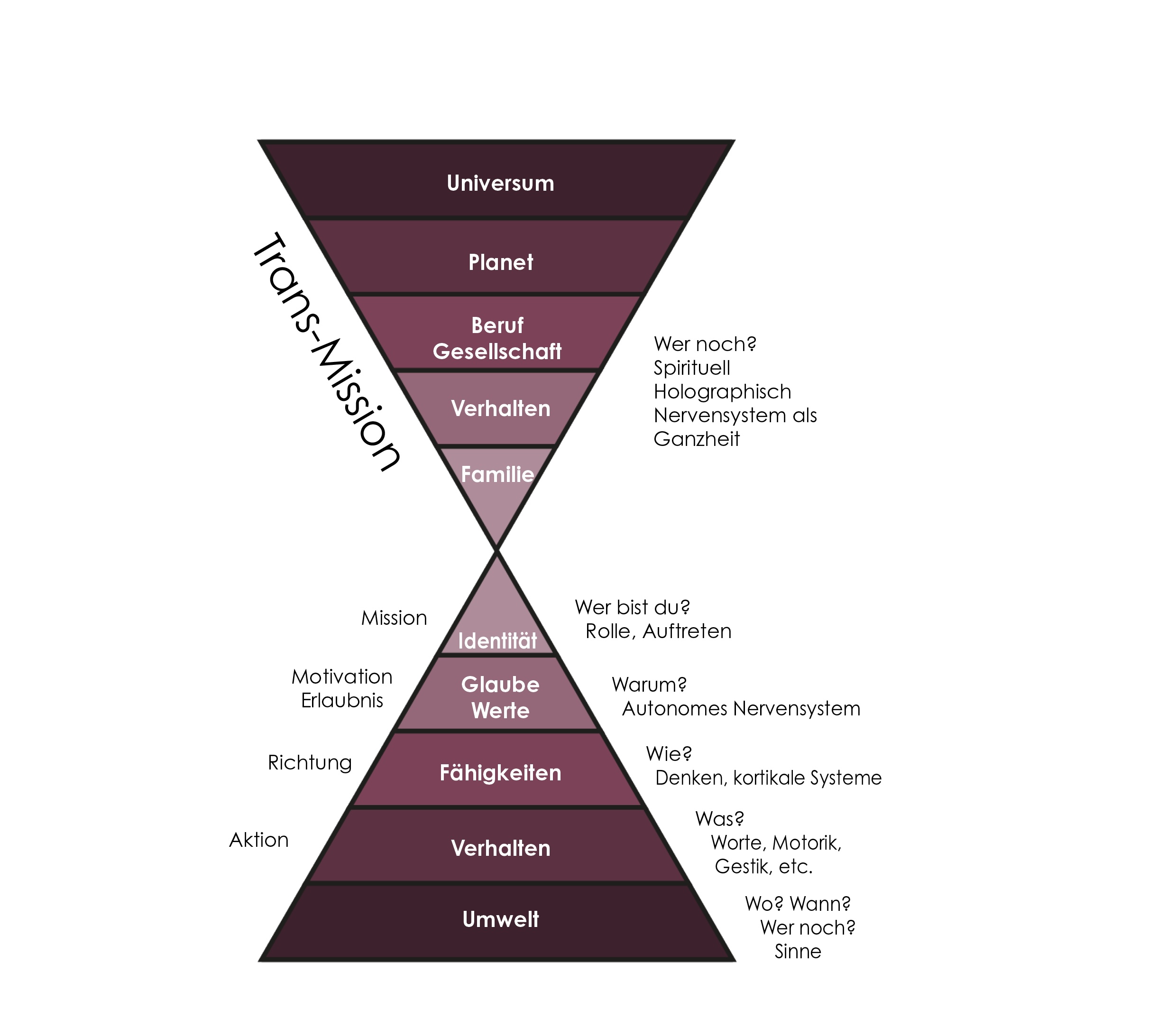
NLP Inspiration: The neurological levels according to Robert Dilts
When we talk to people – what level are we actually speaking on?
- Behavior: "You did that wrong."
- Abilities: "You can't do that."
- Belief: "You're not good enough."
- Identity: "You're a failure."
- Belonging/Spirituality: "You don't belong here."
The higher the level, the deeper the impact. That's why it's worth choosing your words carefully – and speaking in a way that builds up instead of tearing down.
Reflection:
When was the last time you heard or said a "small" sentence that had a big impact – for better or for worse? How could that sentence be rephrased in healing language?
A quiet call
Words leave traces. Some burn in like acid, others soothe like balm on open wounds. Maybe it's time to call ourselves back to language. To ask what we say – and what we plant with it. As a leader. As a parent. As a therapist. As a human being. Because every spoken word is a little promise to the future. It can plant fear or give courage. It can make illness worse or make healing possible. Maybe a healthier world doesn't start on the outside. But in the next sentence.
"Life isn't what it should be. It is what it is. The way you deal with it makes the difference." Virginia Satir

Bernadette Bruckner:
Mag.a (FH) Bernadette Bruckner is a holistic (corporate) health manager, psychosocial counselor, and project mediator who has been integrating NLP into her work since 2003. She develops practical methods for resilience, self-care, and health-promoting (SELF-)communication. With her "iMM – Intuitive Mentoring Method©", she combines NLP, psychoneuroimmunology, salutogenesis, and other approaches to help people consciously shape their language and thus their lives – from the inside out. Her motto: "We move health and connection!"
Bernadette Bruckner ist Gesundheitsmanagerin, psychosoziale Beraterin und Projektmediatorin, die NLP in ihre Arbeit integriert.