

 DE
 ES
 RU
 FR
 ZH
 HI
 GR


Dynamic Learning in the Classroom
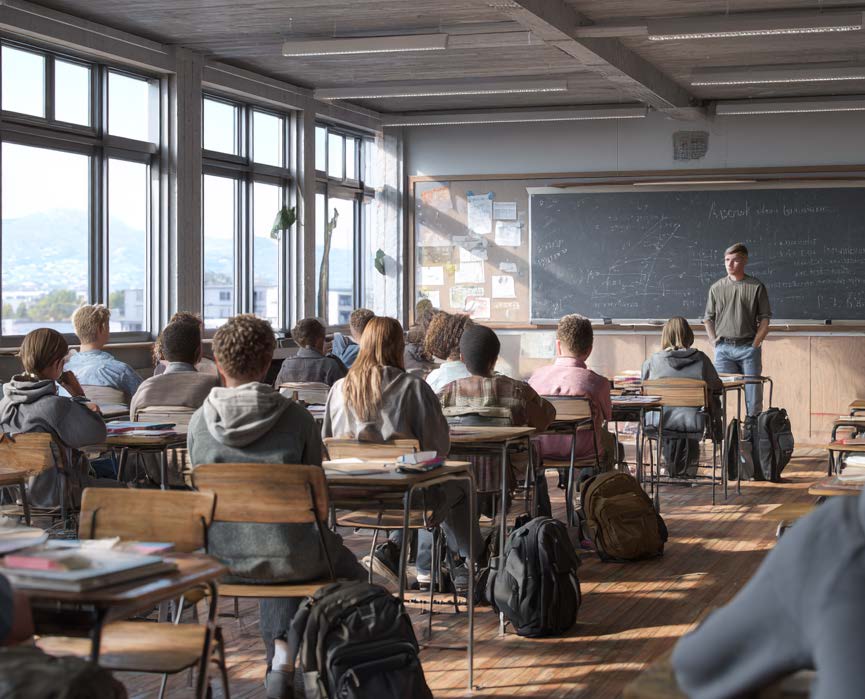
German class, 11th grade
We’re studying the Romantic period and reading excerpts from Joseph von Eichendorff’s “Aus dem Leben eines Taugenichts.” I explain the classic contrast between the Romantic good-for-nothing and his father, the philistine. Terms like “bourgeois order,” “Romantic longing for freedom,” and “Romantic attitude toward life” come up.
The students listen. Some take notes. Some look out the window. Others appear politely interested—but are mentally far away. I ask a question: “What actually distinguishes a Romantic from a philistine?” The answers remain vague. “The romantic is free.” “The philistine works a lot.” Not wrong—but not particularly lively either.
Then I ask another question. “Imagine we’re walking into a Romantic’s room. What does it look like in there?” Suddenly, hands go up. “An instrument!” “A window to nature!” “Maybe books and poems!” “And definitely no order!” Then we shift the perspective. “And what does a philistine’s room look like?” “A desk.” “File folders.” “A clock.” “Everything neat and tidy.” Within minutes, the energy in the room has shifted. The students discuss, laugh, compare, and imagine scenes. The difference between romanticism and philistinism suddenly becomes tangible—not as an abstract concept, but as a way of life.
In moments like these, I feel: Teaching can be more than just the transmission of knowledge. It can be an experience. And this is precisely where the topic of this article begins. Having addressed attitude, motivation, and the teacher-student relationship in previous posts, I now want to turn my attention to the core of our profession: teaching itself. The central question is: How can learning come alive with the help of NLP?
Anyone involved in education knows: learning is more than just absorbing information. Yet when you ask students how they often experience lessons, you hear surprisingly similar answers: “The teacher projects something onto the wall, explains it, and we take notes. Then we do exercises.” From a pedagogical perspective, there is nothing fundamentally wrong with this. Yet this form of teaching often remains limited to a relatively narrow form of information processing.
Internal Representation
Yet we know from learning psychology that learning is not a passive process. It is a complex interplay of perception, thinking, emotion, and experience. Neuro-Linguistic Programming describes this process using a simple yet helpful conceptual model: the concept of internal representation. This refers to the mental images through which people represent and process their experiences in their minds. The key question is: How is what we perceive or experience stored internally and later recalled?
When we experience something, we do not store it as “objective reality,” but as a subjectively perceived experience. This can take various forms: inner images, internal sounds or voices, physical sensations, smells, tastes. In NLP, it is assumed that people constantly access such internal representations when thinking and remembering. A simple example can illustrate this: When you hear the word “beach”—what happens inside you? Different things happen for different people. Some immediately see a picture of the ocean. Others hear the sound of the waves in their minds. Still others feel the warmth or sand beneath their feet. What about you? All these mental images are forms of internal representations.
People store experiences through internal representations—that is, through images, sounds, feelings, movements, or internal dialogues. In the classroom, this concept can offer a helpful perspective, because learning creates not only knowledge—but also a mental image of the content. For example, a historical event might appear in your mind as: an image of a scene, a map of a place, an internal dialogue about causes, an emotional sense of the situation. The more diverse these internal representations are, the more stable the memory often becomes.
In NLP, it is also assumed that these internal representations possess certain characteristics, known as submodalities. For example, an inner image can be: large or small, bright or dark, close or far away, colorful or black-and-white. A sound can be: loud or soft, near or far, bright or muffled. NLP assumes that changes in these characteristics can influence the impact of a memory or mental image. Thus, it can make a difference whether a scene is merely described—or whether learners imagine themselves right in the middle of the action, experiencing the situation up close.
For a long time, educators spoke of so-called learning styles. Today, this concept is viewed more critically, as fixed classifications are difficult to substantiate empirically. At the same time, it is repeatedly confirmed—including in my own teaching experience—that learning is inextricably linked to perception. And this is precisely where an opportunity for teaching lies: learning processes can be consciously designed to address different channels of perception and specifically stimulate inner imagery.
Learning with all the senses – the VAKOG approach
A model from NLP that I encounter time and again in the classroom is the so-called VAKOG model. It describes how we organize our experiences through various sensory channels: visual, auditory, kinesthetic, and—less commonly recognized in an educational context—through smell and taste. In everyday school life, sight and hearing usually dominate. The teacher explains something, the students read a text, look at the board, or listen to an explanation. The kinesthetic aspect is usually limited to writing. But the more senses are involved, the more firmly an experience is anchored in memory—and the more lasting the learning becomes.
In the classroom, this principle can be applied by presenting learning content through multiple sensory channels whenever possible. Here, lessons may consciously deviate from familiar patterns. Unexpected, unusual approaches in particular can intensify learning processes and open up new perspectives.
Imaginary Journeys – Experiencing Lessons in the Mind
One method I have tried repeatedly in recent years in the context of sensory integration is the guided imagery exercise. Here, students are invited to close their eyes and imagine a situation while the teacher verbally guides them through a scene. Background sounds or appropriate music can accompany the journey. A positive side effect: By focusing on the sounds and the resulting sensory impressions, a special calm often settles over the classroom. Students find their inner center, become more focused, and engage noticeably more deeply with the learning process.
Such guided imagery exercises can be used in many subjects. In history class, students can enter a medieval town; in geography class, take a walk through a distant landscape; and in biology class, embark on a journey through the human body. From an NLP perspective, this method utilizes a principle also described in the so-called Milton Model: open, vivid language activates inner imagery and enables people to contribute their own experiences and images. It is precisely these inner images that can intensify learning processes.
Of course, this method is initially unfamiliar to some students. Not everyone wants to close their eyes right away or get involved. But my experience shows that if you use this technique a few times and give students enough freedom, it quickly becomes a special moment in the classroom. For teachers, implementing it is surprisingly straightforward: create a calm atmosphere, vividly describe a short scene, taking the five senses into account, consciously use open-ended phrasing, then discuss the images that have emerged. It is precisely this exchange of different ideas that makes the method so appealing.
From Practice: Learning in the Classroom
In addition to mental imagery, the physical space in the classroom also plays an important role. I have repeatedly observed that learning processes change as soon as content is not only conceptualized but also physically represented in the classroom. An example from my own teaching comes from a grammar lesson. Instead of identifying sentence components exclusively in the notebook, I had students take on individual words of a sentence. Each student represented one word. Together, they arranged themselves in the room, thus forming the sentence. In the next step, we moved sentence components as units. Individual students moved together—such as the subject or adverbial phrases—and checked whether the sentence still made sense. Suddenly it became clear—and above all tangible—which parts belonged together and which did not. At that moment, grammar was no longer just an abstract structure, but an order that could be experienced in the room.
Another example that really impressed me comes from a colleague’s math class. In a lesson on the coordinate system, the students taped axes to the classroom floor. They represented points, moved along straight lines, and checked whether their position corresponded to the given coordinates. The coordinate system became a space in which one could move. These approaches can also be extended beyond the classroom. In the schoolyard, students can measure distances, identify geometric shapes, or compare different routes. They can calculate how much time they save by cutting diagonally across the yard instead of walking all the way around the perimeter. In moments like these, math isn’t just calculated—it’s experienced. Formulas no longer describe mere lines in a notebook, but real paths that one has walked oneself. This is precisely where the special strength of dynamic teaching lies: knowledge does not remain abstract but is linked to personal experience.
From Practice: Learning in the Mind
An example from a German class to set the mood for a series of informational texts about the tropical rainforest. Instead of starting with a visual prompt or directly with an informational text about climate, vegetation, and biodiversity, I dim the lights in the classroom slightly and play soft rainforest sounds in the background. I explain to the students that we are now going to take a short mental journey. Anyone who wants to can close their eyes. Some remain skeptical at first and prefer to observe the situation with their eyes open—that’s perfectly fine, too. Then I begin to speak slowly: “Imagine you’re standing at the edge of a dense forest. Tall trees with huge leaves tower above you. The air is warm and humid. Maybe you hear birds calling or the chirping of insects. Soft ground lies beneath your feet; perhaps you smell damp earth or plants. Only a little light filters through the tree trunks onto the forest floor.”
I describe only a few elements—vines, giant trees, animal sounds, or the dripping of water—but I deliberately leave much open. In guided imagery, it’s important not to be too precise. Phrases like “Perhaps you see ...” or “Perhaps you hear...” give students space to create their own images and activate their prior knowledge of the topic. After a few minutes, we end the guided imagery exercise and share our experiences. The results were astonishing. Some students had imagined a very dense, dark forest, while others envisioned a light-filled clearing. Some even described sounds or smells they had imagined. The subsequent work with the informational texts was significantly more engaging. The students had now developed mental images they could draw upon while reading and analyzing the texts. Terms such as “forest canopy,” “high humidity,” or “biodiversity” thus did not remain abstract but were linked to concrete ideas.
The logical levels – understanding figures as a lived world
Another model from NLP that can prove surprisingly helpful for bringing lessons to life is Robert Dilts’ so-called logical levels. This model distinguishes between different levels of human action: Environment – Where is someone located? Behavior – What are they doing? Abilities – What can they do? Values – What is important to them? Identity – Who are they? Vision – What is their vision, their life goal? In this way, for example, different social systems such as capitalism and communism can not only be compared but also experienced from the perspective of the people who live within them. Historical eras—such as the Middle Ages and the Enlightenment—or geographical regions also become more tangible in this way, because the focus is not merely on facts but on experiences.
From practice: Learning through roles
The example of the Romantic and the Philistine from “From the Life of a Good-for-Nothing” illustrates this particularly clearly. After we had first examined the living environments of the philistine and the romantic, as described at the beginning of the article, we then delved deeper into the different roles. To support this, I used a worksheet with guiding questions for each level. In combination with so-called “floor anchors”—that is, small cards laid out on the floor labeled with the different levels—we first took a closer look at the characters’ environments in comparison and then worked through the individual levels step by step. One student at a time stood on a card and tried to put themselves in the character’s shoes: What does he see, hear, feel, or think as a Philistine or as a Romantic? Initially under my guidance and later increasingly on their own, the classmates asked questions and helped further develop the contrasting perspectives of the two characters. The students then not only analyze the text but also ask themselves questions such as: How does this person live? What is their circle of friends like? What is their daily life like? What is their favorite food? What hobbies do they have? This gives the literary character a face—and sometimes even a room. The romantic might live in a room with open windows, music, books, and travel gear. The philistine, on the other hand, in a tidy study with a desk, a clock, and neatly organized files. This helps students understand not only the terms but also the underlying worldviews and attitudes toward life. The character is not merely described but truly understood within their lived world—and thus remains firmly in the memory.
When characters embark on a journey—learning along a timeline
Another way to bring lessons to life is to make learning content tangible not only spatially but also temporally. Especially in literature classes, it makes sense not only to discuss a character’s development but also to make it visible and walkable. For example, a line can be laid out in the classroom representing the progression of a work—from the beginning to the end of the plot. This line becomes the character’s timeline. From an NLP perspective, this approach can be linked to what is known as timeline work. This method assumes that people organize their experiences along an internal timeline—from the past through the present into the future. By making this timeline visible and walkable in the room, learners can not only mentally follow developments but also physically experience them. The method becomes particularly effective when the perspective is also shifted: one student takes on the role of the character, another describes the situation from the outside, and a third views it from today’s perspective. In this way, different perspectives on the same situation emerge, and the character is not merely analyzed but understood as a process.
From the Classroom: Learning Through Time
An example from a ninth-grade German class features Wolfgang Herrndorf’s “Tschick.” The students mark key points in the plot around the room: the beginning of Maik’s rather withdrawn life, the encounter with Tschick, their journey together, formative experiences along the way, all the way to their return and Maik’s changed view of himself. The students then move along this timeline and adopt the character’s perspective at different points in the plot. They consider: How does Maik feel at this point? What is he thinking? What has changed compared to the beginning? One student stands at the beginning of the timeline and describes Maik as insecure and reserved. Another positions themselves further ahead and speaks from a perspective of growing independence, courage, and new experiences. Depending on the time available and experience with this method, small groups can also be formed so that several students walk the path independently and then compare their impressions. In this way, development is not merely described but is actually experienced by the students.
Learning as Experience – Designing Effective Lessons
When I summarize my teaching experiences from recent years, a clear impression emerges: teaching becomes particularly effective when content is not merely explained but made tangible. NLP complements existing didactic and pedagogical approaches by focusing more strongly on the inner processes of learning. It does not offer ready-made formulas, but rather perspectives and tools that can enrich instruction and make it more experiential. This is not about spectacular productions, but about making learning content accessible from different perspectives. Students can visualize content, discuss it, represent it in the classroom, take on roles, and reconstruct developments and connections. Learning thus becomes an active process in which thinking, perception, and experience are equally involved.
At the same time, practice shows that such forms of learning do not emerge overnight. Students must be introduced to this approach step by step. Especially at the beginning, it makes sense to clearly guide students through individual methods and test them together. However, if these approaches are used regularly in different contexts, familiarity grows. Students develop confidence in dealing with open and experience-oriented forms of learning. Over time, such methods can evolve into more independent work phases or group work. Learners then not only help shape the content but increasingly also the learning process itself. Dynamic teaching therefore means not only variety, but also development—toward greater independence, greater participation, and a more conscious approach to one’s own learning.
One question can help you reflect on your own teaching: Through which sensory channels are my students currently learning—and which ones could be engaged as well? This is precisely where the opportunity for dynamic teaching lies: knowledge does not remain isolated, but becomes part of internal images, ideas, and experiences that take on meaning and remain in memory. And sometimes such an experience begins with a very simple question: “What does a romantic’s room actually look like?”
Outlook: Learning Strategies
One aspect could only be touched upon briefly in this article: the question of how students actually learn and what internal strategies they use in the process. While this article mainly focuses on designing experiential lessons, the next post will focus more closely on learning processes themselves—on how successful learning strategies can be made visible and specifically fostered.

Jean-Claude Eichenseher
AuthorJean-Claude Eichenseher is a dedicated German teacher and career counselor in Luxembourg, who uses NLP techniques to help students build their self-confidence and develop their personal strengths.