 DE
 ES
 RU
 FR
 ZH
 HI
 GR


An Interview with Yvonne van Dyck

What was your first contact with NLP – and what moment really ‘grabbed’ you?
Yvonne van Dyck:
My first contact with NLP was an article in Psychology Today. I had subscribed to the magazine at the time because I was interested in studying psychology. The article was highly critical – and that's exactly what made me curious. I started reading Richard Bandler's book The Structure of Magic. I remember it clearly: I was sitting on a beach in Thailand and was fascinated. Bandler himself says you shouldn't read the book – it's pure linguistics. But that's exactly what grabbed me. I knew at that moment: I want to learn this. Not only that – I want to teach it. This intuitive knowledge was and is one of my greatest resources. Since then, I've known that ‘your body is faster than you think.’
How has your view of NLP changed over the years?
Yvonne van Dyck:
My fascination has grown. The elegance, efficiency and diversity of NLP seem even more inexhaustible to me today than they did back then. I particularly appreciate the fact that NLP is a meta-discipline. In other words, it is a discipline about disciplines. It is the exploration of the structure of subjective experience – and what can be derived and shaped from it. It excludes nothing, but includes everything – it is generative. It enables you to develop your own ideas. For me, NLP is a creativity and clarity turbo.
What do you think is the biggest misconception about NLP among the general public?
Yvonne van Dyck:
That NLP is therapy is a widespread misconception and a limitation. NLP is not therapy, and of course it can also be used very effectively in a therapeutic context. It is about how the brain works, about language, about neurochemical processes and about the effect of inner states on learning. NLP is undoubtedly an educational tool. Because it is a meta-discipline, NLP works wherever people have a brain – and want to learn to use it more effectively, efficiently, elegantly, etc.
NLP consists of two clearly distinguishable parts:
1. Skills
2. Applications of these skills
Most of what is available on the market today are merely applications of the basic capabilities of this technology. Unfortunately, these two levels are often confused. The well-known phobia technique, for example, is an application, a technique. The id' Compass® is also an application, not the technology itself.
What unresolved issues or ‘blind spots’ do you still see in NLP today?
Yvonne van Dyck:
The accusation that NLP is manipulative persists. To be honest, I find that absurd. NLP is a tool – it can be used in an appreciative or destructive way. It depends on the person. For me, manipulation is something positive in the best sense of the word. If I can use it to help teachers respond to learners individually and awaken their joy of learning, then that is a wonderful form of influence.
What is the most profound transformation you have ever witnessed with NLP?
Yvonne van Dyck:
Twice I had the opportunity to accompany people who were at a turning point: the decision to have a child – or not. In one case, the pregnancy was already advanced, and the question was whether to terminate it. In the other case, the decision for or against having a child was still pending. Both decisions were profound, and today both children are long grown up. Being able to experience and accompany this was deeply moving and also challenging for me, because I had to check whether I could accompany them neutrally.
In which areas of society do you think NLP should be used more – and why specifically there?
Yvonne van Dyck:
Definitely at school. I had the privilege of teaching NLP as an elective subject at a vocational education academy. This was possible because they knew me personally – NLP also had a manipulative reputation there. I am all the more pleased that I was able to contribute to bringing it into teacher training.
What does your NLP practice look like – what form of self-application do you practise regularly?
Yvonne van Dyck:
I don't consciously use NLP all the time – a lot of it happens on a subconscious level now. And that's what real freedom means to me: consciously drawing on my knowledge and tools at crucial moments. It allows me to see myself and others in a new light and find new solutions.
Which project are you currently working on with particular passion?
Yvonne van Dyck:
"My WirkSamen Tribe" project. I have already interviewed over 20 wonderful people, including inspiring colleagues from WE EVOLVE WORLD such as Stephan Landsiedel, Karl Nielsen, Nada Kaiser and Kamilla Motazki. This project is about increasing self-efficacy and making it tangible – showing that every person has an impact. Ideas are the seeds of our reality. And I love planting and spreading seeds of positivity. I am also working on a book about my mag(net)ic® feelings.
If you had unlimited resources, what NLP project would you implement?
Yvonne van Dyck:
I would flood the world with good magnetic feelings – instead of all the ‘shit’. I would spread real, genuine good news that would trump the bad news. Because destructive fake news is like poison. NLP can help to refocus attention on what is positive and empowering.
What role could NLP play in an increasingly AI-dominated world?
Yvonne van Dyck:
NLP is the meta-tool for dealing constructively with AI. Because without human intelligence, artificial intelligence is useless. NLP can play a central role because it helps us to communicate, reflect and make decisions more consciously.
What opportunities and challenges do you see for NLP in the future?
Yvonne van Dyck:
There is a great opportunity in combining online and offline – both have their value. I believe that live seminars will regain importance because nothing can replace real experiences in the real world. This experience is simply priceless and will certainly be appreciated more and more again.
How do you deal with criticism of NLP – especially from the scientific community?
Yvonne van Dyck:
I think that's great! It means that science is taking an interest in NLP. If the criticism is constructive and objective, everyone can benefit. Everything that is scientifically proven today was not proven before! And yet it was still true before.
Which three books have had the greatest influence on you as a person?
Yvonne van Dyck:
‘What I Say’ by Émile Coué – I call him my mental granddad. Then ‘The Essential is Simple’ by Jiddu Krishnamurti – I devoured it when I was 19. And finally, ‘The Structure of Magic’ – the book that really grabbed me. Even if I only recommend it to nerds ;)
Is there a belief that you consider ‘non-negotiable’ for a fulfilling life?
Success without fulfilment is nothing.
How do you personally define ‘inner freedom’?
Yvonne van Dyck:
When I can determine my own direction of learning. When everything and everyone contributes to my love growing.
What advice would you give your 25-year-old self today?
Yvonne van Dyck:
I'd rather ask my 99-year-old self what advice it would give me as a 62-year-old: ‘Dance your dance on the rainbow even more – and dance with total abandon.’
Which of your own developments from NLP are the most significant for you?
Yvonne van Dyck:
Definitely Mag(net)ic® Feelings – my navigation system for the inner world. And the Id' Compass® – my guide for the outer world. Mag(net)ic® Feelings are the poles of the compass and show whether success is also fulfilling.
You are known for your unique style – how would you describe your ‘Yvonne van Dyck brand’ in three words?
Yvonne van Dyck:
This is only possible with my own word creations: WirkLicht for optimystical Evolver heroes. :D Please read this with a wink, otherwise it sounds too lofty, and as someone from the Innviertel region, I am very down-to-earth. That's why I call myself an IdeRealist.
What role does intuition play in your work with NLP – and how do you train your own intuition?
Yvonne van Dyck:
Mag(net)ic® Feelings are central to me. I know exactly what intuition feels like – where in the body it begins, how it spreads, what inner images are associated with it, what sound belongs to it. I train these subtle signals with my participants. And then there is my id' Compass® – my external navigation tool, which also trains my inner compass. I remember crystal clear the moment when I ‘knew’ that I would teach NLP – long before I had attended a seminar. It was the same feeling I had when I sat on the stage of the Cueva de los Verdes in Lanzarote ages ago and my body said: This is your stage. (Although at the time I wasn't even thinking of becoming a trainer). 30 years later, that's exactly what happened. I have many moments like this – and I have instructed my subconscious to show me a signal when these qualities are matched ;)
You often use unusual phrasing and powerful metaphors. What significance does language have for your change work – beyond the classic NLP models?
Yvonne van Dyck:
I don't really like the German word language – it contains the word ‘revenge’ ;) I love communication – and the places in words. Even before NLP, I loved ambiguities. I was fascinated by Salvador Dalí's paintings, such as the melting clock – pure submodalities in art form. In my seminars, we create our own submodality words, we explore prefixes and experience how meanings shift. This also gives rise to my own word creations. These ‘one-word reframings’ are not only effective – they are also a source of humour and creativity. They have given rise to company names, visions and entire projects.
How did you experience the NLP scene as a woman – especially in an industry that has long been dominated by men?
Yvonne van Dyck:
There was once an idea to start the Divas of NLP with other international female trainers – only women. We haven't realised it yet – maybe now is the time. ;) Seriously, I don't feel that the industry was dominated by men. Women just don't need the limelight as much. If we're generalising. For example, I sometimes deliberately slowed down my success, the size of my seminar groups... because for me, my joy, development and fulfilment were always the guiding principles, not classic success. So I made decisions that others couldn't understand. Because: I have enough – in every sense of the word – and ‘It followed’ me always and caught up with me again and again, especially when I stood still ;)
What would you say to young women who want to start their own business as trainers, coaches or entrepreneurs using NLP?
Yvonne van Dyck:
Do it – if it goes hand in hand with your best, most positive Mag(net)ic® feelings. Don't do it – if it's only about money. Compare yourself to others only in a way that makes both of you shine even brighter. If it's your fascination, your core potential: go for it!
Many people see you as very creative. How do your ideas come about – are they structured or spontaneous?
Yvonne van Dyck:
That's why I developed the id' Kompass® – because ideas were never my problem. They always came in abundance – like popcorn. The challenge was more: Which idea is the one? Which one is magnetic? With my Mag(net)ic® Feelings, I find out which idea has the greatest potential – and with the id' Kompass®, I realise it in concrete terms. For me, NLP is creativity in action. How does it come about? Through trained perception and trust in it.
You work a lot with female entrepreneurs and visionaries. In your opinion, what is the key to really putting NLP into practice – beyond formats and techniques?
Yvonne van Dyck:
The difference that makes the difference is Mag(net)ic® Feelings. They make your vision tangible, concrete, alive – and then you can't help but implement it. It's not about belief, it's about knowledge. Just as I knew back then that I would teach NLP without ever having attended a seminar. The id' Compass® is a translator between inner reality and outer reality. I have been self-employed for over 40 years and enjoy sharing my knowledge.
If you had to choose one sentence to describe your life's work, what would it be?
EVOLVE & EVOLve LOVE
Develop yourself – and the direction is the one that your love continues to take.
What is the nicest thing a participant has ever said to you?
Yvonne van Dyck:
‘You simply saw me – as I really am – and gave me the courage to show myself in exactly the same way.’ That touches me deeply. Even more touching are the actions that result from this: when participants come back years later and tell me how a seminar has shaped their lives – then I melt away and am just grateful to be able to provide a nurturing environment for people and their ideas so that they can unfold their potential.
Is there an Austrian word or dialect expression that symbolises your work?
Yvonne van Dyck:
Quite clearly: OIDA :D Perhaps you are familiar with the YouTube video ‘How to speak Viennese using only one word?’ Because that is the most ambiguous word in Austria, and that is exactly why I love it. *smile*
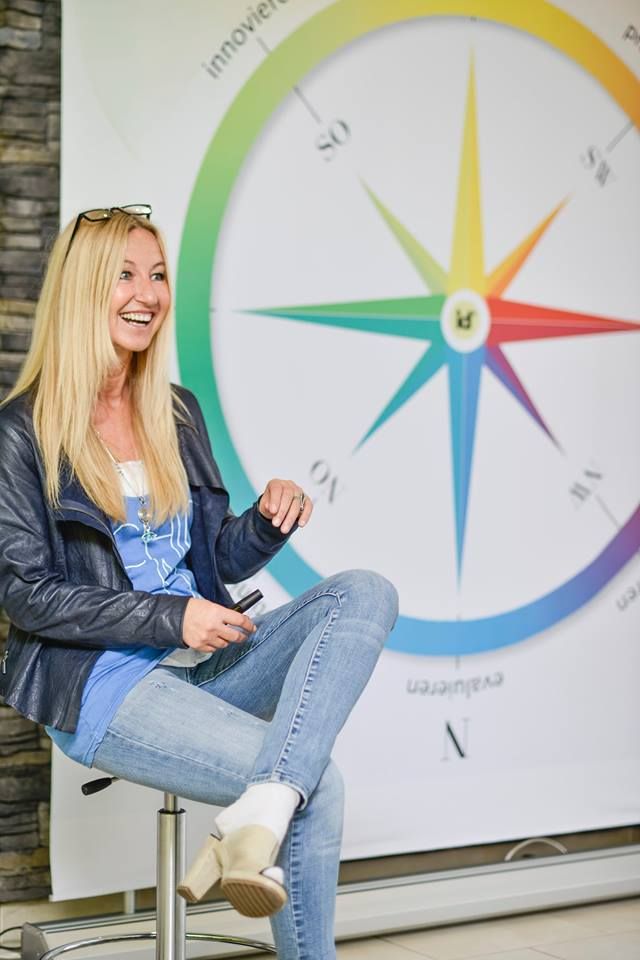
Yvonne van Dyck ist eine österreichische NLP-Trainerin, IdeRealistin und Entwicklerin des id´ Kompass®.