

 DE
 ES
 RU
 FR
 ZH
 HI
 GR


NLP in Schools – Tracking Fading Motivation – Rediscovering the Joy of Learning with NLP
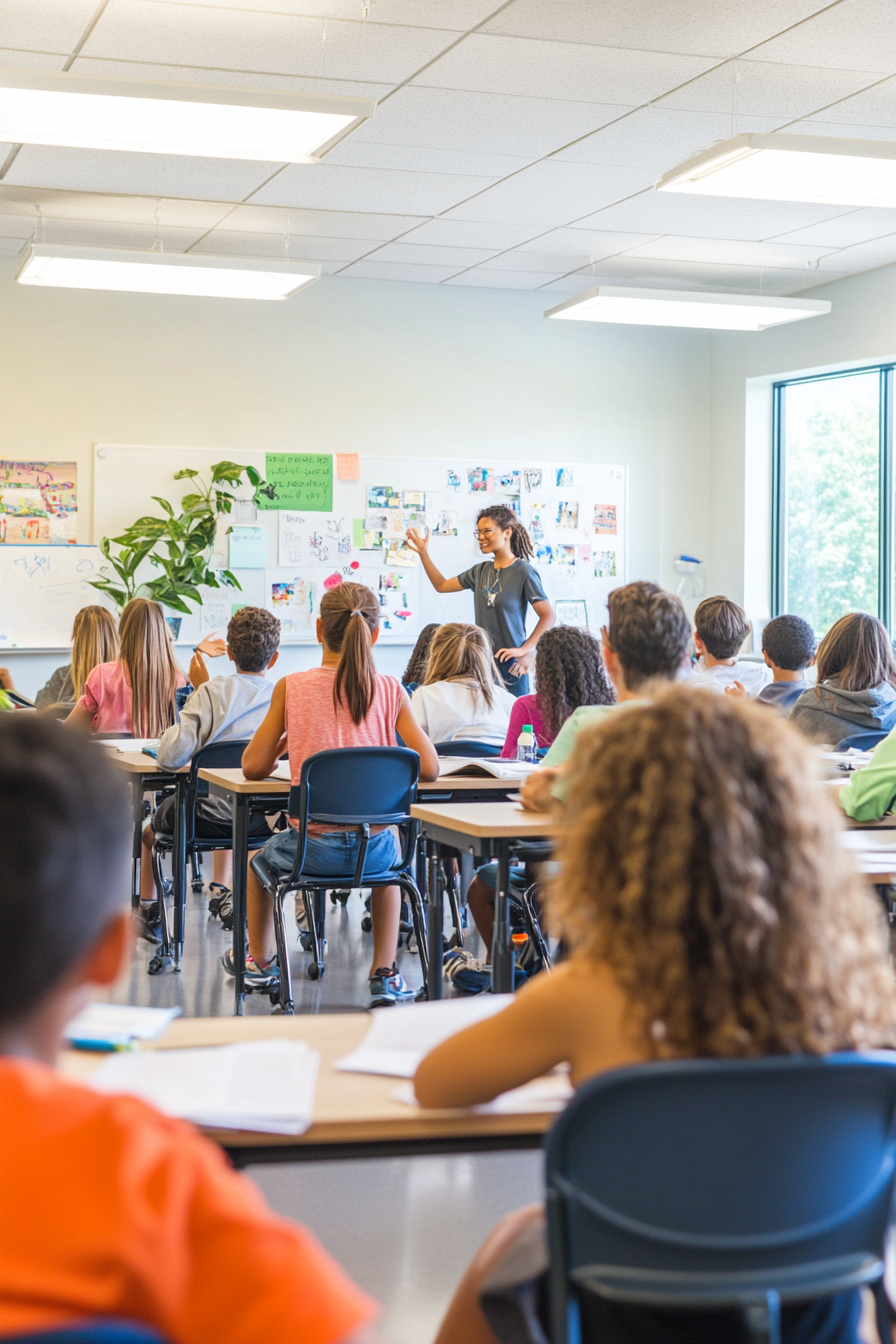
Who doesn’t know it – a vision of a classroom full of curious eyes, where students tackle tasks with enthusiasm, engage in lively discussions, and immerse themselves in new topics with joy? The teacher stands at the front, inspired and captivating, while even the most complex subjects meet attentive ears. One can almost feel the excitement for language, numbers, challenges, for learning itself. A place of shared growth, full of energy and motivation.
This is roughly how I imagined teaching when I started my career – full of drive, with the firm belief that language opens doors and learning is fun. And yes, such moments do exist. They are magical, uplifting – for both students and teachers. But reality unfortunately doesn’t always look like that.
“I don’t feel like doing German.”, “Reading books is boring.”, or “I didn’t have time for homework.” – as a German teacher, I hear these phrases regularly. Whether it’s poem interpretations, essays, or grammar exercises: many students seem unmotivated, disinterested, sometimes even frustrated. And this isn’t limited to German class – similar complaints appear in other subjects as well.
What remains is the gap between the idealized vision and the often sobering reality of everyday school life. And the question: How can we bridge this gap? How can we succeed in sparking the joy of learning – despite curriculum, performance pressure, and adolescence?
Motivation is the engine of human action. It gets us out of bed in the morning, helps us set goals, endure difficult stretches, and celebrate achievements. Demotivation, on the other hand, paralyzes us, slows us down, and makes even simple tasks seem difficult. However, whether someone is motivated or not does not simply depend on laziness or lack of discipline. Motivation and demotivation are complex, often unconscious processes – influenced by psychological, social, and structural factors. These processes also play out in the classroom, resulting in more or less enthusiasm for learning.
Children are born with a natural curiosity. They constantly ask questions, explore their surroundings, and learn playfully – and at a rapid pace. Yet numerous studies show that this intrinsic motivation, the interest that comes from within, decreases over the course of schooling. The willingness to actively participate in class also declines: for example, it can be observed that students raise their hands less frequently over the years. But what ultimately causes this decline in motivation?
Puberty is often cited as the reason – the hormonal changes, the search for self, the onset of sexual interest, which destabilizes self-concept and distracts from lessons. But isn’t that an overly easy explanation? And even if puberty is indeed a major factor – shouldn’t teaching be adapted to these changed conditions rather than accepting the motivation problem as a given for centuries?
These questions, and especially the discrepancy between my own motivation and that of my students, eventually led me to examine the topic of motivation more closely. I wanted to find out and test how Neuro-Linguistic Programming could help maintain or reignite the joy of learning. In the following, I report on my experiences and insights.
Motivation and its influencing factors
The term motivation comes from the Latin movere, which means “to move.” It is therefore about what moves and drives us deep inside. This drive can be intrinsic, arising from internal interest or enjoyment in the activity itself. Motivation can also be extrinsic, triggered by external factors – for instance, when a student studies vocabulary to earn a good grade or avoid a reprimand. Both forms of motivation are valid. In the long term, however, intrinsic motivation is often more sustainable, as it promotes deep learning, creativity, and independent thinking.
Motivation – in the context of this article, we specifically mean learning motivation – is a complex construct influenced by various factors. In my work with students, the following influencing factors have proven particularly significant:
- Goal clarity: Motivation is directed toward a specific goal. If a student clearly understands the goal and finds it appealing, their motivation increases.
- Meaningfulness: Students need to understand why they are learning something—that is, what concrete benefit the learning material has for them. In which areas of life or future situations could this new knowledge be useful?
- Expected effort: If a task seems to require a lot of effort, it demands more motivation than a task with a lower expected effort. The mental hurdle plays a crucial role.
- Required time: The longer a task takes or the more long-term the goal, the greater the perseverance—and therefore the motivation—needed to stay committed.
- Autonomy: The feeling of having control over one’s own actions promotes intrinsic motivation. Students who can set their own learning goals and shape their learning process are often more motivated.
- Sense of competence: We are more motivated when we feel capable of successfully completing a task. A student who regularly receives positive feedback and support develops a sense of competence.
- Social connectedness: The need for belonging and positive social relationships plays a significant role in motivation. Students who feel comfortable and accepted in their class or learning group are often more willing to put in effort.
- Expectation-value factor: Motivation strongly depends on how much someone believes they can achieve a goal (expectancy) and how much value they place on that goal.
These factors influence both intrinsic and extrinsic motivation. The good news is that many of these influences can be consciously shaped to enhance student performance and engagement. Clear goals, experiences of success, greater participation, or a positive classroom climate can often make a big difference.
Tracing the causes: The (neuro-)logical levels
When motivation declines, it becomes visible in students’ behavior—they pay less attention, stop doing their homework, and grades drop. But what are the deeper causes of this waning motivation? And, even more importantly, how can I restore my students’ joy of learning or prevent a decline in the first place?
In the past, I might have asked quite directly: “Why aren’t you paying attention? Why didn’t you study?” Today, I take a more systematic approach. To get to the root of lost motivation and develop targeted solutions, I use the so-called (neuro-)logical levels. This model, originally developed by Robert Dilts, divides human thinking and behavior into different levels. It helps me gain clarity about the various aspects of a situation and to intervene precisely where it will have the greatest impact.
Specifically, the model distinguishes the following levels:
| Level | Explanation | Guiding Questions |
|---|---|---|
| Environment/ Context | Considers the external circumstances and conditions in which a person finds themselves. | In what environment do you work most motivated? What does a setting look like where you feel comfortable while learning? |
| Behavior | Specific actions and behaviors – what the student does or refrains from doing. | What do you do when you are supposed to be studying? Is there something you always do instead? |
| Skills/ Internal Strategies | Mental processes, thinking strategies, and internal images or inner dialogues of a person. | What goes through your mind just before you decide to stop learning? Which internal images or voices appear when you are highly motivated? |
| Beliefs and Values | Includes beliefs, attitudes, and values that act as filters and influence motivation. | What do you think about the subject or topic? Is there a belief that holds you back, such as “This is pointless”? |
| Self-Image (Identity) | Self-perception – how someone sees themselves as a learner and as a person. | How would you describe yourself as a student? What kinds of “I am...” statements do you say or think about yourself? |
| Belonging | Examines the social environment and membership in groups. | Do you feel accepted and included in the class? Are there people—classmates or teachers—with whom you feel unseen or disrespected? |
| Vision/ Spirituality | Explores the larger meaning, vision, or the “big why” behind learning. | What are your dreams? Is there a goal or heartfelt wish that excites you, even if it seems big or far away? |
School-based attempts to motivate students often start relatively low—for example, at the level of behavior, by simply telling the student to “try harder” or “focus better.” However, the real sticking point often lies at a higher level: for instance, in a limiting belief such as “Even if I study, I’ll still only get bad grades,” or a negative self-image like “I’m just not a school person.” In general, regarding the logical levels, when a problem becomes visible at a certain level, a sustainable solution is often found one level higher.
Practical examples from the classroom: promoting motivation on all Levels
Environment/ context – designing the learning space consciously
Imagine a classroom that truly inspires a desire to learn. Unfortunately, many rooms—especially in secondary schools—still look much as they did decades ago: desks and chairs in rows, bare walls with at most a few old posters from group projects, a chalkboard, and—bringing it into the 21st century—a projector on the ceiling. Such a sterile environment hardly contributes positively to the learning atmosphere.
To allow students to learn with motivation, we first need to create a space where everyone feels comfortable. I try to engage all the sensory channels (in NLP, these are referred to as VAKOG: visual, auditory, kinesthetic, olfactory, and gustatory). This means that, in addition to visually appealing decorations such as posters, plants, or colorful pinboards, attention should also be paid to acoustic and olfactory elements: why not play soft background music or a class playlist during certain work phases? Or experiment with pleasant scents, e.g., a hint of citrus to create a “fresh” working atmosphere? For the kinesthetic sense of well-being, bean bags instead of hard chairs in the reading corner or a rug in the circle of chairs can help.
It is important to involve the students in the design process—this way, classroom decoration becomes the first team project of the year, and children and teenagers immediately experience that they can shape their environment themselves. This increases their sense of self-efficacy: the classroom becomes a place they enjoy being in and are proud of.
Behavior – achieving big effects with small impulses
At the behavioral level—that is, in what students actually do—there are numerous ways to influence motivation. One of my favorite strategies is the principle of “acting as if.” In this approach, learners step into a role and act, in a sense, as someone else. At first, this might sound like play, but it has a serious purpose: in a new role, students often behave more freely and naturally because they gain distance from their usual (and perhaps currently unmotivating) student role. In this way, resources that already exist but are not consciously accessible to the students are often unlocked.
Example: I have seen students suddenly dive into a task with great enthusiasm when they were allowed to act as “language detectives” tasked with deciphering a mysterious code. In reality, it was only about sentence components, but embedding the task in a detective story transformed the class into researchers.
Another technique that works at the behavioral level is modeling. This involves taking inspiration from one’s own successful behavior. For example, I ask students to reflect: “How do you behave in an area where you are completely motivated—perhaps in sports, music, or a hobby? What do you do differently there than in school, and what of that could you transfer to learning?”
Skills and inner strategies – motivation through mental images and programs
At the level of skills and inner strategies, I look at how my students learn—trying in conversation to find out what goes on in their minds while or before they are learning (or giving up). Every person has certain mental strategies, internal processes, and images that can either support or hinder motivation. Interestingly, a strategy successfully applied in one area of life can often be transferred to another.
Example: A student in my foreign language class, who would quickly give up when things got too complicated and showed little persistence in learning vocabulary, realized that when she danced in the folklore group, she used inner self-talk to motivate herself when fatigue set in (“Come on, you can still manage the sequence!”). She also remembered the dance steps in the form of mental images, which allowed her to recall them more quickly in context. She then consciously transferred these strategies to her learning in class.
Another very practical tool I use at this level is resource cards. The idea is simple and effective: each student writes down their strengths, talents, and positive experiences on small cards. Questions like: What am I good at? What am I proud of? When have I accomplished something difficult? help guide the collection. Students keep these cards in a fixed place (e.g., in their pencil case) so they can access them anytime.
Beliefs and values – what I believe determines what I can do
At the level of beliefs, the focus is on what students think internally about themselves, about learning, and about school—that is, their beliefs, attitudes, and values. This mental level is often key: what a young person considers true (for example, “I can’t do this anyway” or “School is a waste of time”) has a huge influence on their motivation.
In this area, NLP works specifically with language, meaning-making, and submodalities to dissolve limiting beliefs and strengthen supportive ones. A common limiting belief is, for instance: “I’m bad at math.” When I hear something like this, I counter it with targeted questions—what NLP calls the Meta-Model of language, which challenges generalized, distorted, or unclear statements. I might ask: “Really, in every area of math?” or “Have there not been tasks you succeeded at?” Through these follow-up questions, students often realize for themselves that their sweeping statement isn’t accurate. They discover exceptions.
Equally effective is reframing, that is, redefining negative statements. For example, if a student complains, “I’m totally unfocused; I always drift off,” we reframe it together and explore what could be positive about it: “You’re curious and interested in many things—that’s actually a strength! We just need to work on directing that curiosity toward the current topic.”
Self-image (identity) – who am I as a learner?
The level of self-image goes even deeper: here we ask, “Who am I?”— especially in relation to learning. A person’s self-image is extremely powerful. Whether someone sees themselves as a learner who can grow and improve, or believes, “I’m just not the school type,” influences almost everything: attitude in class, perseverance, self-confidence, and ultimately performance.
NLP also offers effective approaches at this level to question a negative self-image and strengthen a positive one. I like to work in this area with an “I am” exercise. I ask students to spontaneously write down all possible endings to the sentence “I am...”—both positive and negative. Many are very honest in this, and unfortunately often very self-critical as well.
Example: Once, a student actually wrote: “I am dumb and lazy.” His grades weren’t even particularly bad—although he participated little in class and rarely studied at home. Reading it in black and white was really painful for me—and I think for him too. That sentence had become part of his self-image and was negatively affecting his motivation. But by writing it down, we now had something concrete to work with. I sat down with him and we reflected on these self-statements. I asked: “What does ‘dumb’ actually mean for you? Can you give examples of things you are good at?” At first, he was unsure and just said he had bad grades. But gradually he found examples where he considered himself clever—like assembling computers, where he showed real talent. And he wasn’t always “lazy”: he often helped his father with daily tasks and trained several times a week very diligently at his club.
Slowly, a more nuanced picture emerged. Together, we formulated new statements—realistic, but much more positive: “I am skillful and persistent when something really interests me.” “I am curious about topics that suit me.” “I can be successful if I put in the effort.” He wrote these statements down and designed them creatively. Of course, self-critical thinking didn’t disappear overnight—but it was the beginning of a reinterpretation process of his self-image.
Belonging – motivation through connection
Human beings are social creatures – this is true at every age. The feeling of belonging, of being part of a community and being accepted, is a basic need. It has a huge influence on learning motivation.
Already in kindergarten, we make sure that children experience themselves as part of a group: they sing together, sit in a morning circle, maybe even have a group symbol – all of this creates connection so that even the youngest enjoy coming and participating. For older students, the feeling of belonging is often less openly emphasized, but it remains just as important. Teenagers in particular long for recognition from their peers and for finding their place in the social world.
If a child feels: “I belong here, I am valued here,” they will be far more willing to come to school and participate than if they wake up every morning with the gut feeling: “Everyone is against me anyway.” As a teacher, you can do a lot to strengthen the sense of class community. I consciously plan team-building tasks in which students must work together. Many learning contents can be implemented through group work, projects, or small team challenges. In the process, students not only learn the subject matter – they also get to know each other better. They experience success together – and that creates a strong bond.
Vision/ spirituality – meaning creates motivation
The highest logical level – described by Robert Dilts as spirituality or vision – revolves around the question of deeper meaning and purpose. Why should we learn at all? What good could the things we do at school be – for me personally, but perhaps also for others or even for the world?
If it is possible to ignite a spark on this level, an incredibly strong motivation emerges – one that shines from within. Because when someone recognizes meaning in what they are doing, they hardly need any external push – the drive then comes from deep inside. Unfortunately, in everyday school life this greater connection often gets lost. Students then learn “for the next test” or “because you just have to.” The vision level reminds us: learning should have meaning, it should be significant – linked to the dreams, values, and future visions of young people.
That is why I always try to give my students opportunities to reflect on their own goals and wishes. These can be small moments where I ask: “Where do you want to go in life? What really interests you?” Sometimes wonderful conversations develop from this – suddenly a rather quiet girl shares that she wants to start a YouTube channel about sustainable fashion. Or a boy who usually seems unmotivated reveals that he dreams of running his own auto repair shop.
Such moments are invaluable, because they show: in each student, a small flame of passion is burning. Our task as teachers is to connect the subject matter to these inner flames. In practice, I like to use creative methods on this level that allow students to express their visions of the future. A popular exercise is the Vision Board – a collage of images, quotes, symbols, and drawings that represent what they wish for their lives.
Or we do an interview game, where one student “plays” another, now 25 years old, while a classmate interviews them: “What have you done with your life? How did you get there?” The students then speak from the perspective of their “future self”: “At 18, I then...” – and in this playful way, they begin to explore milestones on the path toward their goals.
What is important is that such activities do not feel like just another school assignment, but rather like a personal, open invitation to self-reflection. I always emphasize: “There is no right or wrong here – you are free to dream.”
A particularly effective NLP technique in this area is the “future journey” – a kind of guided trance or fantasy journey. Everyone sits comfortably, closes their eyes, and I invite them to imagine: “Imagine it’s a day in your dream life... Where do you wake up? What do you do first? Who is with you? How do you feel when you’re living your dream?” I paint the scene in vague, open images – in the language of the Milton Model – and engage all the senses (VAKOG): “What do you see... what do you hear... how does it feel?”
When we talk about it afterward, I often see a genuine sparkle in the students’ eyes. Next comes the timeline. I ask: “What do you think needs to happen for you to get there?” We work backward – from the vision through the milestones: in five years, in two years, this year... down to: “What can you do today?” This way, a vague idea can turn into a concrete realization: “If I want to become a veterinarian, I should finish my high school diploma...” or “If I want to travel the world, learning foreign languages would be useful.” The goal isn’t to squeeze every vision into a fixed career plan. But students get a sense of connections: learning isn’t an end in itself, it can be a tool to realize dreams.
Motivation is no accident, it can be shaped
NLP has taught me not to judge too quickly when motivation problems arise, but to look more closely. Behind every “I don’t feel like it” lies a need – often unrecognized, sometimes hidden behind resistance or silence. The logical levels now provide me with a map to explore these signals more effectively – far more than the old blunt approach of “Try harder!”
What I’ve learned: motivation is not random. It can be shaped – through relationships, language, attitude, and carefully set impulses. NLP is not a rigid concept, but a living toolbox filled with practical strategies that are both deep and playful. For me as a German teacher, integrating these methods into my pedagogical work has been a real enrichment.
When I witness students rediscovering joy in learning – when they say after a lesson: “That was really fun” or “Today I actually understood something” – I know it was worth it. Moments like these make our profession so fulfilling.
Learning motivation is complex – no question. But it is influenceable. And that’s a powerful message. With the right questions, the appropriate attitude, and the courage to take new paths, teachers can initiate real change. NLP provides access beyond mere method knowledge: it deepens understanding of inner processes, promotes self-efficacy, and creates space for trust, creativity, and meaning.
So my appeal to you, dear colleagues: try it. Whether a small prompt, a new questioning technique, a visualization exercise, or a reframing at the right moment – NLP often works where classical strategies reach their limits. Whether you work with adolescents in puberty or with children just learning to read, the principles remain comparable – and the effects can be astonishing. Motivation, relationships, self-image, meaning: NLP connects all these levels in a practical way.
In this spirit: experiment. Trust yourself. Take the first step. NLP can be a powerful companion – and at the same time a way to make your teaching more personal, inspiring, and effective. Enjoy exploring this toolbox. It’s worth it.

Jean-Claude Eichenseher
AuthorJean-Claude Eichenseher is a dedicated German teacher and career counselor in Luxembourg, who uses NLP techniques to help students build their self-confidence and develop their personal strengths.