

 DE
 ES
 RU
 FR
 ZH
 HI
 GR


The Enneagram and NLP: Recognizing patterns, shaping relationships, supporting change
Kirstin Kaul highlights how the Enneagram and NLP help to recognize patterns and improve relationships. Using practical coaching examples, she shows how you can use NLP techniques to break old reaction patterns, gain more clarity, and transform your communication strategy—for more ease and harmony in everyday life.
Sometimes, we find ourselves in the middle of a situation – a conversation with a partner, a misunderstanding in the family, tension within a team – and suddenly there’s a moment when something doesn’t quite fit: Someone withdraws, and you don’t know why. Or raises their voice, when you would have expected silence. Or cracks a joke, even though something serious is in the air.
Moments like these are irritating – and they show us how hard it can be to predict other people's behavior. Perhaps you have also noticed that you yourself tend to fall into similar patterns in certain situations. You want to respond differently, yet inside some sort of automatic program takes over.
This is exactly where the Enneagram comes in. The Enneagram is not just a personality model, but a personal development model. It describes nine deeply rooted patterns – each with its own motivations, fears, and views of the world. It’s like a map that shows you why you do what you do, where you lose your life energy, where your relationships get “stuck” – and, most importantly, how you can change all that.
Unlike other models, the focus is not primarily on behavior but on the “why” behind it: the deep inner drives that shape our relationships (with ourselves and others).
For me personally, it was a revelation. It was only through the Enneagram that I realized how much my focus was constantly on what was going wrong – and how deeply I felt responsible for fixing it. I started to learn to view life from a different perspective: “Sometimes it’s okay to just let things be” – and to allow myself joy and ease.
You are probably guessing it: this not only made my own life more relaxed and vibrant, but also those of the people around me. The work with the Enneagram is not about self-optimization or “getting rid” of parts of your personality. It’s about recognizing: “Ah, this is how I’m wired – and that’s how the other person is wired. What do we really need to connect with each other?”
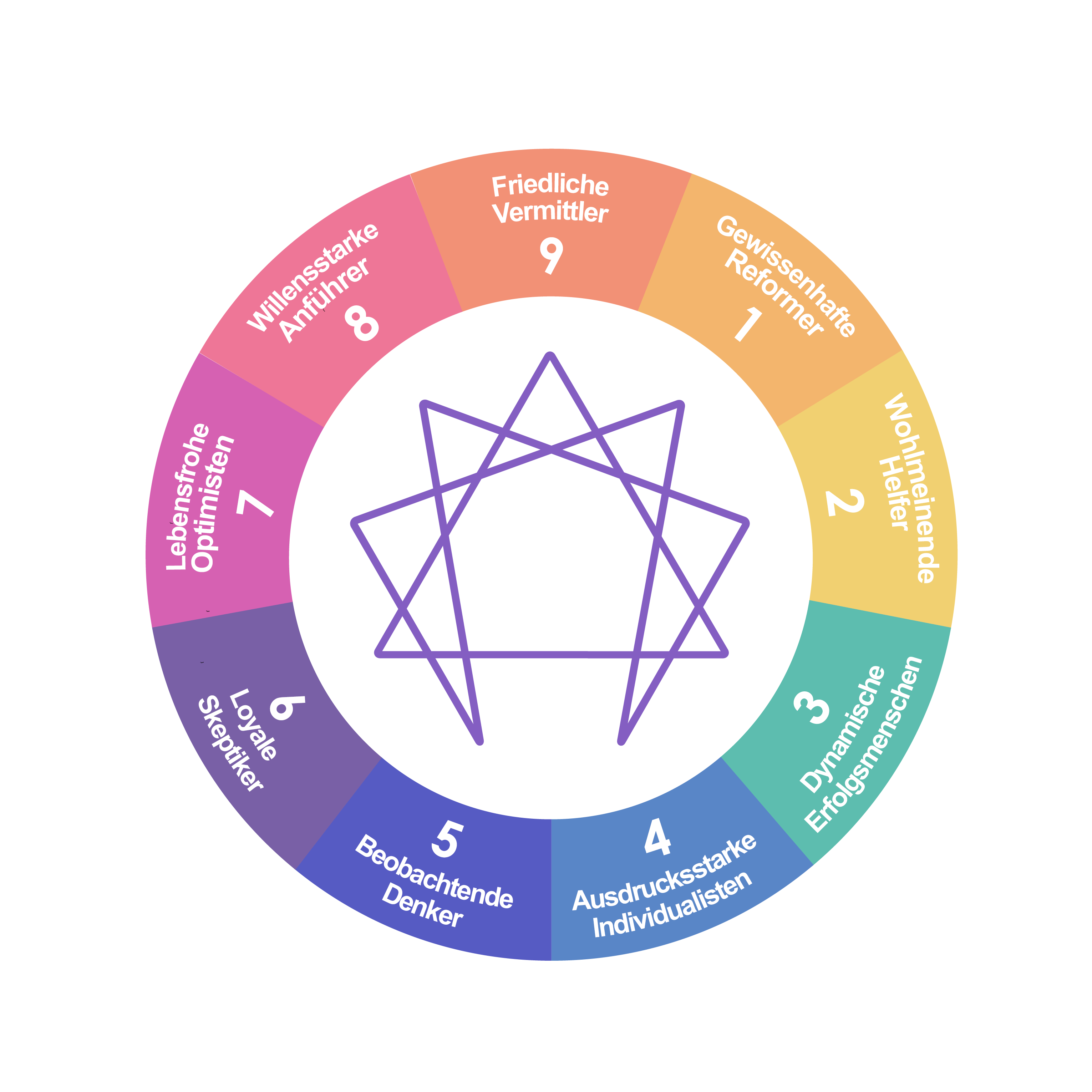
The Nine Enneagram Patterns at a glance
- Pattern 1 – The Conscientious Reformer: Principled, ambitious, idealistic – can be very critical of themselves (and others).
- Pattern 2 – The Well-meaning Helper: Supportive, compassionate, relationship-oriented – often overlook their own needs.
- Pattern 3 – The Dynamic Achiever: Goal-focused, efficient, high-performing – so focused on functioning that emotions may be suppressed.
- Pattern 4 – The Expressive Individualist: Sensitive, creative, deep – experience emotions so intensely that they can get lost in them.
- Pattern 5 – The Observant Thinker: Curious, analytical, reserved – need time alone to protect their energy.
- Pattern 6 – The Loyal Skeptic: Responsible, security-oriented, anticipatory – can be plagued by doubts.
- Pattern 7 – The Joyful Optimist: Versatile, energetic, future-oriented – like to avoid pain and limitations.
- Pattern 8 – The Strong-willed Leader: Direct, powerful, protective – want to maintain control and avoid showing vulnerability.
- Pattern 9 – The Peaceful Mediator: Balancing, harmony-seeking, adaptable – tend to avoid conflict and downplay their own needs.
How does NLP come into play?
The Enneagram provides the map, NLP the tools to move within it. The combination is powerful because it promotes both awareness and change. Here are three case studies from coaching processes:
1. Relationship: “He just doesn’t listen to me” (pattern 4 + pattern 5)
She – an expressive individualist (Pattern 4) – longs for closeness, exchange, emotional resonance and depth. It’s painful for her when her partner withdraws mid-conversation. For him – an observant thinker (Pattern 5) – this withdrawal however is essential to avoid feeling overwhelmed, especially in conflicts.
What seems like coldness to her is actually self-protection for him. What sounds like drama to him is, for her, just a natural desire to connect. Coaching reveals: this isn’t about bad intent or hypersensitivity – it’s about two very different ways of creating closeness. The Enneagram helps them to grow mutual understanding. With the help of NLP techniques like anchoring and re-imprinting both manage to break old reaction patterns: She no longer has to fight right away to feel connection. He no longer has to shut himself off internally right away.
The result: More understanding, genuine conversations, new rituals for difficult moments – and a closeness that doesn’t require either of them to feel uncomfortable.
2. Work: “I feel like an alien in my team” (pattern 9 + boss with pattern 3)
He – a peaceful mediator (Pattern 9) – works conscientiously, values team spirit and cooperation. But since the arrival of his new boss – A dynamic Achiever (Pattern 3) – he feels invisible. The boss wants quick, clear, efficient results. No long discussions. No interpersonal contact.
For someone with Pattern 9’s tendencies, this is tough. In such a situation he retreats, avoids conflict – and becomes even more overlooked. What remains (and grows) is the feeling: “I don’t belong here.” Through coaching, he sees: his strength lies in human connection, not volume. But to be noticed, he needs visibility – and a clear stance.
Through the Enneagram, he understands his pattern, through NLP, he finds ways to work with it. With reframing and resource anchoring, he strengthens his inner clarity. Using NLP’s logical levels, he redefines his role – not as a “passive tag-along” but as a proactive contributor with his own voice. This also changes the conversations with his boss. Respect arises – not because he adapts, but because he shows himself – with his strengths, in his own way.

3. Leadership: “I want to do it right – but what if I fail?” (pattern 6)
She – a loyal skeptic (Pattern 6) – is responsible, thinks ahead, and analyzes risks. As a team leader, she gives her all to guide her team through a complex project. But while she appears confident on the outside, she is exhausted, often torn inside, and struggles with constant doubts.
Her mind sees every possible scenario – especially the worst-case ones. What others see as excessive controlling is, for her, an attempt to prevent danger. What looks like doubt is actually her wish not to overlook anything. Her mind is working at full speed, examining every decision for possible risks. Not out of mistrust – but because she senses how much is at stake.
In coaching, she realizes: her need to be prepared is not a flaw. It helps her minimize risks and also demonstrates her responsibility. But when the desire for security becomes too dominant, it blocks the clarity she actually needs. With the Enneagram, she understands her pattern – including her tendency to fixate on worst-case scenarios. NLP tools like working with the inner team and re-imprinting help her reconnect with her existing strengths – not just theoretically, but viscerally. She learns to build inner support – through structure, clear communication, and conscious self-calming – instead of endless safety checks.
The result: More trust – in herself, in the team, in the process. She appears clearer, more open. Collaboration becomes more relaxed – and she can finally breathe again.
How you can use the Enneagram & NLP for yourself
The combination of Enneagram and NLP is particularly helpful if you...
- experience similar conflicts over and over again
- want to better understand your relationship patterns
- often find yourself (or others) being “wrong” or “exaggerated”
- seek clarity on your inner drivers
- want change – but don’t know where to start
Three reflection questions for everyday life:
- “What is triggering me right now – and how does it affect me?” (Pay attention to repeating loops. That’s often your Enneagram pattern in action.)
- “What strategy am I using to deal with challenging situations?” (Step back: is this an automatic reaction – or a conscious choice?)
- “What do I really need in this moment – beyond being ‘right’, ‘looking good’, or being ‘in harmony’?” (This leads you to the level of your real needs.)

CONCRETE EXERCISE:
Pick a current challenging situation and answer the three questions in writing. Then use an NLP technique of your choice (e.g., future pacing, anchoring, or even the inner team) to activate new possibilities.
The Enneagram
The Enneagram shows you what drives you internally, where your path of development is headed, and which resources you need to integrate. NLP helps you consciously change your course. Together, they’re a powerful duo – for greater self-awareness, better relationships, and real transformation.

Kirstin Kaul ist Trainerin, Coach und Enneagramm-Expertin.