

 DE
 ES
 RU
 FR
 ZH
 HI
 GR


The Power of Inner Images
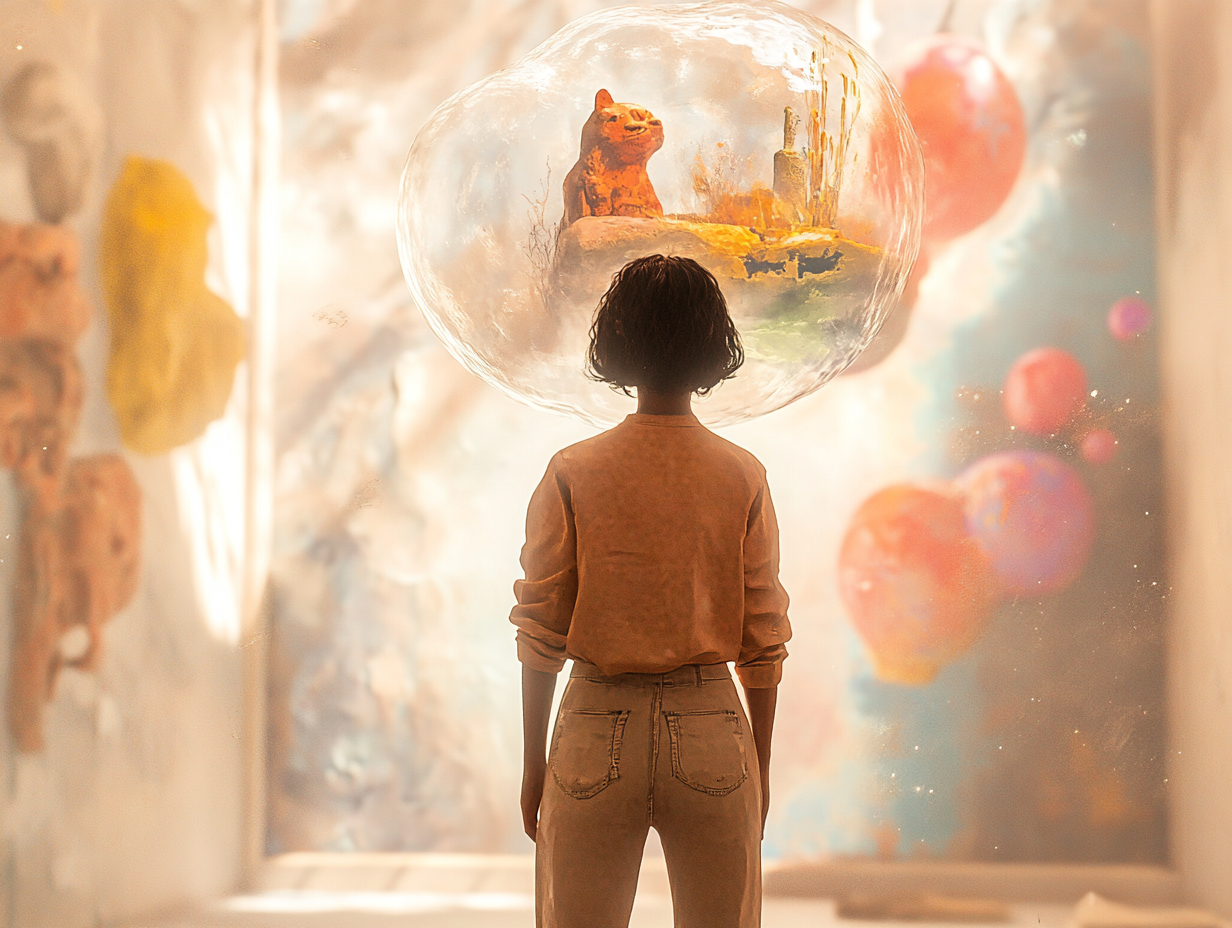
When a feeling becomes a work of art – and changes in the process.
Everyone has inner images. Some are fleeting, like a shadow. Others burn themselves deeply into our minds—as a scene, a symbol, or a feeling. What if you could not only look at these images, but also shape them? That is exactly what happens with submodality shifting using art objects. This technique from NLP allows you to transform a stressful feeling into an inner work of art—and then change it in such a way that your emotional state undergoes a lasting transformation.
Change begins in the mind – and in the imagination.
Sabine is standing in her studio. She is an artist—and currently blocked. Whenever she thinks about the opening of her last exhibition, she feels ashamed. She found it difficult to speak, her voice trembled, and she stumbled over her words several times. Days later, the memory still echoes: the face of a woman in the audience, skeptical and contorted. Sabine asks herself: Why didn't I do better?
In a coaching session, Sabine is invited to imagine this feeling of shame as an art object. At first, she sees only darkness. Then a shapeless, gray block appears before her inner eye – like concrete. "It stands in the middle of my studio," she says quietly. "It is cold, heavy, and full of guilt."
Step 1: Visualize the feeling as an art object
The coachee chooses an unpleasant feeling and imagines an inner image of it. This image is made concrete: What color is it? What shape? Is it static or moving? What material is it made of? Does it have a temperature, a sound, a smell?
The art lies in giving the feeling a form—a stage on which it becomes visible. The brain loves concreteness. Feelings that can be named and shaped often lose their power.
Step 2: Changing the sub-modalities
The next step is to change the art object—slowly, lovingly, curiously. The coachee is allowed to experiment: What happens when the object becomes smaller? When it shines brighter? When it rotates or becomes soft?
Sabine imagines a ray of sunlight falling through a window onto her gray block. The surface begins to shimmer. The concrete becomes porous. The gray block turns into a piece of clay, then a soft lump that she can shape. She begins to model a figure out of it—an animal that bears her shame, but looks friendly. It reminds her of her childhood: a cat with a crooked gaze.
Step 3: Integration and anchoring
In the end, the coachee consciously perceives their new art object. This often gives rise to an inner dialogue, a new understanding, or even humor. Sometimes the new image is anchored as a symbol—with a gesture, a breath, or a sentence.
Sabine touches her chest in her mind, where she now feels the little animal. It purrs. And suddenly she says, "I'm allowed to stumble—it makes me human." She laughs. The scene with the skeptical woman suddenly no longer seems bad to her—rather, it seems like part of her artistic journey.
Why this format is so powerful
The submodality shift with art objects combines several NLP elements:
- Submodality work (color, shape, brightness, movement, etc.)
- Dissociation & Re-association
- Metaphor work
- Resource activation through creative imagination
It is particularly suitable for visual, creative, or sensitive people—in other words, precisely the target group that associates NLP with art, coaching, or personal development.
Step-by-step guide
1. Identify the feeling
Which feeling would you like to transform?
2. Create an art object
Shape, color, material, temperature, movement, etc.
3. Changing submodalities
Change light, sound, size, distance, texture, shape
4. Allow symbolic reinterpretation
What emerges from the object? What does it say to you?
5. Integration
How does the new image feel? Where do you perceive it in your body?
6. Anchoring
Use a gesture, phrase, or movement as a reminder.


Stephan Landsiedel ist Diplom Psychologe und NLP Ausbilder.