

 DE
 ES
 RU
 FR
 ZH
 HI
 GR


The NLP Cases of Creative Consultant Julius Frei
Episode 2: The Colours of Truth

In our short stories, we take you on a creative journey and show you how NLP can be used in practice. In the last case (issue 01), Julius Frei has already solved an exciting case and today we continue.
Julius Frei was known as a "spark catcher" – a creative consultant who could ignite thoughts where others saw only fog. His specialty was to make ideas visible that were buried deep beneath layers of fear, competition, and habit. He was aided not only by his keen sense of language and body language, but also by his years of experience with neurolinguistic programming.
He was not an advertising guru in the traditional sense. While others relied on market analyses and style trends, Julius went where the true power of brands and campaigns lay hidden: in people. He brought clarity to creative processes—and sometimes to interpersonal entanglements that ran deeper than one might have guessed at first glance.
A New Assignment
This time, an assignment took him to a renowned cosmetics company. A new makeup line was to be launched—international, powerful, emotional. But the creative team was stuck. Julius was asked to help create "harmony and clarity," as the briefing stated.
When he entered the studio, the contrast hit him like a blow: the room was open, bright, full of light and colorful inspiration—and yet everything seemed subdued. The energy hung heavy in the air. Collages, fabric samples, test prints, and mood boards with conflicting messages were piled high on the long work tables. Everything seemed to be shouting, "We don't know where we're going." On the wall was a large quote in modern typography: "Color is nature's smile." Ironic, thought Julius, because no one in this room was smiling.

He took a few steps forward. There they were: Elena, the project manager, with her perfectly smooth bob and a tone of voice that couldn't hide the pressure. Marius, the art director—steel-blue eyes, arms crossed, skeptical gaze. Two designers with notebooks, sizing each other up. And in the corner, a young woman with a clipboard, trying so hard to be invisible that Julius noticed her immediately. Lea, the intern, as he would later learn.
He surveyed the scene with a single, long breath. (Technique: Calibrating)
"Welcome," said Elena, the project manager. She had contacted Julius. "Thank you for coming at such short notice. We... are stuck. There are good ideas, but no direction."
"What happens when you try to agree on a direction?" he finally asked calmly. (Technique: pacing & questioning technique)
A designer shrugged her shoulders. Marius snorted. Elena said, "It's getting... sticky. Ideas are coming, but they're not flying."

Contrast and Control
"Good," said Julius, "then let's not fly today, let's land." He laid several color charts on the table. "Which color represents the feeling that this campaign should evoke in the target group? Don't explain, just choose." (Technique: anchoring via representational systems)
The designers reached for pastel colors. Elena chose a bright copper. Lea thought for a moment and then carefully chose a light turquoise. Marius picked a dark anthracite and placed it emphatically in the middle.
"What do you want to show with this color, Marius?" (Technique: metamodel)
He looked directly at Julius. "I want attitude. No soft-focus campaign."


"Because you think softness is weakness?" (Technique: chunking – going into depth)
"No. Because this brand has no idea what it wants to be."
The air in the room grew thicker. Julius turned away and stood by the window. Then he slowly turned around.
"Let's take a little trip. I want you all to close your eyes. Imagine it's a year later. The campaign was a complete success. People are talking about it, sharing it, remembering it. What exactly did we do to make that happen?" (Technique: Future Pacing & Trance Induction)
Lea opened her eyes first.
"We showed people how they really are. No makeup. No masks. Real."
True Motives
After the meeting, Julius invited Marius for coffee. "May I ask you something personal? Why did you stay here even though you are so obviously opposed to the direction of the campaign?"
Marius leaned back. "Because I wanted to prove something: I wasn't hired two years ago because of my portfolio. It was because I covered 'diversity.'"
"And that annoyed you?"
"It devalued me. I feel like I'm just there to look pretty."
"What if you were the one who gave depth to the campaign? Not through resistance, but through contribution?" (Technique: reframing)
Marius looked at him for a long time. Then he nodded almost imperceptibly.


The Silent Impulse
The next day, Julius took Lea aside. "You said something important yesterday. But you seem to be holding back."
Lea blushed. "I'm just the intern."
"No. You are someone who sees. And what you see is clear." (Technique: reframing & value activation)
He asked her to create a mood board for her "own view of true beauty." Two hours later, there was a board full of rawness, light, flaws, and depth. Marius looked at it for a long time.
"We should get started," he said quietly.
The Campaign: "Real in Color"
The concept did not develop linearly, but rather through dialogue. Through contrasts. Through tensions. Each member of the team developed a motif that represented their view of authenticity. They were close-ups. Faces. Skin with pores. Smiles with gaps between the teeth. Colors that were bold—or delicate.
At the heart of the campaign: the phrase "This isn't my makeup. This is me."
Julius accompanied every step: with mini-interventions when decisions were difficult, by asking clarifying questions (technique: metamodel) and by anchoring small successes within the team (technique: resource activation).

The Pitch
The day of the big internal presentation had arrived. The team gathered in a spacious conference room at headquarters—glass walls, a long table, modern technology. Today was crunch time: the global marketing director himself wanted to see the concept. He would decide whether the campaign would be implemented and the million-dollar budget approved.
Julius stood a little apart and watched the group. (Technique: Calibrating) He noticed the typical mixture of nervousness and hope: Elena kept sorting through her documents, Marius chewed thoughtfully on his pen, and Lea unconsciously ran her fingers over her clipboard. But beneath the surface, Julius sensed something new: Pride. Clarity.
The door opened. The head of marketing entered the room—a man in his early fifties with alert eyes and a skeptical smile. He was considered a clever strategist, but also someone who was difficult to impress.
Elena began the presentation. She confidently guided us through the first few slides, talking about the brand essence, authenticity, and the vision of making true beauty visible. Her voice was calm, with only the occasional rustling of her notes betraying her nervousness.
Then Lea stepped forward.
Julius watched as she paused for a moment, took a deep breath—and then presented her mood board. Her words were simple, honest, and therefore all the more powerful: "We wanted to show that beauty is not smooth. It is alive. Authenticity means showing the colors of the soul—not just those of the skin."
The marketing director listened attentively, but his expression remained unchanged. Julius knew that the decisive moment was yet to come.
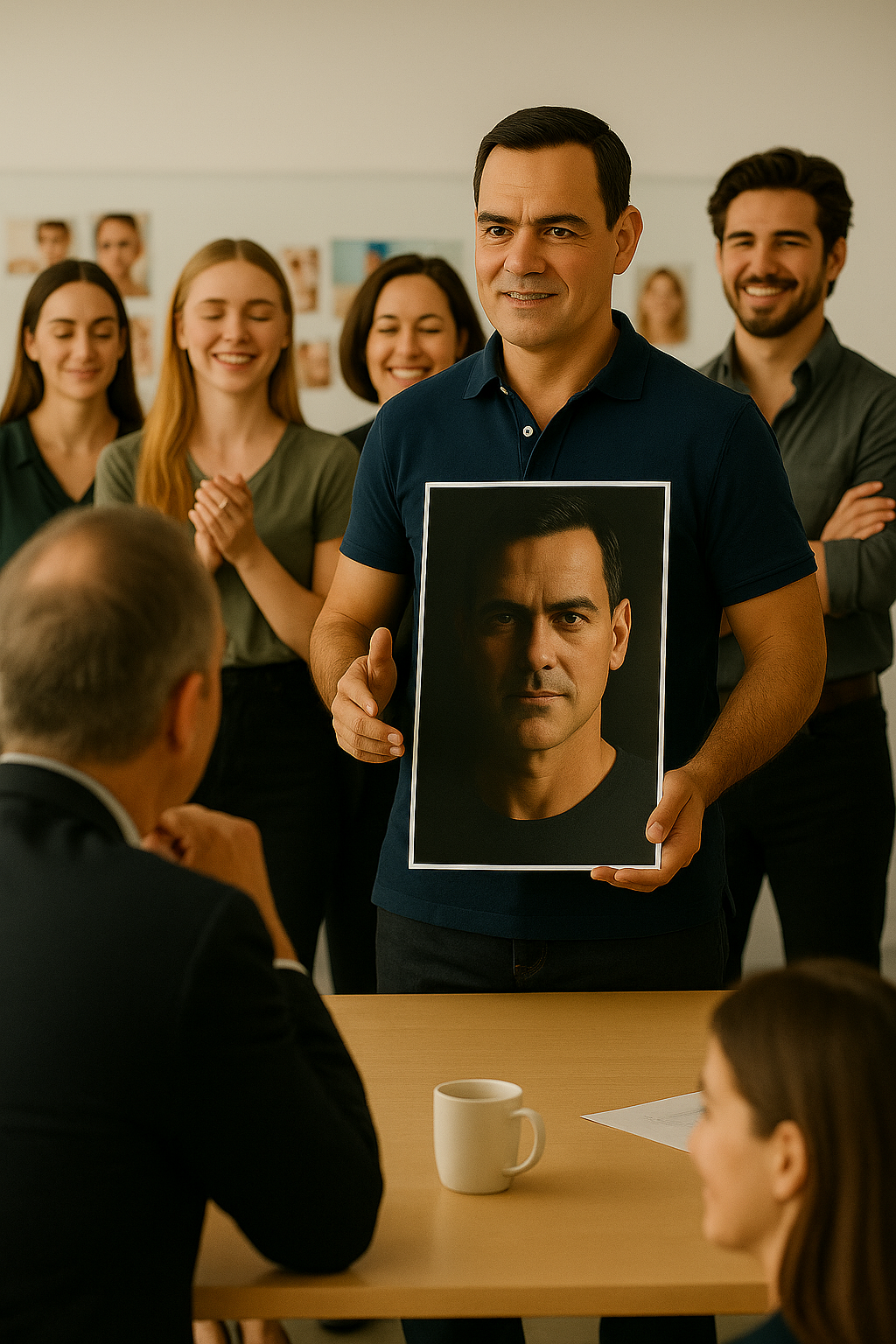
Marius stepped forward. In his hand was a single photograph. He stood upright, his voice calm.
"I would like to introduce you to someone I haven't shown you in a long time: me."
He showed his motif: a face, only half illuminated, bathed in deep anthracite. The shadows conveyed both strength and vulnerability. Above it was written simply:
"That's not my makeup. That's me."
No claim. No logo. Just raw authenticity.
The silence in the room was almost reverential. No one moved. Julius felt as if even the air seemed to be listening.
The marketing director looked at the picture for a long time. Then he slowly leaned forward.
"I see myself. I see my daughter. I see... us."
He nodded slightly. And then, after a moment: "And the logo? Bottom right. Small. White on black. That's all it needs."
A quiet sigh of relief. Then a smile.
"That's brave. And true."
Epilog
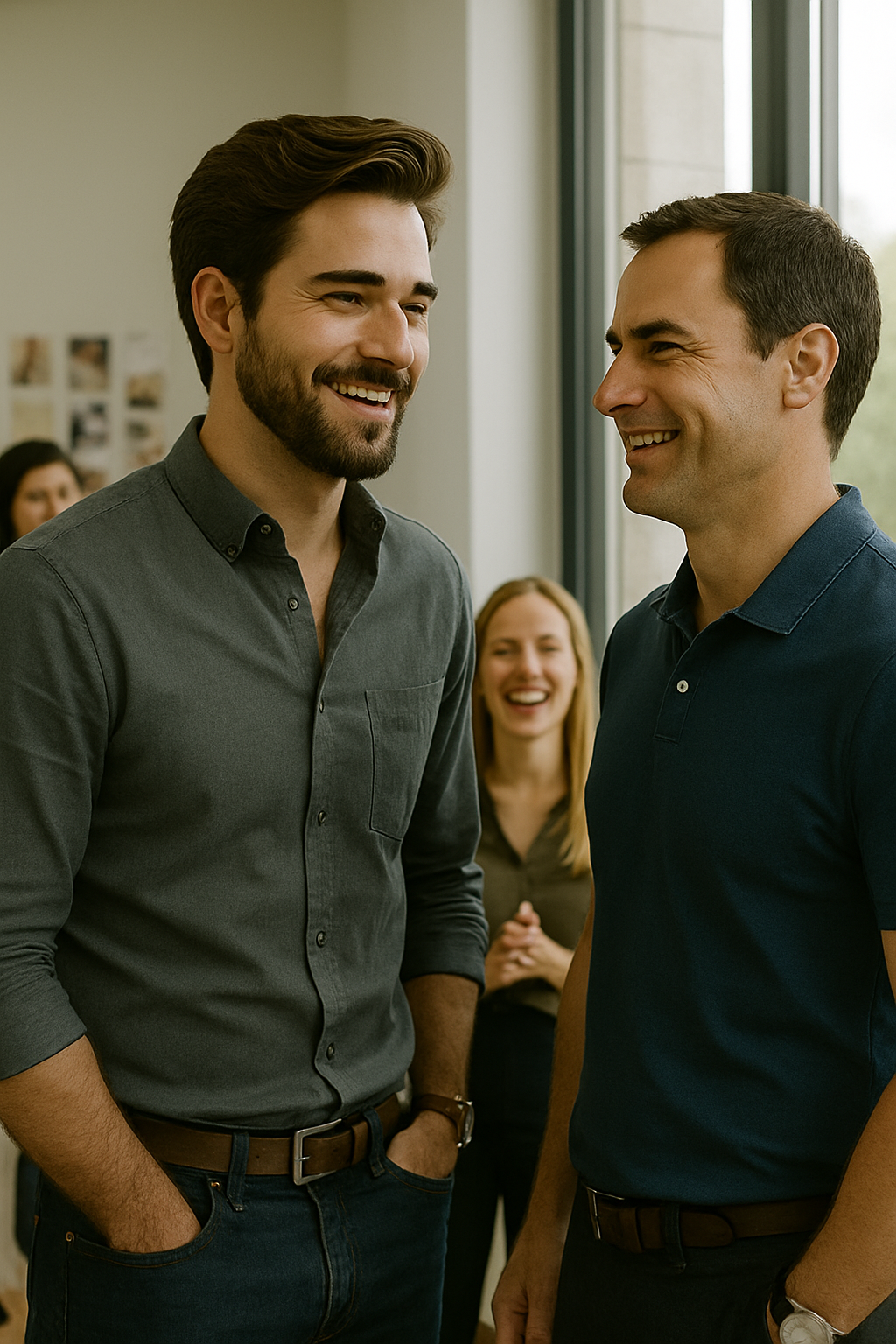
Later, when the presentation was over and the team dispersed into small groups over coffee and relief, Marius joined Julius at the window. Outside, the day shimmered in the soft evening light.
"You didn't change me, Julius," he said quietly. "But you allowed me to show myself."
Julius smiled. "I didn't allow anything. You made the decision."
Marius nodded. Then he turned around and saw Lea laughing freely, almost surprised at herself.
"She was the catalyst, you know," he muttered.
Julius followed his gaze.
"Yes," he said. "Sometimes the quietest voice produces the loudest sound."
Then he stood silent. For everything had been said.
Afterthought
Colors are more than visual impressions. They are emotional markers, subconscious messages, a mirror of inner states. In this campaign, they were both a projection surface and a statement. With the help of NLP, Julius was able to reveal the hidden meanings—not just on paper, but in people themselves. Because sometimes the strongest signal is not the one that screams loudest, but the one that is simply true.
The campaign was a complete success – not just because of its visuals, but because it was real. And Julius knew: truth has many colors – you just have to learn to see them.

Stephan Landsiedel is a diploma psychologist and NLP trainer.