
 DE
DE ES
ES RU
RU FR
FR ZH
ZH HI
HI GR
GR


Timeline Work
Use your timeline to systematically plan your goals and gain clarity in integrating your personal experiences from the past into your future. Develop an irresistible vision.
Eliciting the Timeline
This page describes the basic concept of the timeline and how to discover it for later use in your work.
Basic Concept:
How do we encode memories in some way in time, so that when we have two different memories, we immediately know which one is earlier and which one is later? How does our brain distinguish between the future and the past?
The basic hypothesis is that our brain spatializes temporal differences. This has been empirically confirmed in many people.
The discovery of the timeline allows us to make a large number of changes in a very short amount of time.
Basic Concept:
Take an everyday action like making coffee, brushing your teeth, getting dressed, showering, or something similar.
1. Past
Remember (or just pretend that you can) when you
- made coffee this morning
- made coffee a week ago
- made coffee a year ago...
- made coffee five years ago...
- made coffee ten years ago...
Now, pretend you can perceive all these memories at once: How can you tell that one memory is older than the other?

Useful Questions
For example, are these memories all in the same place, or are they at different places or distances? Are they all in the same brightness/color, etc.?
Is there anything to hear, and if so, is it equally loud/quiet, the same sound quality, etc.?
Do you have the same feeling for all of them, a different one, or none at all?
2. Future
Imagine (or just pretend that you can) how you...
- will make coffee tomorrow
- will make coffee in a week
- will make coffee in a year...
- will make coffee in five years...
- will make coffee in ten years...
Now, pretend that you can perceive all of this at once: How can you tell that one situation is further in the future than another?
3. The Entire Timeline
Now, pretend that you can perceive these future and past situations all at once:
How can you tell that one situation is in the past and the other is in the future?
What is the key difference in the submodalities (VAKOG) between the past and the future?
4. Draw Your Timeline!
Different Timeline Types
Here, the two characteristic timeline types are introduced:
The In-Time type and the Through-Time type (also out of Time type), explained with their properties.
In-Time
The timeline goes through the present point (in my body).
- People live in the here and now (can really enjoy a party, no plans in mind; just where they are)
- Ability to be punctual (overview of the timeline is poorly developed, total overwhelm)
- From back to front
- Not everything is visible in front of us
- Time is flexible / time schedules are not very important
- Memories are mostly associated
- Easy to focus on the present
Through-Time
The timeline lies completely outside the person.
- Western
- From left to right
- Past, present, future
- Visible and manageable in front of us
- Ordered existence / time schedules are more important
- Memories are usually dissociated
- More difficult to stay in the here and now
- I paid and I want all the time that is due to me
Some people can switch very well, for example, during vacation. Acting from the present moment.
Spatial Configuration of the Timeline
Various spatial arrangements of timelines are possible and are presented here in their specifics.
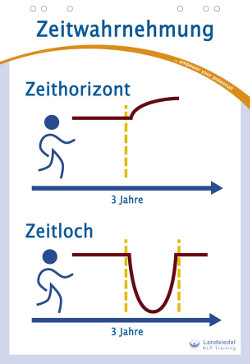
There are very characteristic forms, such as time bulges, time horizons, which are expressions of specific trauma.
Time Horizon
With this type of timeline, the person in question can no longer visualize future images beyond this horizon. However, this does not automatically mean that their life is endangered or uncertain, although that can also occur. Example: Heart attack patient sees only a black hole in 3 years. For short periods: fear of death.
Time Hole
Here, the person has difficulty or is unable to create images for a certain period. If you want to make an appointment with this person within the next 7 days, you will have no problems. However, if you want to know whether you can go to the theater together in 14 days, you will get the answer that one cannot plan so far ahead because one does not know whether they will feel like it, etc. But if you ask whether this person would be willing to move to America in 4 years, you will get a definitive answer.
Time Bulges
This timeline comes from a man, about 40 years old. Three years ago, he went through a divorce that still affected him greatly. When asked how the past three years had gone, he could talk about it normally. The same applied to his future. However, when he was asked about something three years into the future, he became depressed and expressed hopelessness and despair. However, his mood changed immediately when talking about a time further into the future. Apparently, his grief about the past was influencing his visions of the future.
In addition to the bulges or holes, the "inclination angle" of your timeline is important. This refers to the angle your timeline forms with the horizontal. Your timeline can be horizontal, ascending, or descending.
Language Patterns
The types of timelines and the way we represent time are reflected through our language and expressions. Based on the vocabulary used, we can draw initial conclusions about the timeline.
What differences can you notice in your reaction to the following phrases?
- Think of a time when you were hiking.
- Think of the last time you went on a hike.
- Think about how you will be in the process of hiking.
- Think of a time when you will go on a hike.
And now I invite you to be in the distant future and to think back to an experience from the past that actually has not yet happened:
Think of a point in time when you will have gone on a hike.
1. Therapist:
"So you were afraid? Is that what you felt?"
2. Therapist:
"So you are afraid? What keeps making you afraid?"
We constantly influence ourselves and others with such language patterns. Do we achieve
what we want with them?
Idioms
- That is behind me!
- That is ahead of me!
- Time is slipping away.
- To look back on something.
- There is still a lot coming my way.
- The past is catching up with me.
- I let that pass me by, etc.
- Time is on my side.
Eliminating Bulges and Holes
This section describes how to free timelines from holes and bulges.
- Imagine that your timeline is like a clothesline and the individual images are pinned to this line; then further imagine someone pulling on this line so that the bulges disappear.
- Imagine how you would like your timeline to be and ask someone to hold their hand where you want each image to be. Then imagine the respective image in that place.
Make your timeline aesthetic, e.g., straight or parabolic, without bulges and overlaps.
Design Criteria
- Future and past should be clearly distinguished: e.g., front-back, left-right.
- If the lines cross, it causes illness.
- It is unfavorable if timelines reverse so that they can be confused.
The Submodalities of Time
Discover the special features of your timeline. For some, this is one of the most impressive parts of their NLP training.
In which representational system do you first perceive your timeline, and how does it develop further? Suppose you could also (see, hear, feel, etc.) your timeline —
what is it like now?
Location / Direction
- from back to front; from left to right; right to left; from top to bottom
- far away/near
- where in space are your future, present, and past located?
- at what distance from you are the past, present, and future?
- does the timeline pass through you (associated) or is it outside of you (dissociated)?
- is it above you/below you (height)?
Shape / Form / Extension
- line, arc, spiral, parallel lines, different strands, stream, loop
- stepped, on one level, differences in height
- clothesline with photos, film, road, beam, microchip, scale 1:1, hose, islands in the sea
- limited/unlimited; interrupted/continuous
Appearance
- colorful/black and white; bright-dark; sharp-blurry; transparent-opaque
- spacious-crowded; small-large; near-far
Movement
- moving-stationary; jerky-flowing; photo-film; fast-slow
Sound
- loud-soft; clear-unclear; high-low; fast-slow
Feeling / Smell / Taste
- intense-neutral; pleasant-unpleasant; connected-unconnected; present-not present; attractive-repulsive; enthusiasm-indifference; happy-sad; light-heavy; dense-airy; fragrant-odorless; tasteless-delicious, etc.
The more flexibility you gain with the submodalities of time, the greater your understanding of other people's and cultures' sense of time will be. And the more you will use your freedom to use your brain rather than merely possessing it.
Experiment with the Submodalities of Time
- Now change the characteristic submodalities of your timeline
and discover how it changes your feelings and perceptions. Make sure that you can return to your original timeline.
How does each change affect you? Which submodalities make the biggest difference?
a) Change:
Direction, extension, shape, arrangement of past and future, being associated or dissociated with the timeline
b) Change:
V: Colorfulness, brightness, sharpness, size, distance
A: Sounds, noises, voices, volume, pitch, musical background
K: Intensity, quality of your feelings towards it
O: Smell
G: Taste
How does this change your perception? What would you feel more comfortable with compared to before? In which situations could this be useful for you? Make sure that you return to the original submodalities of your timeline (ecology).
If you would like to keep a changed timeline, set a time frame as a trial period (ecology) or define the contexts in which you would like to have this variant available as an option. - Try out the submodalities that someone else uses in their timeline.
How does this change your perception/feeling?
Make sure that you return to the original submodalities of your timeline (ecology). - Try out someone else's complete timeline.
How does this change your perception? Make sure that you return to the original submodalities of your timeline (ecology). - What advantages and disadvantages can certain time representations have in specific contexts?
Try out how your own representation of time is in different contexts. For example: When I was once depressed, very busy and successful, on an absolutely relaxing vacation, in love. What differences in the submodalities of your timeline can you notice, and to which reactions do they lead? - Experiment with the submodalities of the future:
For example:
- How is it for you if it is very close and very detailed (10 years later only a tiny step away from you)?
- How is it if it is very far stretched and blurry?
- What if the next few days are very clear and close, but all future beyond that is rather unclear and distant (or vice versa)?
- What if today stretches to the front door, next week to the street, and so on?
- What if it is dark and small or bright, large, and shiny?
- What if you install a symbol for each wish you have in the future?
- Play with individual and (sub-)cultural differences in timelines
How might the future of a dynamic optimist look compared to that of a "nothing-makes-sense-anymore" type?
How about that of a future-oriented manager/a no-future type, a hippie/an archivist, a future planner/a punk, a pedant/a notoriously unreliable person?
How might the timeline of a nun, a globetrotter, or a Bedouin compare to that of a German? etc.
Enticing Future
The "Enticing Future" format is a technique used to plan your future and pre-program it on your timeline.
The "Enticing Future" format consists of 8 steps, which are explained in detail below:
- Finding a goal: Find a goal that you would like to have achieved in five years, for example. Think about who you want to be by then, in which areas you want to do or not do certain things, how you want to live, with whom, and what will be good for you. (Well-formedness criteria)
- Visualize the goal: dissociated self-image. Now create an inner image of this goal, so that you can see yourself from the outside. Does anything still need to be optimized? (SM)
- Place the goal image on your timeline. Visualize your timeline. Where do you now want to implant this goal image? Choose the spot where you feel or sense it fits perfectly. Associate into it and check if everything is in order.
- Go into dissociation and check if something is still missing. If so, send the missing resources there and improve the submodalities. Associate into it again and check "from within" whether everything is now right.
- From dissociation: What else do you need now to truly achieve your goal?
- Now find all the resources on your timeline that are still important and anchor them. Distribute them where you will need them (activate anchors). Check: Is anything still missing? If yes: repeat the process.
- From the present: How does your future entice you, how does your past support you, and how does all of this give you direction in the present? (Review)
- Future Pace
Re-Imprinting According to Dilts
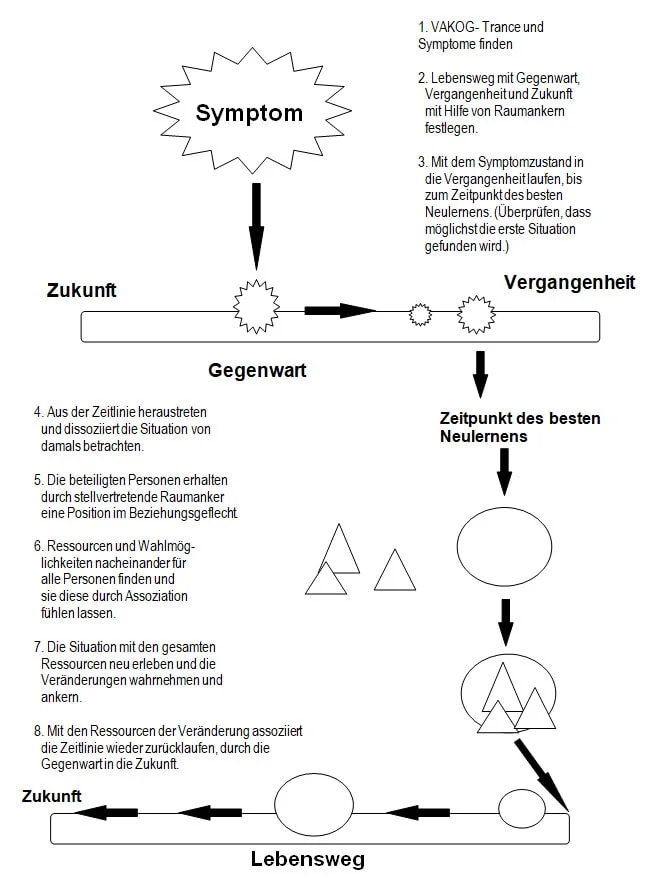
The so-called Re-Imprinting is one of the most powerful NLP formats. It is particularly suitable for treating severe trauma and serious early childhood experiences.
Table of Contents
What Does Re-Imprinting Mean?
An imprint is a formative experience from the past from which the individual has formed a belief or a set of beliefs. Such an imprint often also includes an unconscious adoption of roles from other important people who were involved.
The purpose of Re-Imprinting is to find the missing resources, change the belief, and adapt the role model that was developed at the time to the real and current circumstances of the individual.
Stephan Landsiedel Explains: Timeline & Re-Imprinting
Procedure
- A identifies a limiting behavior they want to change.
- B identifies the associated symptoms (feelings, words, images) that go along with the behavior. B inquires about the underlying belief. Characteristic: hopelessness, helplessness, or worthlessness. Anchor. Ask for the associated submodalities (what comes to A’s mind first): Anchor.
- A then goes back along their life path with this anchor to the point where they had the earliest experience with the feeling/symptom. Allow A to find the generalization or belief that they developed from this experience.
- Have A take another step back to the point where the experience had not yet occurred. Then have A step out of their timeline and return to the present, dissociated from their timeline, and look back at the formative experience in their past. Ask A to notice the impact of this experience on their later life. Allow A to also identify any other generalizations and beliefs they may have developed later from this experience, if any.
- Find the positive intentions, secondary gains, or positive outcomes that might have been associated with this experience. Identify important other people who were part of this experience. Some symptoms are related to the fact that the individual has taken on a role of someone involved in the situation. Also, find the positive intention for these people and their behavior. To find this, you can have A simply ask these people, for example.
- Go through the following steps for all the people connected to the imprinting situation:
- From dissociation, find the resources or choices the person would have needed but didn't have at that time. You can stack resource anchors, collect experiences on the timeline, send energy, colors, etc. Let your imagination play. Pay attention to the logical levels of the resources.
- Have A associate with all these resources into the experience of the person who would have needed them at that time. Activate the anchor, the resources.
Now have the person relive the entire situation with the resources. - Have A step out of the timeline again and reassess the experience from dissociation: How have the perception of the situation, the generalizations, and the beliefs formed from it changed? What new learning experience does A want to draw from the entire experience now?
- Ask A to find the most important resource they would have needed and anchor it. With this anchor, have A go back to a point just before they had this experience. Have A integrate this resource into their younger self and go through the entire timeline up to the present.
"Notice the changes that have taken place through this process."
Flowchart for Re-Imprinting