

 DE
DE ES
ES RU
RU FR
FR ZH
ZH HI
HI GR
GR


NLP Self-Concept
Life Design
Create your life anew. Become a designer of your future. NLP is a powerful tool when it comes to changing your thinking, feeling, and actions in such a way that you create the life you truly want. In this chapter, the foundation is laid for living according to your own ideas. Because in my view, success is: "Living according to your own ideas." That can mean something different for everyone. NLP offers us many starting points to achieve this goal and to enjoy the journey with great joy.
NLP Self-Concept
The self-concept is the image, the idea, that we have developed of ourselves. It refers to how we perceive and define ourselves. Our self-concept significantly influences our thinking, feeling, motivation, performance, learning, and behavior.
"Recognize your self, trust your self, enjoy your self, enrich your self, find the expression of your self: Because you are the only person you will live your entire life with." — Johann Kluczny.
Unfortunately, many people develop their self-concept based on the reactions and behaviors of others instead of based on their own experiences and events. Many people do not even manage to see feedback as a reaction to their behavior. Instead, they condemn their self. Your self and its attributes are valuable.
The reactions of other people are merely responses to your behavior.
"The world is a reflection of ourselves. If we hate ourselves, we also hate everyone else. If we like who and what we are, the rest of the world is wonderful. Our self-image is the blueprint that precisely determines how we behave, who we associate with, what we try out, and what we avoid; every thought and action stems from the way we see ourselves. The image we create of ourselves is colored by our experiences, by our successes and failures, by the thoughts we harbor about ourselves, and by how we interpret others' reactions to us. If we regard this image as fact, we live entirely within the boundaries it sets for us. Therefore, our self-image determines:
How much we love the world and how much we enjoy living in it. How much we will achieve in life." — Andrew Matthews
Thus, the goal of any kind of psychotherapy is to change the image the client has of themselves. Every person determines their own self-image and thereby decides their own worth and the amount of happiness that awaits them. There is no stronger lever for changing human behavior than the self-image.
Our self-image is our identity. Identity encompasses all the beliefs through which we define our individuality — our unique character traits that distinguish us from others. We act in accordance with our self-image, regardless of whether it reflects reality or not.
Five Important Components of the Self-Concept
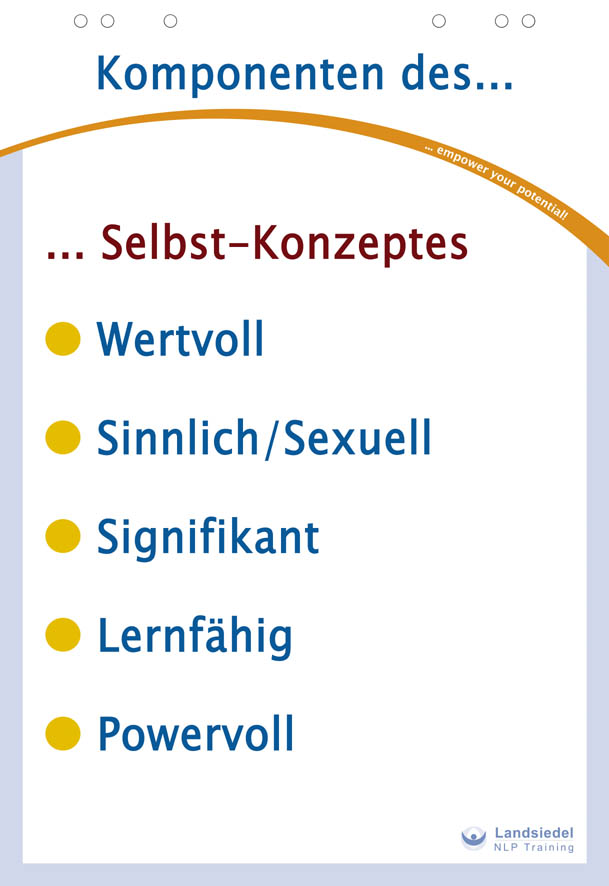
Valuable
Gives you the experience of the emotional quality:
"I am important"
Sensual / Sexual
Gives you a physical substance and physical identity through which you interact with the world:
"I like the feeling of my body."
Significant
Gives you a sense of importance to other people, to the world, etc.:
"I have the ability, I am significant."
Capable of Learning
Gives you the experience that you can do anything because you can learn:
"I can improve myself, I can enrich myself."
Powerful
Gives you the experience that you can influence your own experience:
"I can choose the state I want to have."
Who Am I?
There are countless possible answers to this question. We can describe ourselves based on our emotional qualities (I am loving), our profession (I am a doctor), our rank (I am a CEO), our financial status (I am a millionaire), the various roles we play (I am a mother of three children), our behaviors (I am an athlete), our possessions (I am a Porsche driver), our metaphors (I am just a small cog in the machine), our faith (I am a Christian), our nationality (I am German), our achievements (I am a world record holder), our past (I am a failure), and so on.
Put yourself in a state of curiosity and relaxation, and then ask yourself one of the most profound questions of philosophy:
Who am I?