
 DE
DE ES
ES RU
RU FR
FR ZH
ZH HI
HI GR
GR


Beliefs
A belief is the linguistic expression of something that someone believes in, something someone holds to be true. In NLP, beliefs are an expression of internal models that each person continuously creates and must continuously create in order to orient themselves in the world. Other terms for this include: convictions, attitudes, beliefs, opinions.

Table of Contents
- What are beliefs?
- Examples of limiting beliefs
- Examples of positive and negative beliefs
- How do beliefs influence our lives?
- The consequences of beliefs
- How does a belief arise?
- Finding beliefs
- How can beliefs be changed?
- Belief change techniques
What are Beliefs? Definition
Beliefs are generalizations about the "relationships between experiences."
Beliefs are generalizations about:
- Connections / Causes
„It runs in our family.“ - Meaning
„Smoking means weakness.“ - Limits
„That is impossible.“
And with regard to:
- The world around us
„One cannot concentrate with noise.“ - Specific Behaviors
"You shouldn't do that." - Skills
"I will never learn that." - Our Identity
"I am competent in my profession." - Spirituality
"The universe is a friendly place."
Beliefs control the focus of our attention, determining which information we absorb and how we interpret it.
Beliefs form the large framework of any change work you do. When people truly believe that they cannot do something, they will unconsciously find a way to prevent the change from happening. They will interpret the results in a way that aligns with their existing beliefs.
We all have beliefs, attitudes, expectations, and beliefs derived from culture and society, derived from our personal experiences, adopted from others, generated from past traumas, and generalized through repetition.
The American sociologist W.I. Thomas was one of the first to express the now widely known view that reality, in its consequences, is what people perceive and define it to be. This means that the way I construct my world, the way I imagine it, influences my actions and activities.
Every person has belief or conviction systems that are closely linked to their personal values and criteria, which can significantly influence motivations, decision-making, and performance. They shape not only the will to live, the ability to cope with stress, but also enable the development and shaping of positive life plans, goals, and needs.
Belief systems consist of several beliefs that support and reinforce each other.
"Believe in your limits and they will belong to you."
"What a person believes, they can also achieve."
"All personal breakthroughs begin with a change in our belief patterns."
Anthony Robbins
Beliefs – What is it? Stephan Landsiedel explains
Examples of Limiting Beliefs
Below are some of the most common limiting beliefs and some facts and examples that should make you think.
"I'm too young."
- Boris Becker won Wimbledon for the first time at the age of 17.
- David Stuart gave a scientific lecture at the age of 12 to a group of 150 archaeologists and Maya researchers about a Maya language hieroglyph he had deciphered.
- At the age of 15, Judit Polgar became the youngest chess grandmaster of all time.
"I'm too old."
- Hulda Crooks didn’t know at 60 that she would discover mountain climbing as a new hobby at 70. At 90, she became the oldest woman to ever climb Mount Fuji.
- Livius wrote the history of Rome at 75, and Goethe wrote "Faust" at 80.
- George Bernard Shaw broke his leg at 96 when he fell while picking plums from a tree.
"I don’t have enough education."
- About 80% of the most successful entrepreneurs didn’t graduate from high school or university.
- Albert Einstein didn’t graduate from high school. He failed his first entrance exam at the Federal Polytechnic Institute. Nevertheless, he developed the theory of relativity and became the most famous physicist of the 20th century.
- No one is stopping you from starting a new education today.
"I don’t have enough money."
- Even Robert Schuller, the famous master of possibility thinking, had no money. Without a dollar, he started a church, held services in a drive-in theater, and eventually built the Crystal Cathedral, which is now worth over 100 million dollars.
- Andrew Carnegie started with a weekly salary of 15 marks in a spool factory. In the last 18 years of his life, he donated over 1 billion marks.
"I lack the ability to... "
- Robert W. Woodruff couldn’t even read properly due to dyslexia. Even as a big entrepreneur, he had to pronounce each word individually. Nevertheless, he led the Coca-Cola Company in Atlanta until his death in 1985, creating one of the world’s most successful corporations. If Robert Woodruff could build such a company with this weakness, what’s stopping you from being successful?
"I come from humble beginnings."
- Arnold Schwarzenegger came from humble beginnings. But that didn’t stop him from becoming the most successful bodybuilder of all time, a Hollywood star, and marrying into the Kennedy family.
"My physical impairments prevent me from being successful."
- Demosthenes stuttered but became the greatest orator of ancient times.
- The blind José Feliciano earned 38 gold records.
- The blind Stevie Wonder became world-famous.
- Sylvester Stallone, despite his paralyzed eyelid and slow speech, became one of Hollywood’s greatest heroes.
Examples of Positive and Negative Beliefs
Money
| Positive | Negative |
|---|---|
| I attract money effortlessly like a magnet | I need a lot of money to be happy |
| I feel rich and successful. I am rich and successful | Rich people all became wealthy through lies and deception |
| I love money and feel good about having a lot of it | Without a lot of money, I am worthless |
| I deserve wealth and prosperity | Other people envy me for my prosperity |
Self-Worth
| Positive | Negative |
|---|---|
| I accept myself as I am | I am a failure and worth nothing |
| I am grateful for what I have | Everyone else is better than me and achieves their goals, unlike me |
| I am a wonderful person | I am unimportant |
| As I am, I am valuable, complete, and happy | I can't do all of this |
| My opinion is important | If I make a mistake or fail, I will be rejected |
Weight Loss
| Positive | Negative |
|---|---|
| Living and eating healthily is fun for me | Losing weight is way too hard |
| I am allowed to be slim | I can't stick to a diet anyway |
| I feel good in my body | Everyone in my family is overweight |
| I allow myself to be slim and proud of it | I just have bad genes |
| I easily reduce and maintain my weight | No matter what I eat, I still gain weight |
| My weight settles at the point where it is right and good for me | If I want to lose weight, I have to sacrifice |
Love
| Positive | Negative |
|---|---|
| I am worthy of being loved | No one loves me |
| I am surrounded by people who love me | I am alone |
| Love and harmony fill my life | No one wants me |
| My family gives me love and affection | I don't deserve love and affection |
| I live in love and harmony with my soulmate | My relationships are doomed to fail |
| I have an endless source of love within me | Other people don't love and respect me |
Health
| Positive | Negative |
|---|---|
| Being healthy is the normal state of my body | My illness is incurable |
| I feel healthy and fit | I can never be completely healthy |
| I have control over my health | Age is the reason for my health condition |
| Every breath fills me with new, healthy energy | If I’m fully healthy, no one will care about me anymore |
| I choose a conscious lifestyle | There is no more help for me |
Limitation
| Positive | Negative |
|---|---|
| I am special | I am unattractive |
| Despite my limitation, I can achieve anything I want | I am disadvantaged and hopeless compared to others |
| I love and accept myself as I am | My limitation prevents me from achieving my goals |
Relationships
| Positive | Negative |
|---|---|
| My relationships are based on love and affection | I am incapable of having a relationship |
| I have an amazing partner by my side | I feel suffocated in relationships |
| I fully enjoy my relationships | Relationships can't always be easy and harmonious |
| I find a partner who matches me | It's normal to argue a lot in a relationship |
| My relationship gives me security and support | My partner doesn't respect me |
| I respect and love my partner as they are | I won't be happy in a relationship |
How Do Beliefs Influence Our Lives?
Beliefs influence our bodily functions. Our body reacts as if what the mind believes is true. Furthermore, your behavior is also significantly shaped by your beliefs and convictions. Once we have deeply anchored a belief within us, even massively opposing information won't shake us. We simply ignore it or consider it wrong. The mechanisms of generalization, deletion, and distortion are particularly useful for this. Some people even feel the need to change the entire world just to prove their belief is right.
Examples
-
The Corpse
A good example of this is the story of a man who believed he was a corpse. He just sat there and insisted he was dead. A psychiatrist came and the two argued for a while about whether the man was actually a corpse or not. Suddenly, the psychiatrist had an idea.
He asked the man whether corpses could bleed. Since all bodily functions cease in a corpse, the man said no. The psychiatrist then pricked the man’s finger with a needle. When the finger started to bleed shortly after, the man said: "Oh, I guess I was wrong. Corpses can bleed after all." -
Cancer Study
In an interesting study, a woman interviewed 100 "cancer survivors" in the hope of discovering what all of them had in common. She defined a cancer survivor as someone who had been diagnosed with "terminal cancer" with little chance of recovery, but who was still alive and healthy—and still enjoying life ten or twelve years later.
Interestingly, the researcher could not find any common pattern in the treatments these patients had received. Different people had undergone different treatments, including chemotherapy, radiation, diet programs, surgery, spiritual healing, and so on. Yet there was one thing all the survivors had in common: they all believed that the treatment they were receiving would work for them. It was the belief—not the treatment—that made the difference. -
Hypnosis with Ice
Belief also shapes our perceptions. Through the network of beliefs in our minds, messages take on different meanings. This even happens at the level of the nervous system. We are capable of reinterpreting incoming stimuli based on our beliefs. The description of an experiment helps illustrate this idea more clearly:
Test subjects were touched with ice while under hypnosis and simultaneously given the suggestion that it was a piece of hot metal. All of them developed blisters at the point of contact, as if they had actually been burned. -
Intelligence Tests in School
In 1968, psychologists Rosenthal and Jacobsen gave elementary school students an intelligence test. They then told the teachers that these were not ordinary intelligence tests, but rather tests that could predict the future intellectual development of the children.
This created the expectation among the teachers that certain students would improve significantly in the future. Randomly, 20% of the children were selected and presented to the teachers as those who would show exceptional academic growth in the coming year. In reality, these children were no better or worse than the others.
When the students were retested a year later, the selected group showed significantly greater increases in their intelligence test scores than their peers. The teachers' positive expectations had apparently had a direct impact on the students' performance.
The Consequences of Beliefs
Beliefs are always associated with emotional reactions. The most common consequences of beliefs can be categorized into the following emotional states:
- Hopelessness:
A belief that the desired outcome is not attainable, regardless of a person’s existing abilities and resources, e.g., “Cancer is incurable.”
➨ Hopeful:
A conviction that the personal abilities and resources are sufficient to achieve the desired outcome. - Helplessness:
A belief that the desired goal is theoretically achievable, but not for the person themselves, e.g., “Others can do it, but it won't work for me.”
➨ Empowered:
A conviction that achieving the desired result or state is entirely possible, and that the person is capable of learning. - Worthlessness:
A belief that one does not deserve the desired goal because of something they did (or didn’t do), or simply because of “who they are,” e.g., “I don't deserve an easy life.”
➨ Worthy:
A conviction that the person deserves to achieve the desired outcome because they have made appropriate efforts. - Meaninglessness:
A belief that the intended outcomes have no significance either for the individual or for others around them.
➨ Meaningful:
A conviction that the desired outcome will benefit both the individual and their social relationships. - Pointlessness:
A belief that life itself is pointless and that pursuing a desired outcome isn’t even worth the effort.
➨ Purposeful:
A conviction that the desired outcome fits into the overall process of life and that the person perceives life as meaningful.
How does a belief arise?

In our development, we go through three different phases.
- Imprint Period
- Modeling Period
- Socialization Period
From birth to the age of seven, we go through the imprint period, during which we absorb all events, images, sounds, feelings, tastes, and smells.
In the following modeling period, we imitate our parents and other people we admire. This period lasts approximately from the age of eight to thirteen.
After that, we enter the socialization period, in which, as adolescents, we move beyond our family environment and get to know new people. During this time, our social values and belief systems are formed.
An important source in the development of belief systems and convictions is our immediate personal experiences, from which we derive conclusions and assessments about our surroundings, the people in them, and our past experiences. Much of the information we receive about the world, human relationships, or ourselves also comes through language (media, books, etc.) and through communication with others.
Information gained through direct experience or verbal communication with others forms the basis for conclusions and generalizations from these experiences and messages, shaping our belief systems and personal convictions. As a result, it becomes important which elements of our current individual experiences we distort or delete in order to maintain our beliefs as generalizations from the past.
During childhood development, parents play a significant role in these generalization processes. The personal "model of the world" is conveyed to the child through both verbal and non-verbal messages, as well as through meta-messages. These results become assumptions for the child, as parental messages about the child can become the child's messages about themselves. For example, a parent's statement about their daughter, “You are so clumsy”, may lead the girl to adopt the belief, “I am so clumsy, I can't do things.”
Identifying Beliefs
The key factors in the formation and maintenance of our beliefs are reference experiences, environment, role models, and our self-programming through self-suggestions. Analyze yourself in these areas and ask yourself the following questions:
- What role models have you had in your life? What did these people believe? What was important to them?
- What kind of environment did you grow up and live in?
- What reference experiences have you had so far?
- What self-suggestions have you given yourself up to now?
- What beliefs do you hold? What do you think about life, your identity, your career, work, time, money, love, etc.? Often, these beliefs begin with phrases like “I am...”, “Life is...”, and so on.
How Can Beliefs Be Changed?
How must I perceive the world in order to get what I desire?
What assumption best supports me in achieving my plans and goals?
- What beliefs does the person you want to become have?
- What experiences or reference events are necessary to fulfill your dream and become the person you want to be?
- Use the experiences of other people (mentors) and study the biographies of successful individuals. Who could your mentors be? Which biography would you like to start with?
- What environment would optimally support you in achieving your goals?
- What self-suggestions fit your new self?
Changing Beliefs with NLP
Techniques for Changing Beliefs
- Generate a new belief (New Belief Generator or Mentor Technique)
- Installation of a belief on the timeline
- Changing historical imprints (Re-Imprinting)
- Installation of belief systems through submodalities
- Dickens Pattern
Mentor Technique: Generating a New Belief
This model is suitable for someone who wants to change their behavior in a specific situation but isn't exactly sure how. The Mentor Technique is ideal for "stuck states" that need to be enriched with new ideas.
A mentor is an advisor, a counselor, a benevolent or wise friend. In the Mentor Technique, real or fictional mentors are used as resources. These can be people the individual knows, people they've heard of or read about, characters from novels or movies, fairy tale figures, animals, plants, mystical beings, abstract entities, guardian angels, or even natural phenomena such as the ocean or mountains (essentially, anything that fits within the client's belief system and makes sense to them).
In situations where the client can't identify any resources within themselves to make a change, the mentor position helps to highlight or provide the desired resources.
The use of mentors to discover resources is known as the Mentor Technique.
- Identify a problematic situation in your life or with another person, where you felt helpless, confused, or overwhelmed and now wish to make a change.
- Relive a key event of this experience in an associated state (1st Position). Install a grounding anchor for the problematic situation.
- Shift into a Meta-Position (3rd Position) and dissociate yourself from the problematic situation, recognizing and distinguishing the messages and meta-messages from the experience.
- Find 1-3 mentors who have positively influenced your life. Think of someone or something that embodies the exact qualities, abilities, etc., that you need and could help you as a mentor (advisor, idea giver). These mentors should be role models for the desired behavior you want to adopt, so you can model it.
- Take the position of each mentor (2nd Position) and identify with them. Describe what advice or message each mentor would give you for the problem situation.
- Shift to a Meta-Position and discover the connecting meta-message from all three mentors (Meta-Message).
- Validate the common message by assuming each mentor’s position (2nd Position) and verbally state the Meta-Message, ensuring you say it congruently and harmoniously.
- Integrate the message/advice: Stand in front of your mentors and feel their hands on your shoulders. Hear the unified message spoken with one voice. Visualize this message and feel it as light, melody, or temperature entering and spreading throughout your body. Set an anchor to store this new resource.
- While still hearing, seeing, and feeling the unified message, return to the problem context. Notice how your perception of the situation, the message, and the meta-message have changed the original problem.
- Bridge the common message from your mentors to a future situation and observe how you will behave.
Installation of a Belief System
To install a belief system, you can use the following guide:
- Establish the client’s timeline and a Meta-Position (3rd Position) outside the timeline.
- Develop the desired future outcome for the client and the corresponding belief systems that support the desired outcome. Consider the well-formedness conditions for the desired outcome.
- Have the client step associated into the present on the timeline, facing the future, walking to the point where they know they will have achieved their desired outcome. Have the client experience the desired outcome through all their senses, associated with it. Guide them to make desired changes (optional).
- Reorient the client back to the present and discuss with them the necessary steps to achieve the desired outcome.
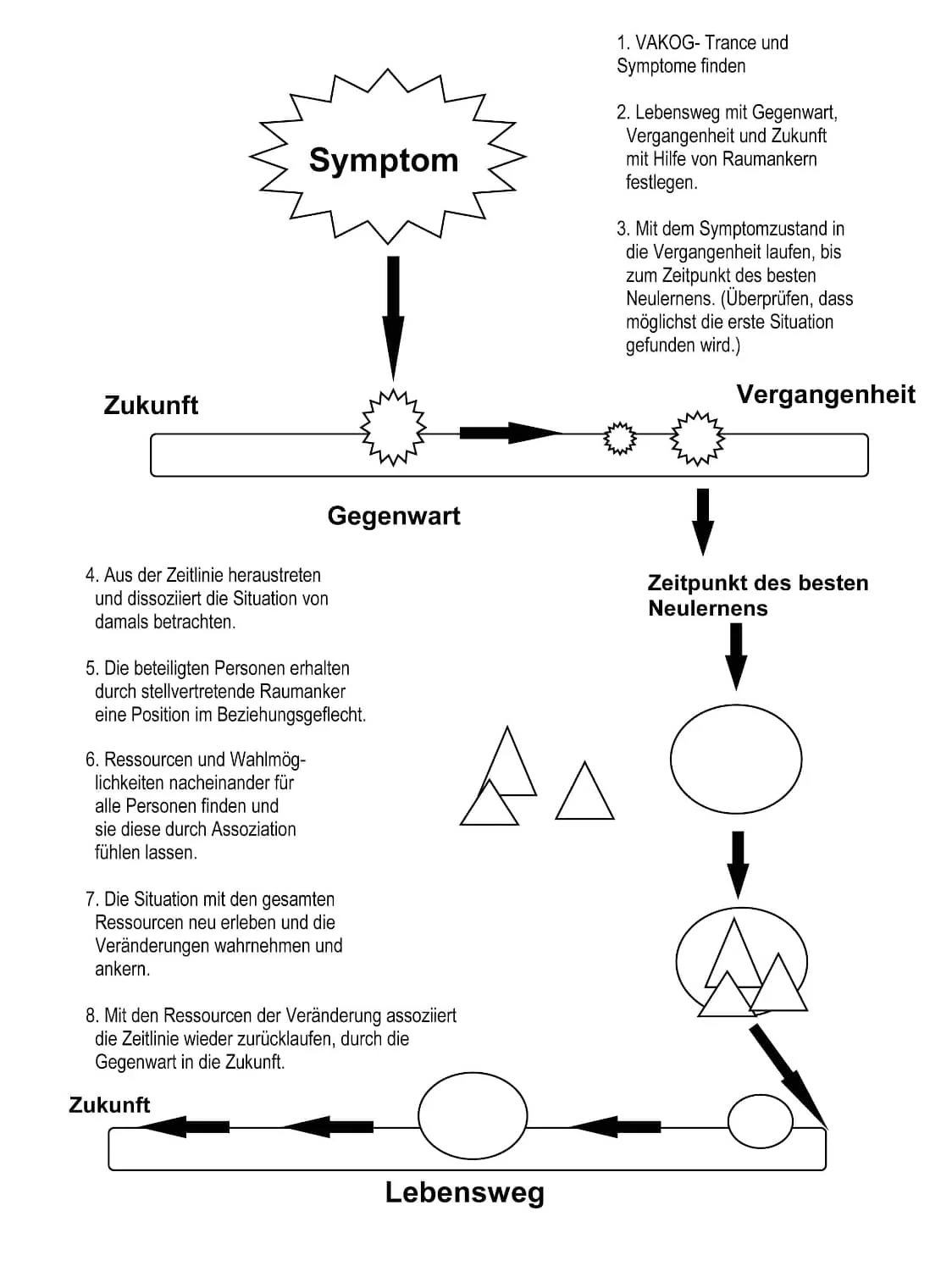
Re-Imprinting by R. Dilts
An imprint is a significant experience from the past, from which the individual has formed a belief or a bundle of beliefs. Such an imprint often involves an unconscious role adoption from other important people involved in the experience.
The purpose of Re-Imprinting is to find the missing resources, change the belief, and adjust the role model that was developed there to the real and current circumstances of the individual. The format proceeds as follows:
- A identifies a limiting behavior that they wish to change.
- B identifies the corresponding symptoms (feelings, words, images) associated with the behavior. B then asks for the underlying belief.
Markers: hopelessness, helplessness, or worthlessness, anchor, and inquire about the related submodalities (what first comes to A's mind). - A now goes back along their life path with this anchor, to the point where they had the earliest experience with the feeling/symptom. Let A discover the generalization or belief they developed from this experience.
- Have A take another step back to the point where the experience had not yet occurred. Then, A steps out of their timeline and returns to the present, dissociating from their timeline. A now looks back at the formative experience in their past. Ask A to notice the effects of this experience on their later life. Also, have A identify any additional generalizations and beliefs they may have developed later as a result of this experience, if applicable.
- Find the positive intentions, secondary gains, or positive effects that may have been associated with this experience. Identify key individuals who were involved in this experience. Sometimes, a symptom is related to the fact that the person has taken on or modeled the role of someone involved in the situation. Find the positive intention behind their behavior. To do this, you can have A ask these people directly, for example.
- Go through the following steps for all individuals connected to the formative experience:
a) Identify, from the dissociation, the resources or choices that the person would have needed at the time but did not have. You can stack anchors, collect experiences on the timeline, send energy, colors, etc. Let your imagination play. Pay attention to the logical levels when identifying resources.
b) Have A associate with all these resources in the experience of the person who would have needed them. Activate the anchor and the resources. Now, have the person re-live the entire situation with these resources.
c) Have A step out of the timeline again and re-assess the experience from the dissociation. How have their perceptions of the situation, the generalizations, and the beliefs that were formed changed? What new learning experience does A want to draw from the entire experience? - Ask A to identify the most important resource they would have needed and anchor it. With this anchor, have A go back to a point just before they had the experience. Let A integrate these resources into their younger self and walk through the entire timeline to the present.
"Notice the changes that have taken place through this process."
Process diagram for re-imprinting