 DE
DE ES
ES RU
RU FR
FR ZH
ZH HI
HI GR
GR


Dilts Pyramid – The Neurological Levels
Robert Dilts developed a wonderful model for NLP that can be very effectively used for our personal development and for describing processes of change: the Dilts Pyramid.
The model offers valuable insights and support, particularly in the areas of goal-setting and personal development.
Table of Contents
What is the Dilts Pyramid?
The model helps to better understand oneself and the environment. At the same time, it should offer guidance on which level changes need to be made in order to enable personal development. The logical levels are levels of change. They help clarify, for example, where a problem, a goal, or one’s personal mission is situated. The logical levels can be used in problem-solving and resource work.
Through guidance and targeted questions, resources on each level are made conscious. These are then integrated into the levels below. A common misunderstanding of this valuable concept arises from the term "logical levels," because strictly speaking, they are neither truly logical (as defined by logicians) nor clearly separated levels. For this reason, the term "Dilts Pyramid" is now more commonly used.
- Pyramid of Motivation
- Model for structuring change processes
- Higher levels generally influence lower levels more than the other way around
- The solution to a problem is rarely found on the same level as the problem itself
- One of my most important coaching models
Robert Dilts
Robert B. Dilts, born in the USA, is an author, trainer, consultant, and developer in the field of Neuro-Linguistic Programming (NLP). He pioneered the application of NLP in areas such as organizational development, leadership, and learning. He has worked in more than 30 countries with companies like The World Bank, Isvor Fiat, and IBM Europe.
He developed the model of logical levels in the mid-1980s. He formulated them based on Bateson's logical levels of learning. Since their introduction, they have gained significant importance in NLP. The model was likely first published in book form in 1990 in “Changing Beliefs with NLP.”
The Levels of the Dilts Pyramid
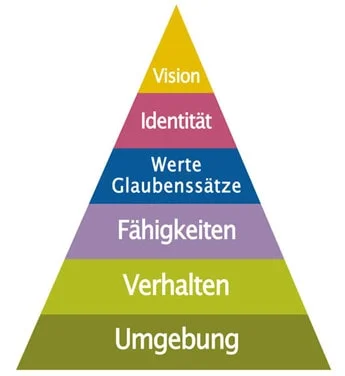
On the lowest level, the "Environment" (Level 1), the person moves with their "Behavior" (Level 2).
Behind the behavior lie the "Capabilities" (Level 3), which make it possible to perform any behavior at all.
Behind/above the capabilities lies the motivation to want to act in a certain way or to develop and practice the skill to do so. Since this motivation is not purely driven by instinct, we speak not only of motives, but generally of "Values and Beliefs" (Level 4). We use these constructs (our model of the world) as criteria to decide what we believe to be true, right, and important. In NLP, we often use the English term "beliefs" because English more clearly differentiates between "to believe" (belief) and "religious belief" (faith) than German does.
In Level 5, we define our "Identity" (Level 5). This defines who we are, what we are, what belongs to us, and what does not.
In the 1990s, Dilts added another level above identity. Transcending personality, he refers to both "Belonging" and "Spirituality." As part of the further development of NLP, he laid the foundation for what he later called "Third Generation NLP." This 6th level is often referred to as "Vision." Since "spirituality" can be easily misunderstood, I personally prefer to use the terms Vision and Belonging for this 6th and, in my view, most important level.
Environment
At the lowest level is the environment. Every event takes place within a specific time and space context. The environment level includes all external conditions that influence a person. These are perceptible through the senses and can be explored with the questions “Where?”, “When?”, “Who?”, “With whom?”, “Who else?”.
Behavior
The behavior level refers to all externally observable actions and reactions of a person: their actions, their words, tone of voice, gestures, movements, and breathing. Behavior can be described using sensory-specific terms. This level is about the “What?”.
Capabilities
Capabilities are cognitive and emotional processes that a person goes through in order to make specific behaviors possible. They are not visible from the outside. This level concerns the ability to do, think, and feel, including the awareness of these capabilities. The related question is “How?”.
Values and Beliefs
The next level is that of beliefs, convictions, values, and inner criteria that underlie (consciously or unconsciously) a person’s actions. These are the actual motives, guiding ideas considered true, and used to apply their abilities. People only use their abilities when the necessary beliefs and criteria are present and allow them to do so. Beliefs are interpretations of past experiences and are personal theories about why things are the way they are.
Identity
The next level is that of identity: the self-image, the concepts a person constructs—often unconsciously—about themselves, their behavior, capabilities, and beliefs. Identity—between the poles of personal and social identity—can also be seen as a specific pattern of belief. It represents the central model of one’s overall personality.
Vision
The highest level is that of belonging or mission, vision. It concerns our professional, familial, societal, or perhaps philosophical or religious affiliation and vision. This spiritual level guides and shapes our lives and gives our existence a foundation. It addresses the “big questions” in life: “Why do we live?”, “Why are we here?”, “What is the meaning of life?”
Questions and Examples
| Level | Question | Example |
|---|---|---|
| Environment | Where are you here? Who are you with? What do you hear? What do you see? What do you taste? What do you smell? | The noise in the room makes it difficult to do dictations. Anchors can be easily set during a group exercise. “The cancer has taken hold of me.” |
| Behavior | What are you doing here? | You didn’t spell well in this dictation. You set an anchor on this person. “Sometimes I just can't behave healthily.” |
| Capabilities | How do you do what you do? How do you relate to others here? What special abilities do you have here? | “You can't spell well.” “You are capable of anchoring other people.” “I’m unable to be in a good state.” |
| Values and Beliefs | What is important to you here? Why do you do what you do? What do you believe in here? What motivates you? What do you believe about yourself, others, your job, etc.? | “If you can’t spell, you’ll never succeed in school.” “Knowing how to anchor makes you an influential person.” “It’s a wrong attitude to want to rebel against the inevitable.” |
| Identity | What is your self-concept here? How do you understand yourself, who are you? | “You are dumb, a learning-disabled child.” “You are a good NLPer.” “I am a cancer victim.” |
| Vision | Where do you belong? Is there someone, a group, or something on a professional, personal, ideological, or spiritual level that you know you belong to? What mission or purpose do you have? | “You belong to the learning disabled, the slow learners.” “You belong to the top of the NLP elite.” “You belong to the victims of cancer who suffer the same fate.” |
The Dilts Pyramid Illustrated with an Example
In the context of stress, we want to use the neurological levels according to Dilts to identify stressors and activate resources that help us counteract stress. On each level, there are numerous NLP intervention techniques that can help bring about the desired changes.
Environment
- What in the environment triggers the stress?
- Possible answers: noisy office, conflict with colleagues, morning meetings, etc.
To reduce stress, it can be helpful, for example, not to perform certain tasks in a noisy environment or to schedule them at another time of day when the office is still quiet. At this level, one looks within the individual environment for missing resources that help to avoid stress.
Behavior
- What in my behavior contributes to the development of stress?
- Possible answers: I constantly change my daily routines, attend appointments at the last minute, etc.
After answering this question, one looks for useful behaviors that can serve as resources. For example, one could take time to relax during lunch breaks or engage in physical activity after work. NLP offers an extensive collection of tools for behavior change. Simply by consciously influencing one's own physiology (e.g., changing posture, breathing, voice), stress can be effectively reduced.
In dealing with strong stressors, the so-called VK dissociation has proven very effective. In this technique, you watch yourself on a movie screen as you face the stressor. Through targeted influence, it becomes possible to observe the situation calmly and composedly, thereby paving the way for implementable behavioral change. Methods from classical conditioning—called "anchors" in NLP—and relaxation techniques are also used here.
Capabilities
- How are tasks carried out, what internal processes and programs are running?
- Possible answers: I can't concentrate. I can't be punctual because something always comes up.
To activate resources at this level as well, it is helpful if the client learns to imagine how they can develop the missing capabilities—for example, arriving punctually for appointments—and then explore what they did to achieve this positive goal.
At this level, strategies play a special role in NLP. These describe the internal processes that lead to a specific outcome. The goal is to interrupt inappropriate stress strategies and learn new, effective alternatives. These are derived from already successful models. In this way, new skills for dealing with one's own stress factors can be developed effectively in a relatively short time.
Values and Beliefs
- What beliefs might be causing stress?
- Possible answers: I must be able to anticipate others' wishes. I must always do everything perfectly.
"All beliefs that make you dependent on the grace of others or specific events, or that leave no room for alternative actions, contribute to the creation of stress," say Ian McDermott and Joseph O'Connor, who dedicate an extensive chapter to the topic of stress in their book *NLP and Health*. They argue that all beliefs that enhance the sense of having influence are resources.
Identity
- Who am I (when I live according to these beliefs and capabilities)?
- Possible answers: I am a slave to my schedule. I am a servant to others.
Healthy self-awareness is a strong source of energy to prevent stress. Self-aware individuals know who they are, and therefore also what they can do to take care of themselves. Stress arises at this level when one's own personality is not being lived. This can manifest in hiding oneself, not showing emotions, or wearing a mask to protect oneself both from others and from oneself.
It is important here to delve deeper into one's true personality. For example, one can consciously ask: "Who am I really?" and "What am I like?" Insights can also come from contrast: "What am I not like?" or "What don’t I want to be like?" NLP offers methods to explore one’s own identity more deeply. In doing so, one becomes aware of their traits (e.g., passionate, patient, vulnerable, etc.), which are then examined: Are there reference experiences that 'prove' someone has these traits? What are they based on? Are there also experiences that show the opposite? These experiences are questioned. Step by step, one’s self-image becomes clearer and clearer.
Vision
- Is there something or someone—on a professional, personal, idealistic, or philosophical level—that you know you belong to? What is my role in this world?
- Behind the answers to these questions lie very powerful resources.
Those who find meaningful answers here and are able to live them will no longer perceive their stress as such. They will feel happy and grateful to live a bit more of their purpose each day.
The limits of one’s current identity can be transcended with this awareness and integrated into a more expansive sense of self. This can be achieved through various paths such as meditation, spiritual experiences, love, etc.
The Application
-
Coaching Questions on the Different Levels:
Environment: Where are you here? Who are you with here? What do you hear? What do you see? What do you taste? What do you smell?
Behavior: What are you doing here?
Skills: How do you do what you do? How do you relate to others here? What special skills do you have here?
Beliefs and Values: What is important to you here? Why do you do what you do? What do you believe here? What motivates you? What do you believe about yourself, others, your job, etc.?
Identity: What is your self-understanding here? How do you understand yourself, who are you?
Belonging: Where do you belong? Is there something or someone, or a group, here on a professional, personal, ideal, or spiritual level that you know you belong to? What purpose, what mission do you have?
Now take one more step further.
Your unconscious will now give you another important piece of information. It could be an idea, an image, a symbol, a feeling, or whatever it may be. It is a special gift from your unconscious to you, for your goal. Take as much time as you need to fully absorb it. -
Part: Collecting Resources
- Now go back along the path and remember all the insights and resources you have already found on this journey. Experience how each level has been enriched and intensified by the knowledge and experience of the others. Notice the changes.
- If something is still missing at any level, go into dissociation and provide resources from here (send them or set a resource anchor). Go back to the relevant level and experience the change that now occurs with the resources.
- Continue to the Environment level and recall your goal. Experience how your goal has become richer compared to the beginning.
-
Part: Internalization and Conclusion
- Now go through all the levels again at your own pace. Take the time you need.
- Now go through all the levels quickly from top to bottom without thinking. Return to the starting position and notice how your goal has become richer.
- Future Pace: When will you take the first steps towards fully realizing your goal?