

 DE
DE ES
ES RU
RU FR
FR ZH
ZH HI
HI GR
GR


Metaprogram: Work Organization
How does someone organize their work? Does the person focus more on thoughts and feelings or on ideas, systems, tools, and tasks?
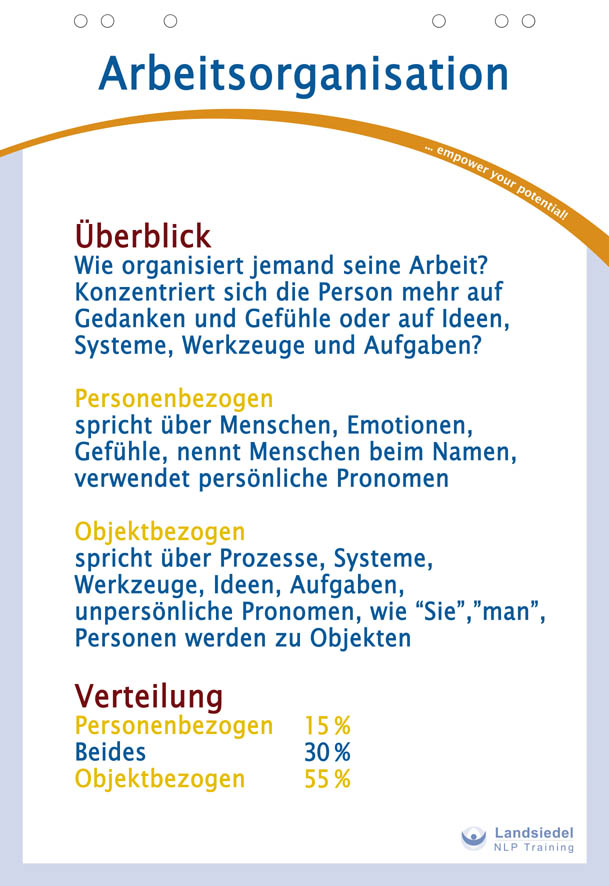
Work organization describes whether someone primarily focuses on feelings or on completing tasks at work. There are two patterns in this category:
People-Oriented:
Individuals with a people orientation focus on emotions and thoughts—their own and those of others. Emotions become so important that they themselves become the task. These people will organize their work in a way that allows them to focus on people and their feelings. They are easily able to establish rapport.
Object-Oriented:
People with an object orientation focus on products, ideas, tools, tasks, and systems. They treat people and ideas as objects and believe that emotions have no place in the workplace. They want to get their work done and are strongly task-oriented.
Questions:
Tell me about an experience at work that was (insert personal criterion). Wait for the answer: "What did you like about it?"
People-Oriented:
- talks about people, emotions, feelings
- mentions people by name, uses personal pronouns
- people are present in their sentences
Object-Oriented:
- talks about processes, systems, tools, ideas, tasks, goals
- rarely mentions people, except using impersonal pronouns like "they" or "one"
- people are treated as objects, parts of processes
Examples:
- people-oriented: "Mr. Richler was thrilled with my report. I was quite pleased with it too."
- predominantly people-oriented: "Mr. Richler was thrilled with my report. I was pleased too, because it represented quite a breakthrough for the whole company."
- equally people- and object-oriented: "Mr. Richler was thrilled with my report. It was quite a breakthrough for the company."
- predominantly object-oriented: "My report represented quite a breakthrough for the company. My boss liked it too."
- object-oriented: "My report represents quite a breakthrough for the company."
Language Patterns:
People-oriented: uses personal pronouns; names of people; emotions; thoughts; experiences; "for you"; "for others"; "the people"; "our team"; "our group"
Object-oriented: uses impersonal pronouns; things, systems; objects; tasks; goals; processes; getting the job done; focusing on the task at hand; the goal; the company.