

 DE
DE ES
ES RU
RU FR
FR ZH
ZH HI
HI GR
GR


Metaprograms of Information Processing – Chunk Size: Overview - Detail
What size are the units of information that the person handles best? Do they prefer working with the big picture or specific details?
People have preferences for how they want information to be presented and how they want to present it. From the overview to the details or from the details to the overview.
Detail:
These people first talk about the details and are primarily interested in the details when something is being explained to them. They feel especially comfortable and have a talent for remembering many details. For them, it's harder to get the big picture, and the saying "can't see the forest for the trees" applies to them. As a result, it is also difficult for these people to set priorities. They tend to consider overview types as talkative.
Overview:
These people always give you an overview first and want an overview first before they are interested in the details. For them, meaning comes from the "big picture." They think about projects in terms of the whole and not so much the individual steps and details. These people often speak at such a high level of abstraction that it can feel like they are talking about nothing or just vague generalities. They consider detail types as small-minded accountants and get bored by the many details after a short time because they can't place them into a larger meaningful context.
Classifying Questions
- Tell me what you would like.
- What is important to you at your main bank?
- I would like to explain something to you: Would you like the big picture first, or are you more interested in the details?
- What would you like to know first about this project?
- (General pattern: Listen to the different sentences and pay attention to the ratio of overview to detail.)
Recognizing and Identifying
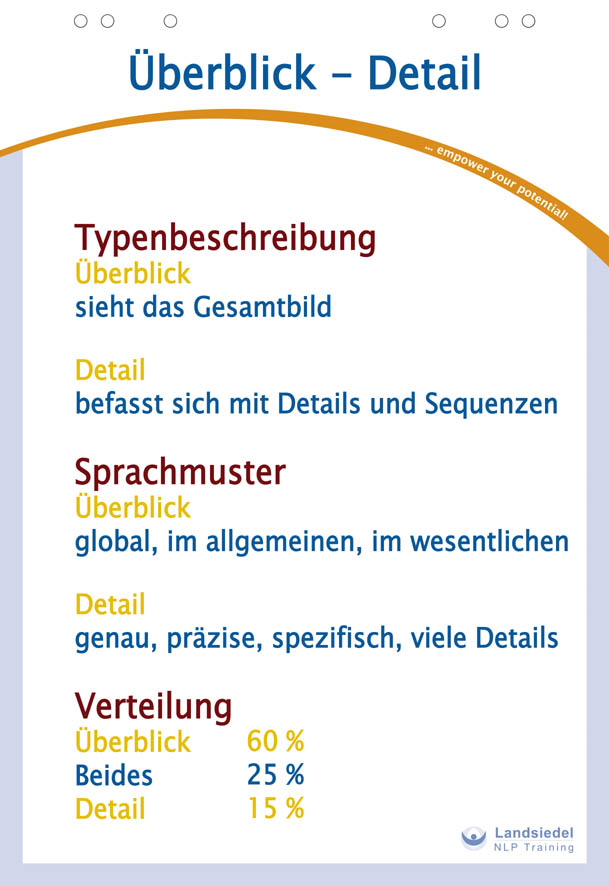
Detail: These people will first tell you all the details that seem important to them and will explain one step after another in a sequential order. When explaining and describing, they rarely provide the goal or purpose but rather the order of individual steps. If interrupted, they often start over. Conversely, these people tend to ask for many details.
Overview: These people always start with the overview, without going into the details. They describe the situation more randomly and often jump from one aspect to another, without following a specific order. They frequently use short sentences without presuppositions. When they receive too many details, they become easily bored and will ask questions about their meaning in the larger context.
Examples:
Detail:
"At my main bank, what's important to me is that it's within walking distance from my office, that they pay at least 70% interest on my deposits, and that I can handle all my banking through them."
"First, we met Ed, and then we went to the new steakhouse on Main Street, where Peter joined us later, and we all ordered filet steaks with fries."
Overview:
"I want a bank that's close by and pays high interest."
"We all went to eat together."
Statistical Distribution
Detail: 15%, Detail and Overview: 25%, Overview: 60%
Patterns in Conversation:
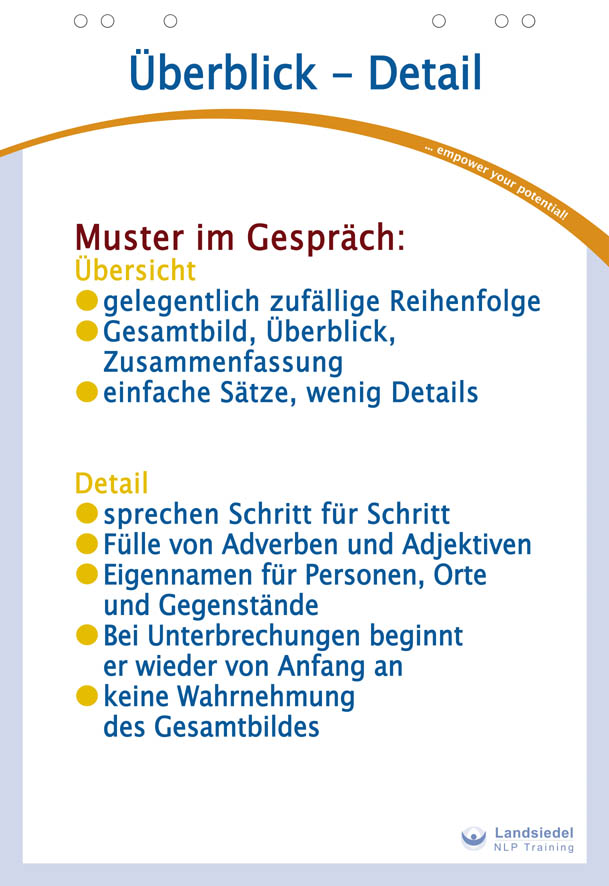
Detail speak in sequences, step by step, lots of modifiers, adverbs, adjectives, proper names for people, places, and objects. When the sequence is interrupted, the person starts again from the beginning or from where they were interrupted, seem only aware of the step immediately before or after the one they are currently focusing on. No perception of the big picture.
Overview present things occasionally in a random order, overview, big picture, summaries, concepts, summaries, simple sentences, few modifiers or details.
Language Patterns:
Detail: exact, specific, precise, thorough, first ... second ... third, then, after, before, logical, consistent.
Overview general, overall, overview, context, framework, in principle, basically.