

 DE
DE ES
ES RU
RU FR
FR ZH
ZH HI
HI GR
GR


Metaprogram: Procedure Options - Procedures
What does a person's thought process look like? Is there a constant search for alternatives, or is there a preference for following established procedures?
Optional
People oriented towards options are motivated when they have the opportunity and possibility to do something in a new way. For them, there is always a better way to do something. They love developing procedures and systems, but they have great difficulty following them themselves. If you give an options-oriented person an absolutely safe method to make a million, they will try to improve the method. Unlimited possibilities and new ideas have a tremendous appeal to them. The opportunity to break or bend the rules is irresistible to an options-oriented person. They enjoy developing new ideas and projects, but they do not necessarily feel the urge to complete them. They prefer to focus on development and preparation rather than maintenance and preservation.
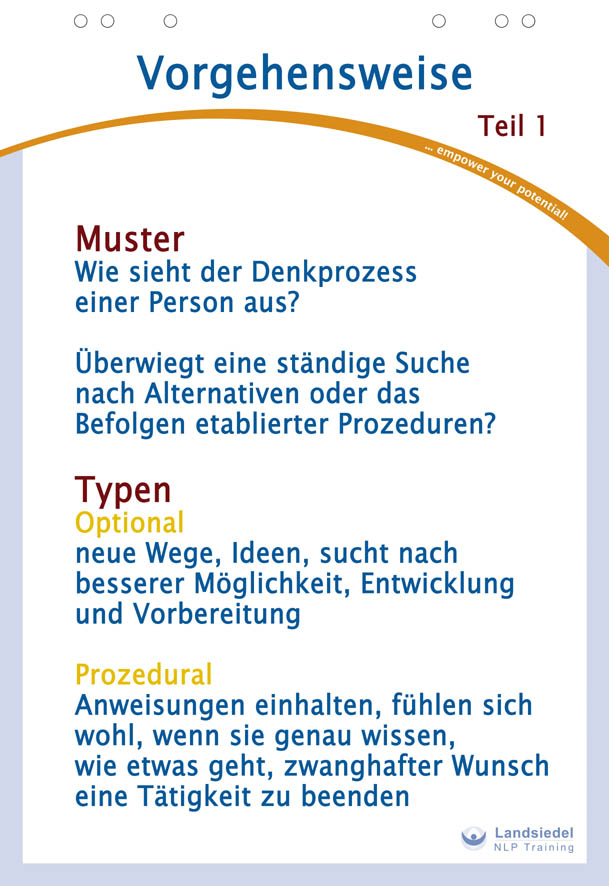
Procedural
People who are procedural-oriented are very good at following instructions and procedures. They feel comfortable and secure when they know exactly how to do something. They believe that there is a "right" or "best" way to do everything. However, if the procedure they are using does not work or no longer works and they don't get an alternative, they can easily get stuck, as their ability to invent a new approach on the spot is quite limited. They also have a compulsive desire to finish a task once they've started it.
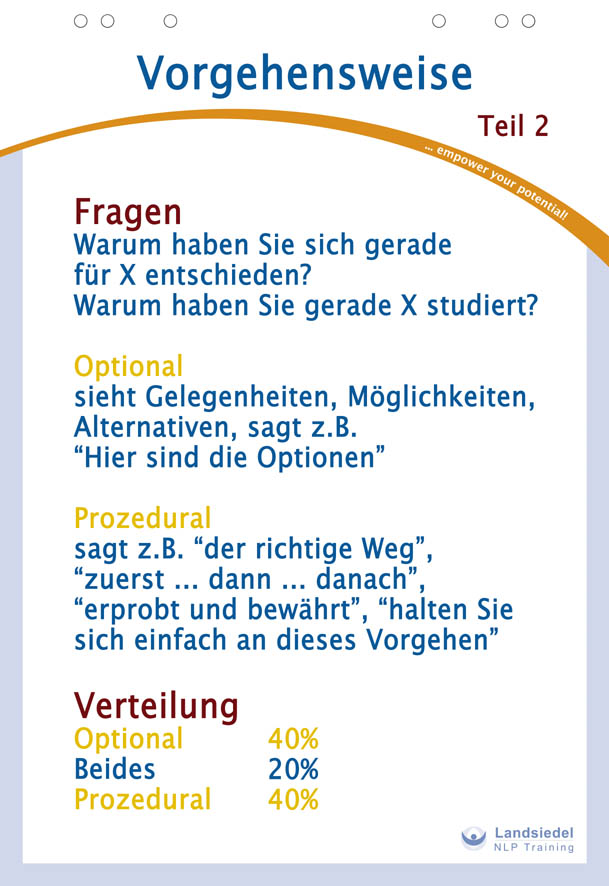
Classifying Questions
Why did you choose this bank?
Why did you study X?
Why did you buy this car?
(General pattern: "Why did you choose X?")
Recognizing and Identifying
Optional: People with this meta-program will give you reasons why they made the decision they did; they will often mention other alternatives they considered. They will point out the expansion of their possibilities.
Procedural: People with this meta-program will tell you how they ended up making this decision, but in a way that sounds like there was no meaningful alternative. Things happen to these people, or they end up in situations, etc. They do not speak about choosing, deciding, options, etc.
Examples:
Optional: This gave me the opportunity to... After a lot of back and forth, I decided on X. I've always wanted to try something different. In my new job, I have the opportunity to travel abroad frequently.
Procedural: I was driving down the main road, saw the bank sign, and immediately stopped, went in, and opened an account.
Statistical Distribution:
optional: 40%, optional with procedural: 20%, procedural: 40%