

 DE
DE ES
ES RU
RU FR
FR ZH
ZH HI
HI GR
GR


Activity Metaprogram: Proactive - Reactive
Does a person take the initiative, or do they wait for others to take the initiative?
This metaprogram allows us to predict how much energy someone will invest in achieving their life goals. Additionally, it tells us something about how quickly someone will start acting in a given situation.
Question:
When you find yourself in a situation, do you tend to act quickly after surveying the situation, or do you prefer to study the situation carefully first?
Proactive:
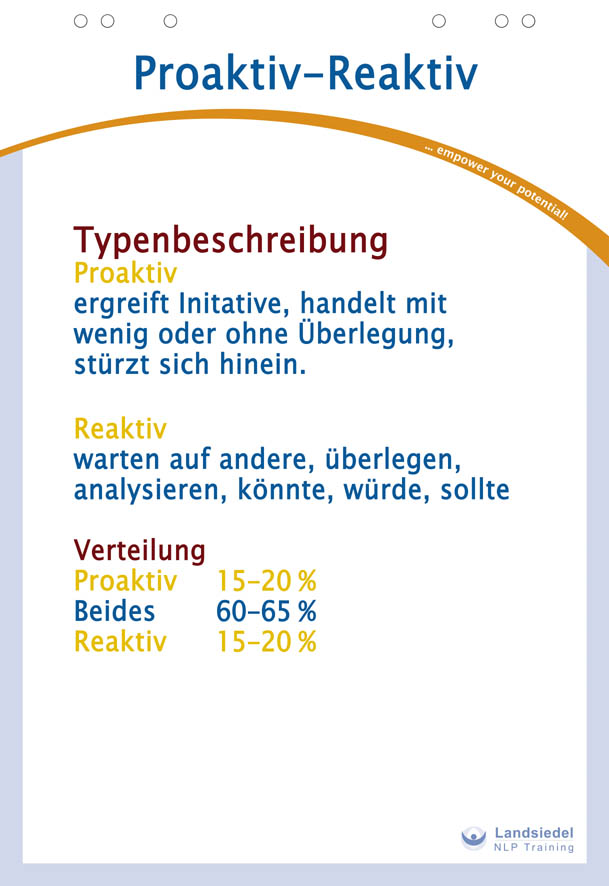
These people are active; they want to make something happen, get things moving. These are people who make history, who change the world. Entrepreneurs, doers, etc. These people go into the world and explore it, they are decisive and far from hesitant. They usually take the initiative first in any round. Of course, it’s likely they will make mistakes first, but they are also the ones who do something when others don’t dare. They dive into situations and are good at doing what needs to be done without hesitation.
Reactive:
These people tend to let things unfold rather than initiating them. The prototype would be the scientist in their ivory tower. These are more passive types. They are reluctant to jump into a situation before they have thoroughly analyzed it. They often act only when forced to. Their motto is: "Don’t rush anything!" Bureaucrats often fall into this program: "Don’t make any mistakes!" With this metaprogram, it feels as though things in life just happen. "I am a victim of my environment." These people believe in luck and fate. They spend a lot of time waiting.
Both:
Some people show traits of both types. They have the energy to do something for their goals and are also able to consider the consequences of their actions in the given situation.
Inactive:
They neither study anything nor do anything! Their motto: "Enjoy the day and let God take care of the rest." They tend to ignore events that don’t suit them. Such people are rarely found in the business world. They are more likely to be found sitting at home.
These four categories, of course, do not cover everything that exists: more refined categories can be introduced as needed, such as superactive, reflective, apathetic, etc.
Statistical Distribution
(for the work context, according to Rodger Bailey)
proactive: 15-20%, equally proactive and reactive: 60-65%, reactive: 15-20%
Recognizing and Identifying
| Proactive | Reactive |
|---|---|
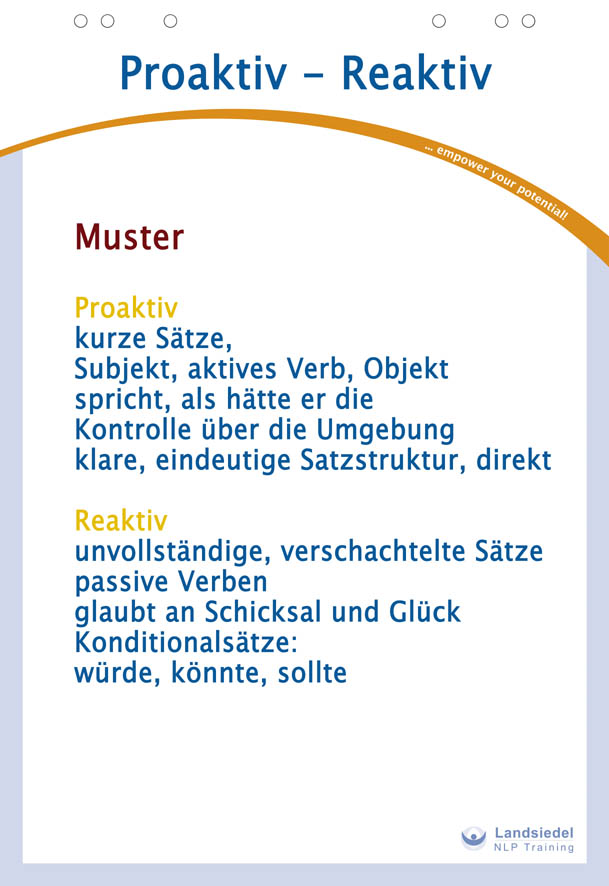
| Sentence Structure Short sentences: Subject, active verb, concrete object. The person speaks as if they have control over their surroundings. Clear, unambiguous sentence structure. Direct. In extreme cases, they roll over everything like a steamroller. |
Incomplete sentences, missing verb or subject. Passive voice or verbs turned into nouns. Many infinitives. The person speaks as if they are controlled by the world, as if things happen to them, believes in luck or fate. Long and complex sentences. Frequent mention of thinking, analyzing, understanding, waiting, or principled questions. Conditional sentences, would, could, should. Extremely cautious; need to understand and analyze. |
| Body Language Signs of impatience, speaks quickly, taps with a pencil, lots of movement, difficulty sitting still for long periods. |
Can sit for long periods without difficulty. |
| Effective Language Patterns Get started; just do it; why wait; right now; immediately; get it done; you can do x; take the initiative; take control; do what you think is right; what are you waiting for; let's hurry up with this. |
Let's think about it; after we've analyzed it; this will make it clear to you why; consider the following; this will clarify it for you; think about your response; you might consider; the time is right to ....; you will be lucky with this. |
Examples
- Proactive: "I meet with my team once a week."
- Mostly proactive: "I meet with my team when it seems necessary."
- Equally proactive and reactive: "I meet with my team to discuss current proceedings. It's important to stay updated."
- Mostly reactive: "You might wonder if it's necessary to meet with the team once a week, but I do it because it's important to make everyone feel heard."
- Reactive: "Even if everyone questions whether it's really necessary to meet every week, it's important to consider the employees' need to have their opinions heard."
Criteria
Which words will trigger a physical and emotional reaction in the person?
The terms a person uses are significant to them in a given context. They are "trigger words" because they are connected to emotions and memories.
Questions:
What do you expect from ... (your job, a house, a partner, etc.)?
What is important to you?
What matters to you?
What is indispensable for you? (Which features must a product have for you to buy it?)
What would you like to have, be or do?
Hierarchy of Criteria
Discover the hierarchy of criteria. Proceed in the same way as when uncovering a hierarchy of values.
Effective Language Patterns
Use a person's criteria to capture and maintain their interest. When someone hears their own criteria, they will immediately experience the emotions associated with those words.