

 DE
DE ES
ES RU
RU FR
FR ZH
ZH HI
HI GR
GR


Metaprogram: Rule Structure
What behaviors does the person apply to themselves and others?
The Rule Structure provides information about a person's ability or willingness to set rules for themselves and others. In this category, there are four patterns:
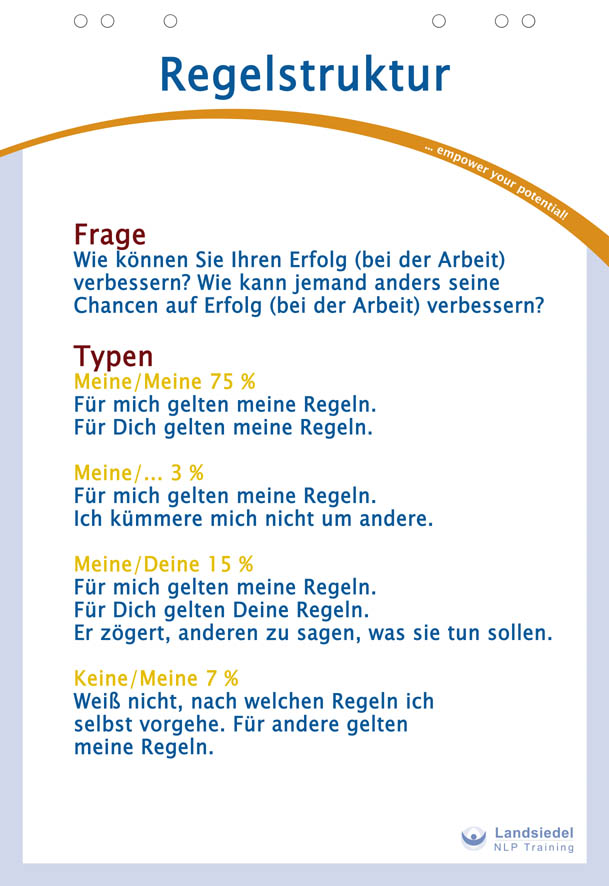
My/My: My rules apply to me/My rules apply to you
My/My individuals have rules for themselves and for others. They are willing to communicate their rules to others. Since they assume all people are similar, they believe what's good for them is good for others too. They might say things like: "If I were you, I would..." The majority of the population has this pattern in work contexts and likely other contexts as well.
My/.: My rules apply to me / Don't care
Individuals with a My/. pattern have rules for themselves and don't concern themselves with others. They don't necessarily have bad intentions toward others; it's simply not their problem or concern. These people often do what they need to do without thinking of others. Sometimes they're perceived as selfish because they consider no one but themselves.
None/My: No rules or unknown rules apply to me/My rules apply to you
None/My individuals have no guidelines for themselves or aren't aware of them, but are readily willing to pass rules to others when communicated. Consequently, they may struggle with finding direction for themselves or making decisions. They easily get stuck and don't know what to do.
My/Your: My rules apply to me/Your rules apply to you
Individuals with a My/Your pattern know which rules and guidelines to follow at work, but are unwilling or unable to communicate these rules to others. They operate from a "to each their own" perspective. Since they believe everyone is different, they would consider it arrogant to tell others what to do. This often leaves others unclear about their expectations. These are the people who can understand both sides of a conflict, however difficult this may be to accept for those of us who prefer clear positions.
Statistical Distribution:
My/My 75%, My/. 3%, None/My 7%, My/Your 15%
Pattern Recognition
Ask the following two questions and observe whether the person answers both questions or only one.
- How can you improve your chances of success (at work)? Pay attention to the answer!
- How can someone else improve their chances of success (at work)?
To identify this pattern, you'll need to compare the answers to these questions. If someone doesn't know the answer to these questions, they typically won't hesitate long before responding in an uncertain voice.
My/My:
The same answer to both questions, or the person finds it easy to answer both questions.
My/.:
Clear answer to the first question. Shows lack of interest in the second question.
None/My:
Doesn't know the answer to the first question. Has rules for the second question.
My/Your:
Has rules for the first question. Doesn't know the answer to the second question or doesn't presume to judge.
Examples:
My/My:
- 1. Work more. Better organization.
- 2. Same thing. Work more. Better organization.
My/.:
- 1. Better organization
- 2. Not my problem.
None/My
- 1. Uh, hmm... not really sure.
- 2. Better organization.
My/Your
- 1. Work more. Better organization
- 2. Every person is different