

 DE
DE ES
ES RU
RU FR
FR ZH
ZH HI
HI GR
GR


Metaprogram: Sameness - Differences
How does someone respond to changes? How often does someone need changes? Is someone motivated by the search for "differences" or the search for "equality"?
In every situation, a person's attention is either focused on equality or difference.
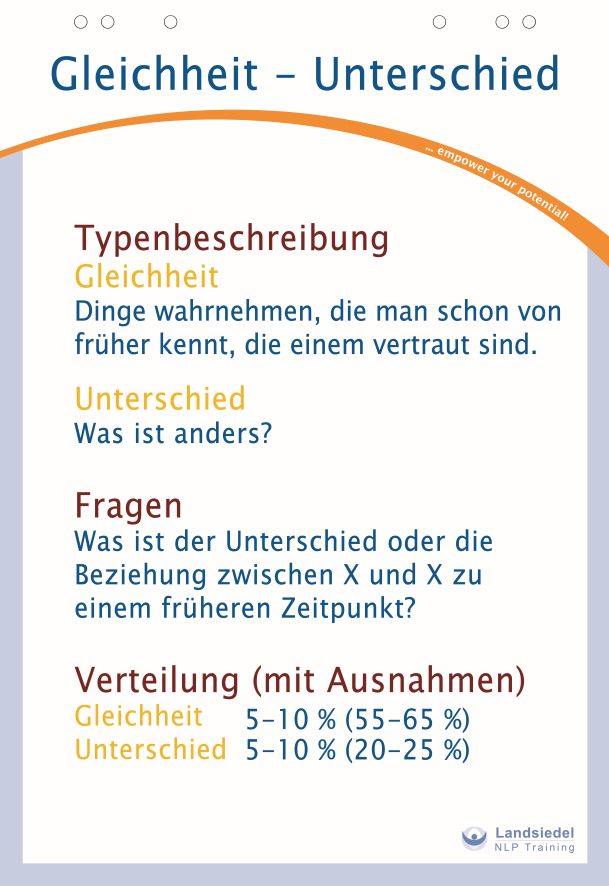
Equality:
People who tend to sort by equality are constantly paying attention to things in their environment that they already know from the past, things that are familiar to them. They prefer it when little to nothing changes in their world. They don't particularly like change. They are fine with professional changes every 15-25 years. Their motto is "There is nothing really new under the sun," and they believe in the eternal recurrence of the same.
Equality with Exceptions:
People who prefer this perceptual filter first focus on equalities, on similarities, and then begin to notice differences and distinctions. They like it when things change only gradually and slowly. They are fine with workplace changes occurring every 5-7 years. Their principle could be "Nothing should be rushed."
Difference:
People with this perceptual filter constantly observe their environment with the question: "What is different from before?" They love change, and their life motto could be "Nothing is constant except change," or they would endorse Heraclitus' statement "You cannot step into the same river twice." They despise static and stable situations, organizations, belief systems, etc. They prefer revolutionary change, change for the sake of change. They are constantly reorganizing their office, their workflows, etc. If their job itself does not bring enough change and transformation, they will frequently switch careers. They would prefer new tasks, workflows, etc., every 9-18 months.
Difference with Exceptions:
These people first notice differences and distinctions and then look for equality and similarities. They love change and variety, but it doesn't have to be revolutionary or abrupt. They are fine with changes in their job description every 18-36 months.
Classifying Questions
How would you describe what you are doing now in relation to what you did a month ago?
What is the difference between your current job and your previous one?
(General pattern: "What is the difference or relationship between X and X at an earlier time?")
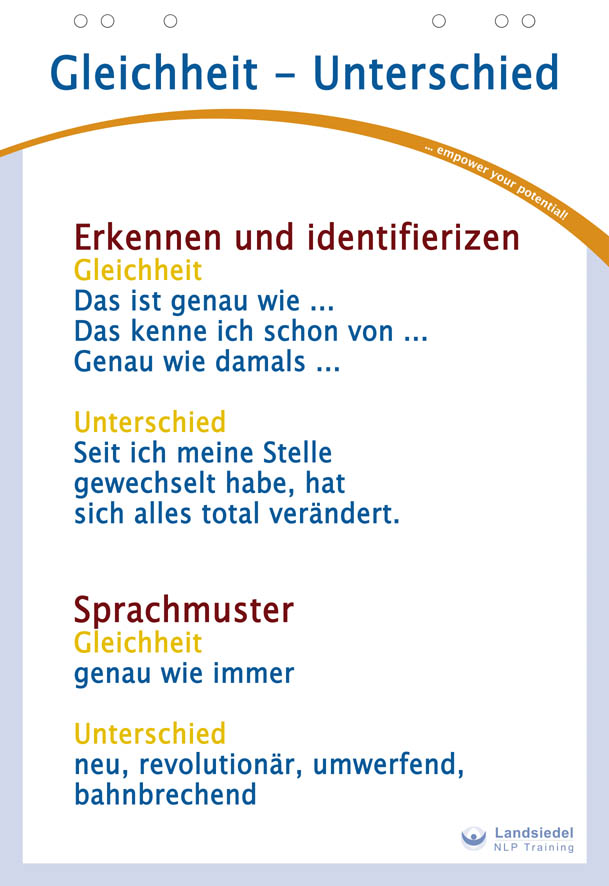
Recognizing and Identifying
Equality: These people will list all the things that have remained the same, that have not changed, and even when they point out differences, they will use phrases like: "That's true, but basically, things remain the same."
Equality with Exceptions: People with this perceptual filter always start by pointing out similarities, equalities, and agreements before mentioning the differences and distinctions. They will focus on how things have gradually changed over time. They often use comparatives like "It's better than ...", "There are more opportunities now than before.", "We have less stress today.", "It's almost the same as ..."
Difference: People with this perceptual filter incessantly point out what has already changed, how things and situations are not comparable. Even if you point out an obvious equality, they tend to say: "Yes, on the surface, that may seem like it, but essentially, it's something completely different." They use words like new, change, difference, rapid development, revolutionary innovation, etc.
Difference with Exceptions: People with this perceptual filter always start with differences, distinctions, deviations, and changes before pointing out equalities. They emphasize change and perceive equality as something incidental.
Examples
- Equality: "This is exactly like ...", "I already know this from here and there.", "This reminds me of X.", "Just like back then."
- Equality with Exceptions: "My new job is basically the same as before, except that I have more responsibility."
- Difference: "Since I changed jobs, my responsibilities have completely changed."
- Difference with Exceptions: "My role has fundamentally changed, except for the fact that I'm still sitting in the same office."
Statistical Distribution
Equality: 5-10%
Equality with Exceptions: 55-65%
Difference with Exceptions: 20-25%
Difference: 5-10%
Language Patterns
- Equality: just like, consistent quality, just like always, maintain, equality, be the same, in accordance with, repetition, repeat.
- Equality with Exceptions: bigger, better, more beautiful, more, developed, gradual, improved, evolutionary, just like with the exception of.
- Difference with Exceptions: new, different, changed, unusual, atypical.
- Difference: new, unique, revolutionary, groundbreaking, completely different, radical. People have specific preferences in their approach. Some love having precise instructions to follow, while others prefer to be given just a goal and find their own way to get there.