

 DE
DE ES
ES RU
RU FR
FR ZH
ZH HI
HI GR
GR


Metaprogram: Source of Motivation – Internal or External Frame of Reference
Where does someone find their motivation? In external sources or in internal values and beliefs?
This category deals with the source of motivation or, in other words, the locus of motivation. This pattern influences how someone makes value judgments and decisions. When you try both patterns, you can decide which one to use best in which situation; the increase in your effectiveness will soon be noticeable.
There are two fundamental ways to evaluate people, situations, events or things: internal and external.
Internal:
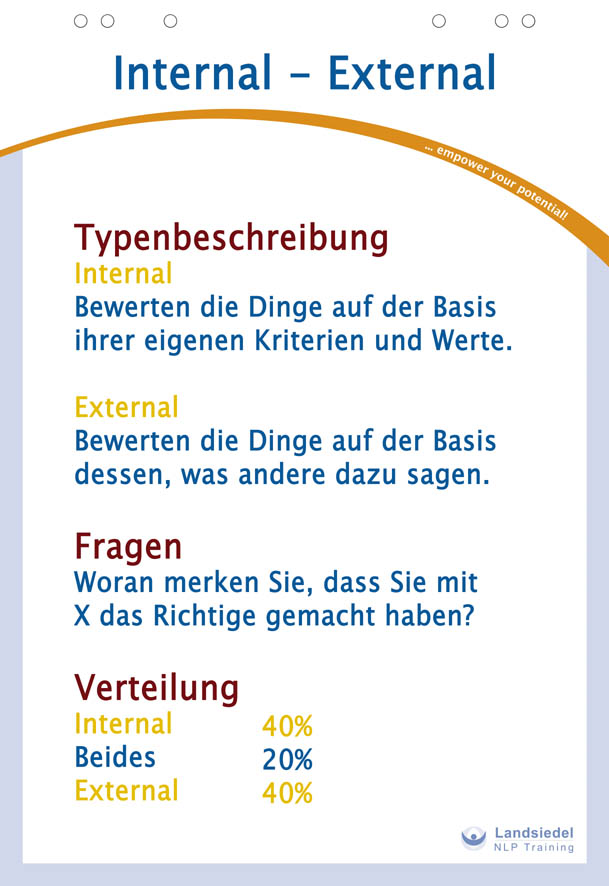
People with an internal frame of reference evaluate things based on their own criteria, values and opinions. They make up their own mind, make their own decisions and have their own motivations. They decide for themselves what and how to do things. They have difficulty accepting commands or instructions from others and aren't good at receiving critical feedback. They are certainly capable of taking note of information and opinions from others, but ultimately they decide based on their own convictions.
External:
These people tend to evaluate things and events based on what other people think about them. They need leadership and motivation from others. They have difficulty making decisions for themselves and need feedback from others to know whether what they're doing is appropriate. They struggle to start or continue a task unless someone else provides goals, direction and procedures.
Classifying Questions
- How do you know when you're right?
- How do you know when you've done a task well?
- How do you know you've chosen the right bank?
- How do you know you've chosen the right car?
- How do you know you've done your job well? Do you know it yourself or does someone need to tell you?
- General pattern: "How do you know you've done the right thing with X?"
Recognition and Identification
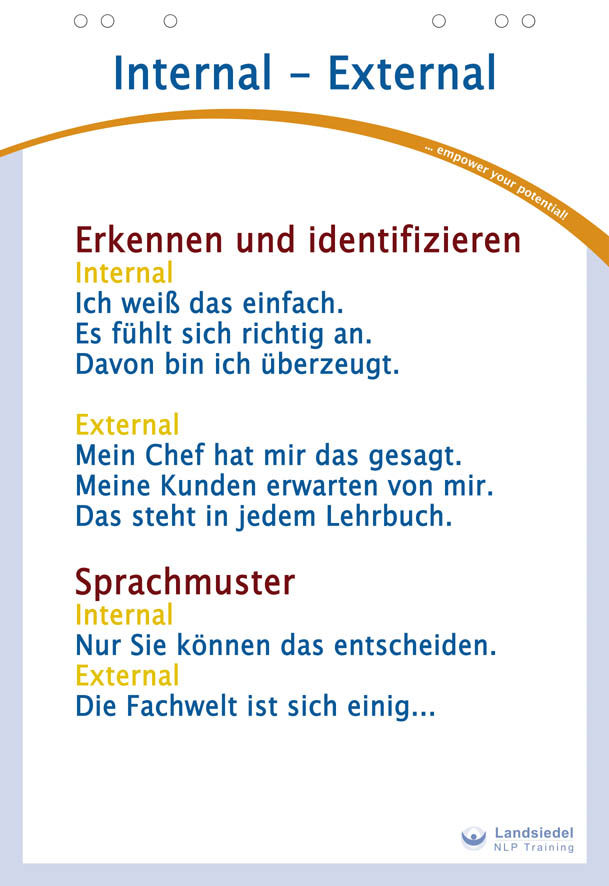
Internal: These people will tell you what they've decided. They'll inform you that this or that feels right or that they know it's correct. While they're open to being informed, they ultimately make decisions based on this information themselves. These individuals will immediately resist if someone tries to decide for them.
External: These people will tell you they know this or that because someone else told them, because it's written here or there, etc. They prefer when others make decisions for them. They behave as if the information they receive is already a decision or instruction. They need external standards and feedback to know whether what they're doing is right or wrong.
Examples
Internal: I just know it. It feels right. This is my inner certainty. I'm convinced of this.
External: My boss told me this. My customers expect me to... This is evident from the sales statistics. It's written in every textbook.
Statistical Distribution
Internal 40%, internal and external 20%, external 40%
| internal | external |
|---|---|
| Language Patterns "Only you can decide this." "The decision is entirely yours." "It's important to me that you can fully stand behind this decision." "Does this feel right to you?" "Does this meet your expectations?" "Is this also your goal?" |
"Experts agree that..." "Studies have shown that..." "Surveys have consistently found that..." "All your colleagues believe that..." "I will inform you how we..." "In my opinion you should..." Give clear instructions, praise and criticism. |
| Sentence Structure decide or know for themselves: "I just know." Evaluate their performance based on their own standards and criteria Resist when someone tells them what to do or tries to make decisions for them Instructions from others are perceived as information |
let other people or external sources decide or judge for them Need to measure their work against an external norm or standard, such as checklists or quotas External information is perceived as a decision or command. |
| Body Language sit upright; point to themselves; often pause before responding to someone else's evaluation to assess it; minimal gestures and facial expressions (within their cultural norms) |
lean forward; observe their counterpart's reaction; facial expression shows they want to know from their counterpart whether what they did or said was acceptable |