

 DE
DE ES
ES RU
RU FR
FR ZH
ZH HI
HI GR
GR


Metaprogram: Work Style
In what environment is someone particularly productive: when working alone, when involving others, or when sharing responsibility with others?
The Work Style category allows you to find out or confirm how you work best—whether you prefer collaborating with others, working independently while involving others, or working entirely on your own.
In this category, many people exhibit more than one pattern; often there is a dominant and a secondary style depending on the context. The three patterns in detail:
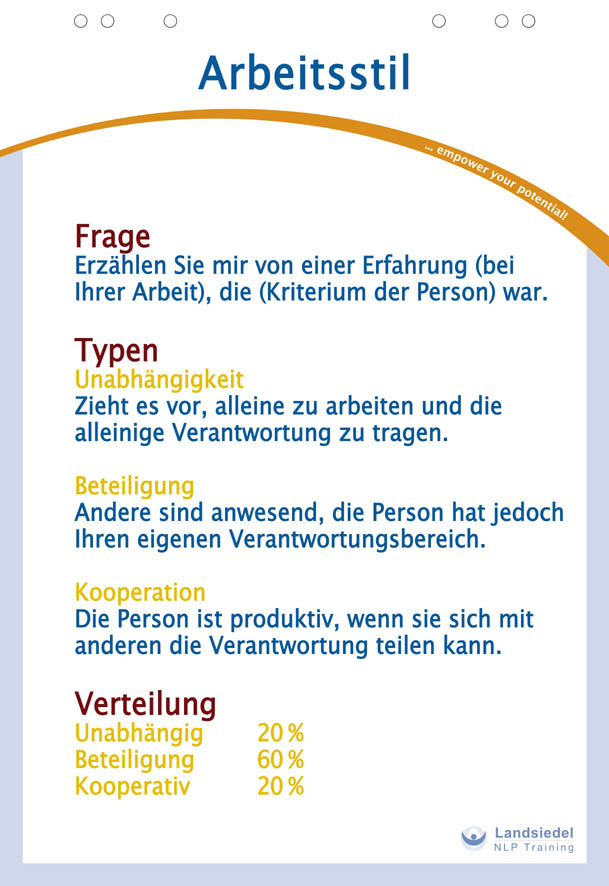
Independent:
People with an independence pattern in a work context prefer to work alone and take sole responsibility. Their productivity suffers when others are present or when they have to share responsibility. If interrupted, they easily lose their train of thought. They prefer to work behind closed doors in their office. In extreme cases, they may forget to consult others (especially if they also have an internal reference pattern). They can work for long periods without missing contact with others.
The Expression:
"A camel is a horse designed by a committee" was likely coined by someone with this pattern. As a manager, a person with an independence pattern will do most of the work alone and will likely have difficulty establishing rapport.
Involvement:
People with an involvement pattern want clear accountability but also need others to be involved in or nearby their tasks. They need clearly defined responsibilities, and in order to stay productive and motivated, their tasks must involve other people. Their productivity declines when they have to share authority and responsibilities or work entirely alone. This pattern is best suited for leading employees and managing projects.
A person with this pattern will ensure that everyone knows what they are responsible for. People with an involvement pattern are well-suited as supervisors. If they work as subordinates, their responsibilities must be clearly delineated.
Cooperative:
Cooperative individuals like to work with others and share responsibility. They believe in the principle of synergy: 2+2=5 — the whole is greater than the sum of its parts. They find it difficult to meet deadlines and complete tasks when they have to work alone. They do not need an area of sole responsibility and, when working as managers, will want to do everything together with their employees.
The California lightbulb joke applies to these individuals: How many Californians does it take to screw in a lightbulb? Six — one to change the bulb and five to share the experience.
A cooperative pattern does not necessarily mean the person "cooperates" in the usual sense of the word — it simply means they need to perform tasks together with others.
Statistical Distribution:
Independent: 20%, Involvement: 60%, Cooperative: 20%
Question:
Tell me about a work experience that was (person’s criterion). What did you like about it?
Alternatively: How long can you work alone in your office without calling or visiting someone?
Independent:
- says “I”, “myself”, “my responsibility”
- does not mention others
- the activity described implies it was performed alone
Involvement:
- others are present, but “I did it”
- may or may not mention others, but the nature of the activity requires others to be present (e.g., sales or teaching)
Cooperative:
- says “we”, “us”, “our task”, “together”, etc.
- includes others and shares responsibility
Examples:
- Independent: "I developed the new program and checked it for errors."
- Independent and Involvement: "I developed the new program and then checked it for errors together with my team."
- Involvement: "I developed the new program together with my team."
- Involvement and Cooperative: "I developed the program with my team, and then we fixed the bugs together."
- Cooperative: "We developed the new program and checked it for errors. It was a great team effort."
- Independent and Cooperative: "I developed the new program, and then we all sat down together to check it for errors."