

 DE
DE ES
ES RU
RU FR
FR ZH
ZH HI
HI GR
GR


Metaphors
Metaphors have an incredibly significant impact on communication and personal understanding.
Since ancient times, metaphors have been used as tools for teaching and transforming concepts, ideas, and attitudes toward life.
Table of Contents
- Introduction and Function
- Important Principles of Metaphors
- Metaphorical Solution
- Construction of Metaphors
- Beware of Misunderstandings in Metaphors
- Exercise for Developing Metaphors
- Symbols for Metaphors
- Collection of Metaphors
- E-Book: Metaphors – Stories that Heal the Soul
Introduction and Function
Introduction
Metaphors have an incredibly significant impact on communication and personal understanding. Since ancient times, metaphors have been used as tools for teaching and for changing perceptions, ideas, and attitudes toward life. Shamans, philosophers, and prophets intuitively recognized the inherent power of metaphors and made use of them. From Plato to Jesus, from Buddha to Don Juan and Richard Bandler, metaphors have been identified and used as powerful tools of influence.
In metaphors, people, animals, or plants face particular difficulties or find themselves in special situations. The metaphor tells how they solved the problem or managed the situation. Through this, we learn something—and perhaps the metaphor resonates with us and gives us an idea of how we might solve our own problems.
Function and Benefits
- The metaphor provides material for the unconscious to play with. The metaphor’s storyline keeps the left brain occupied, allowing the message to go directly into the unconscious; the left hemisphere has no access to it.
- The metaphor can also be effectively used in coaching, as it offers a stimulus for thinking about something in a new way. The current issue is translated into a different context and can then be viewed with more distance.
- The metaphor can often be extremely helpful for integration. A dead end dissolves through a sudden insight — even if all the metaphor does is translate information for the other hemisphere of the brain.
- Participants in seminars find the content much more familiar and accessible after hearing a metaphor related to it.
- Metaphors enhance motivation and mood. They can be effectively used to bring someone into a particular emotional state.
Important Principles of Metaphors
A) Pacing and Leading
Cameron-Bandler shares the following example, in which the current experience and the desired experience soon begin to blur, allowing pacing and leading to blend seamlessly:
"An attractive woman named Dot came in for counseling. She wanted to learn how to control her promiscuity and was seeking help for that reason. She was married to a good man (according to her description) and had two lovely children, but engaged in extramarital affairs whenever and with whomever the opportunity arose. She wanted to stop this behavior.
I used the following elements from her account to construct a therapeutic metaphor. Like many attractive women, Dot was concerned about her slim figure (even though she was by no means overweight), and so I used this topic to make the metaphor appear as a natural extension of our therapeutic interaction."
Problem Description – Therapeutic Metaphor
This promiscuity leads her to lose her husband and her self-respect. A woman on the path to obesity. Dot cannot resist the temptation that other men represent for her.
A woman who cannot resist rich desserts and good food when dining out. Dot finds extramarital sex more exciting. This woman loves dining out. Dot is dissatisfied with the sexual relationship in her marriage. This woman just picks at her own home-cooked meals.
Each extramarital encounter produces more guilt and brings her closer to losing her husband. Each meal eaten out adds more fat. Dot’s guilt becomes so painful that she feels compelled to do something about it. She can’t sleep at night, and so on. The overweight woman must change her habits. Her clothes no longer fit. Dot never developed a satisfying sexual relationship with her husband. The overweight woman never learned to cook something delightful for herself.
Up to this point, each element in the constructed metaphor is isomorphic (i.e., there is a one-to-one correspondence in structure) to the real-life problem. The elements reflect the problem through an analogous form. The next step is to move from mirroring the problem to providing a behavioral-level solution.
The desired response that the metaphor aims for is that Dot changes her behavior in a way that leads to solving the problem. The story must therefore trigger a behavioral change in the obese woman, who metaphorically represents Dot.
Dot should focus her energy on creating stimulating and fulfilling sexual experiences with her husband. The woman began to reorganize her kitchen. She started reading cookbooks to find suitable dishes and began experimenting with preparing healthy and enjoyable meals.
Dot should find the necessary satisfaction at home. Over time, more quickly than one might expect, she discovered that there was nothing in the restaurants that could match her own homemade creations, and she no longer felt the urge to overindulge elsewhere since she now found satisfaction at home. Dot is proud of her marriage and her sexual relationship with her husband. Slim and fit as she is now, the once-overweight woman is just as proud of her culinary skills as she is of her toned figure.
People respond to such metaphors without consciously trying. Something happens—but they often don’t even know exactly what.
Metaphorical Solution
B) Double Induction
Double induction is characterized by the simultaneous delivery of one or more metaphors, suggestions, or instructions to a person by two speakers. One speaker uses the person's right ear for auditory input, while the other uses the left ear. The goal is to overload conscious perception in order to transport information directly to the unconscious. Each message is processed by the opposite hemisphere of the brain, resulting in different experiences in the two halves of the body.
C) Nested Stories
When it comes to metaphorically representing complex relationships or steps in communication, working with so-called "nested stories"—also referred to as "stacked realities" or "nested loops"—is a useful approach. Structurally, this involves embedding one story within another ... and so on. The transition or shift from one story to another occurs at a moment of relative tension within the current story.
Beginning
1. Begin Story A
2. Begin Story B
3. Begin Story C
4. End Story C
5. End Story B
6. End Story A
7. End
Closing the stories is like drying washed dishes. Just as the last story started is the first one to be finished, the last dish washed is the first one to be taken from the stack to dry.
Construction of Metaphors
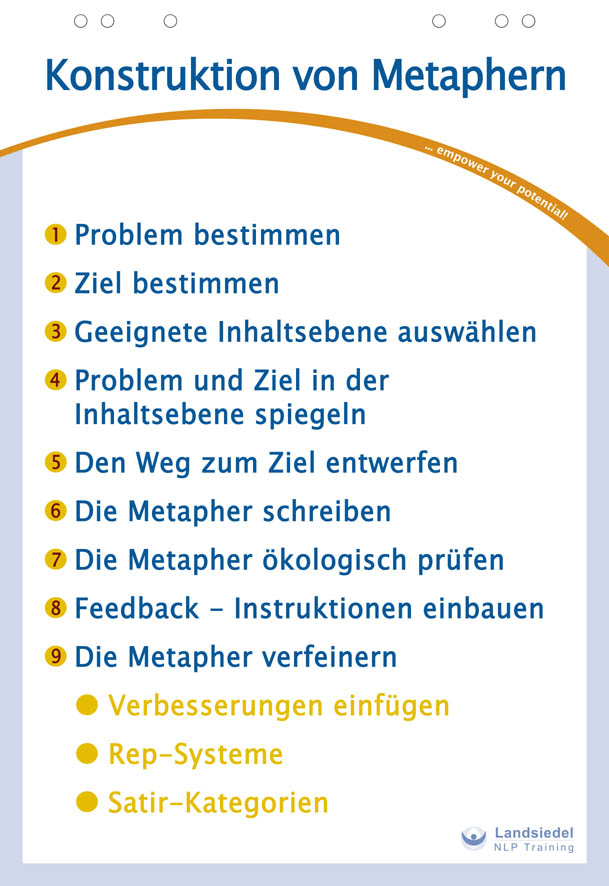
- Define the Problem:
What is it about? Who are the relevant people? What role do they play?
How does the main character act? How do the others react? etc...
Create a problem description. - Define the Goal:
What does the person with the problem want to achieve? How do the relevant others react to the behavior?
Also, document this problem solution in writing. - Choose an Appropriate Content Level:
Find a content level that could mirror the problem structure, e.g., the heavens of gods, the realm of demons, fairy tales with princes, princesses, wizards, witches, and fairies, talking animals, plants and stones, mythical creatures, and beings from the realm of science fiction, great historical figures.
Important: The content level must be interesting for the recipient of the metaphor. - Mirror the Problem and Goal in the Content Levels:
The story must be structurally similar to the problem. The therapeutic metaphor fundamentally contains the structure of the client's problematic situation, their relationships, and the context of the problem. Then, the structures and processes of achieving the goal should be mirrored in the medium of the story. - Design the Path to the Goal:
Bring in resources and build the feeling that the client is capable of handling the problem. Document the path to the goal in writing. - Write the Metaphor:
Please leave a line free after each entry. - Ecologically Check the Metaphor:
Check the ecology of the goal. Does the goal fit into the life context of a person without leading to negative consequences for their personality structure and social context? Unnecessary and dangerous insights should be excluded. Check the metaphor for discomforts that can be removed and possible interpretations and conclusions that should not be considered. - Incorporate Feedback Instructions:
Include ways to provoke physiological signals to determine whether the listener is "following along." - Refining the Metaphor
- Insert improvements
- Use NLP patterns for the path to the goal
- Mirror and Lead with Representation Systems:
Pacing the main representational system,
Leading into new representational systems to expand perception. - Mirror and Lead Satir Categories:
Placater, Blamer, Rationalizer, Distractor.
- Deliver congruently
- Hide the intention (Act as if the story is from someone else or meant for someone else)
- Trance, yes or no (usually better to anchor in trance)
- Pay attention to unconscious feedback
- Don't interpret
- Bandler and Grinder recommend professional journals
- Animal fables
- Fairy tales for children (Grimm's Fairy Tales, One Thousand and One Nights, etc.)
- Sufi stories
- The Bible and other religious books
- Internet collections
- Science fiction
- Historical metaphors (Hannibal, Caesar, Henry VIII, and many others)
- A identifies a state they want to change and defines a corresponding desired state they would like to achieve instead.
- B then interviews A using the list, first about the initial state: "If this state, this problem, this feeling... (insert the appropriate terms from the list here)... were something, what kind of... (e.g., landscape)... would it be?"
Find five to ten or more metaphors for this state, and then go through the same steps for the desired state. - B now creates a story using the discovered terms. They start with the initial situation and then smoothly transition to the desired state within the story using the corresponding metaphors.
- a flying carpet
- the main character boards an airplane
- they dream a dream
- another person appears and tells a story, etc.
- Why Metaphors Can Heal the Soul
- The Truth About Metaphors
- What Metaphors Mean and Why They Are So Effective
- How to Use Metaphors in
- How to Construct a Metaphor – Step by Step
- Tips for Presenting Metaphors in Training Contexts
- They offer people a suggestion of what the truth could be
- They provide solutions without overwhelming
- They show or illustrate things, structures, and situations to people
- In individual coaching, the question is often helpful: "If this state were a landscape, a plant, an animal, a fairy tale, a sound, a movement, the weather, a fruit, or a sport, what would it look like?" From the answer, further work with the metaphor can follow.
Example
Client: "This state is like a bird locked in a cage."
Coach: "What would the bird in the cage need?"
Client: "It needs more space to spread its wings."
Coach: "What would give it more space to spread its wings?"
Client: "If it could leave the cage."
Coach: "What prevented the bird from leaving the cage until now?"
Client: " ........." - In conflict resolution, metaphors are frequently used.
Example
Client: "This colleague treats me like a five-year-old little boy!"
Coach: "What behavior from the colleague would make you feel treated as an adult?"
Client: " ........." - In the training context and in lectures, metaphors help make content better understood and retained. Participants often remember the stories even after years. They also provide entertainment, variety, and brevity.
A example about the priority in customer contact. It is often desired in the training context to remind employees that the customer should be the top priority. Unfortunately, this is often underestimated in retail customer service or on the phone. To highlight this, I like to say: "In the clothing store, it often feels like I can tell by the behavior of the salespeople: I MUST BE INVISIBLE!" - In a consulting conversation, metaphors can "illustrate" situations.
An example of a leader who frequently put unnecessary time pressure on himself: "A man, completely out of breath, runs to the boat dock, throws his suitcase onto the ferry three meters away, jumps after it, pulls himself aboard with his last strength, and sighs in relief: 'Just made it!'"
"Not too bad," says the sailor who had been watching him, "but why didn’t you just wait until we docked?" - In child education, metaphors are a very powerful tool. As shown by the story of the porcelain cup at the beginning.
An example of encouraging a child or adolescent to realize their potential and overcome limits is this story: "At the University of Heidelberg, students conducted a flea experiment: They placed fleas in a glass container that was open at the top. What happened was predictable: the fleas hopped cheerfully and jumped out of the container. A few times, the students put the fleas back in the container, and just as quickly, they were free again. Then the students closed the container with a lid. The fleas tried again to escape the container and kept bumping their heads against the lid. After a while, the fleas settled for staying in the container. Even after the lid was removed, the fleas surprisingly kept their low jumping height, so they no longer left the container. The students then added new fleas to the container with the others. The 'newcomers' quickly observed the general jumping height and immediately adapted to it."
In a situation, metaphors are suboptimal when there is time pressure.
A metaphor in dealing with people whose focus is on numbers, data, and facts was quickly disproven as unsuitable. This is because these people readily accept metaphors, as they provide material for the unconscious mind. - Metaphors have great significance in communication and for personal understanding.
- Shamans, philosophers, prophets, and Jesus intuitively recognized the inherent power of metaphors and used them.
- They are used to change perceptions, ideas, and life attitudes.
- The red thread of the metaphor drives away the rational mind (left hemisphere), allowing the message to go directly into the unconscious. The rational mind (left hemisphere) has no access to it.
- Learning
School, survival, little chicks, young animals, driving a car, computer - Self-confidence
Foundation, building, predators, rocks - Creativity
Nature, music, theater, drawing, colors - Decision
Fall of the Berlin Wall, dinner, economy, career - Motivation
Athlete, Mozart, Michelangelo, experiences of success - Conflicts
Gandhi, fairy tales, archetypes - Time
Seasons, clock, Einstein, growth of trees, moon, children - Self-Realization
Butterfly, Leonardo da Vinci, the ugly duckling, flower - Determine the Problem
What is the problem about? Who are the relevant people involved in this problem? Who plays which role? How does the person experiencing the problem behave? - Determine the Goal
What does the person with the problem want to achieve? How do they want to behave? How do they feel when they reach their goal? - Choose an Appropriate Content Level
Look for a content level where you can mirror the problem structure. Everything is possible depending on your preference. Fairy tales, fables, science fiction, ... - Mirror the Problem and Goal in the Content Level
If a story is meant to solve problems, it must be structurally similar to the problem. The therapeutic metaphor generally contains the structure of the client’s problematic situation, their relationship, and the context of the problem. - Design the Path to the Goal
How does the hero or heroine of the story reach their goal? Consider resources that the recipient of your metaphor might also use to achieve their goal. - Write the Metaphor
Let your imagination run wild while keeping in mind the structure. - Check the Ecology of the Metaphor
We call a goal "ecological" if it fits into the person's life context without having negative consequences for their personality structure and social connections. - Speaking quickly indicates: stress or fear, that you are at the end of your strength, disappointment or despair, impatience or rush, anger or rage.
- Speaking slowly indicates: shock or disbelief, boredom or lethargy, fear or concern, controlled anger, exhaustion or fatigue, resignation or defeat.
Beware of Misunderstandings in Metaphors
"A very competent woman who worked in a social-therapeutic residential community wanted a woman with schizophrenia to spend more time in the common room so that she would come into more contact with others and spend less time in isolation. So she told her a story about a beautiful rose that was blooming in a shady, damp corner of a backyard. One day, the gardener noticed this rose, cut it, and placed it in a vase in the entrance hall, where everyone passing by could see and admire it...
The next day, the young woman slit her wrists to gain attention (just like the gardener had cut the rose)!"
You can never completely prevent someone from finding an interpretation that you didn't intend them to make; but you can at least be careful enough to make it hard for them to go down the wrong path. Therefore, check your metaphors for unintended meanings, ambiguities, presuppositions, and possible interpretations. Of course, a good metaphor also thrives on these processes.
Phrases like "kick the bucket" have two meanings: a literal one and that someone dies. Every time such an expression is used, both meanings are registered.
Delivering Metaphors
Just as important as the construction is the way the metaphor is ultimately delivered. An optimal rapport is extremely important. In groups, it's best to pace the three main representational systems.
Sources for Metaphors
Exercise for Developing Metaphors
The transition from one state to the other can take place in many different ways:
Worksheet for Developing Metaphors
If this state were a ......?
Landscape
Color
Fairy tale
Idol/Hero
Vehicle
Beverage
Temperature
Sound
Music
Taste
Bird
Plant
Weather
Animal
Symbolism for Metaphors
| Symbolism | Meaning |
|---|---|
| Abyss | Fear of falling/crashing down |
| Harbor | Arrival, home, safety |
| House | Security, a symbol of the person themselves and their current state |
| Insects, maggots | Something is rotten; Flies: something is annoying; Butterfly: transformation; Bees: diligence |
| Juggler | Desire to do various things well and elegantly at the same time |
| Cactus | Shyness about touch/being touched |
| Circle | Perfection, complete harmony |
| Teacher | Inner advisor |
| Lily | Rebirth, transformation |
| Magician, wizard | Someone who has the power to transform their inner spaces |
| Magnet | What attracts us |
| nudity | Unprotected, open, sensuality |
| Fog | Something that rests hidden, slow progress |
| Oven | Hatching an idea, resting |
| Oil | Fueling the fire, calming the waves |
| Package | Letting something go |
| Perfume Sensuality | Loss of self-control, feeling like a victim |
| Puzzle | Lack of clarity |
| Pyramid | New level of consciousness |
| Rainbow | Pot of gold at the end of the rainbow, completion |
| Journey | Change and growth |
| Shadow | Untapped potential, hidden "good intention" |
| Ship | Person in their emotions |
| Dance | Loss of self-control, feeling like a victim |
| Tunnel | Constrained, altered state of consciousness, inner path to oneself |
| Weather | Emotional state |
| Meadow | Balance, connection with nature |
| Room | An aspect of the self |
E-Book: Metaphors – Stories That Heal the Soul
In this e-book, you will learn:
Wishing you much fun and joy while reading and trying out, from author Stefie Rapp and publisher Stephan Landsiedel!

In my NLP Master training, I first consciously encountered the topic of "metaphor." Fascinated from the very first moment, I entered into a love relationship with it that still lasts to this day.
Why Metaphors?
When I delved deeper into the topic of "metaphor," I realized how powerful and helpful the use of a metaphor is. Since then, I have been using metaphors every day in my professional context: in training to illustrate concepts, in one-on-one coaching to find solutions in a figurative or metaphorical sense, in conflict resolution, and in employee conversations, to give the conversation partner the opportunity to discover their own "solution" or "truth." I would now like to share this insight with you and provide you with tools that will help you quickly develop effective metaphors.
The Truth About Metaphors
"Truth knocked at the door of people, but
no one answered, as she was naked.
The parable found Truth alone and freezing.
She took her home.
There, she dressed Truth in a story.
When Truth knocked on people's door again,
they opened it, and sat around the fire together late into the evening."
(Author unknown)
This chapter is like a visit to a nursery where you can buy different seeds. You can choose what kind of seeds you want to purchase and what fruit or flowers will grow from them. It is in your hands whether your seed will sprout and bear fruit or whether it will be forgotten.
Meaning:
Metaphor translates to "a figurative expression." The term comes from the Greek, metaphorá, meaning "to carry elsewhere" and "transfer."
Example:
Trust is like a beautiful porcelain cup. Once it falls and breaks, it might be glued back together and it may be possible to drink from it again. However, it will never be as beautiful as it once was. I used this metaphor to explain to my then 7-year-old son how important it is to tell the truth, because otherwise, "trust" between him and me changes. I told him this story when I suspected he wasn’t entirely truthful at that moment.
Why are Metaphors such a Powerful Tool in Communication with People?

Every metaphor offers meaning; this creates or deepens our understanding. It tells us a story that consists of a single word or expression. It can show us the ideas of other people. However, if we do not grasp the nature of metaphors, they can even think for us.
At some point in their life, many people encounter a metaphor that deeply moves them or will accompany them for a long time.
This metaphor still moves me today:
"Millions of years ago, when the Earth was created, creation made the duck and placed it in a pond. The duck was fed and had nothing to worry about. Therefore, it had no responsibility. After a while, creation made the eagle. This had a much more exciting life. It could reach the highest peaks of the world, soar high in the sky, and enjoy its boundless freedom. However, it had to find its own food and thus take responsibility for its own life.
Now creation made humans and gave them the choice between the boring life of a duck and the exciting life of an eagle. But then something happened. When the humans looked at the duck, many only wanted to enjoy the advantages but did not want to pay the price. Then they looked at the eagle, and here too, they only wanted to enjoy the advantages that the eagle's life brings. But they didn't want to pay the price for that either. And so, as it had to happen, most humans simply could not decide: Duck or Eagle? Creation made this the human's life task. Since then, two souls have lived in their chest: the soul of a duck, who always quacks and never looks beyond the edge of its pond, and the soul of an eagle, who flies free and majestically in circles, enjoying freedom. Every person has both within them and knows both states: that of a problem-seeking duck and that of a solution-oriented eagle."
Metaphors are usable in almost every context, here are 5 application areas:
The Meaning of Metaphors – Why Metaphors Work
Construction Aids for Metaphors
To have ideas for constructing metaphors, here is a small collection of themes that are often considered the subject of a problem in practice. In a brainstorming session, appropriate "transfers" were sought. If there are difficulties with the topic of Learning, a metaphor with the content "school, survival, little chicks, ... " might offer a possible solution.
Constructing Metaphors in 7 Steps
Tips for Presenting Metaphors in Training Contexts
Use body language so that the listeners can see what you are saying. The difference between INSIDE and OUTSIDE moments. When a significant action or reaction occurs, always step INTO the story and SHOW that moment rather than describing it. Bring metaphors to life.
OUTSIDE: Address the audience directly. Make eye contact with the audience. Speak in a narrative voice in the past tense.
INSIDE: Do not address the audience directly. Avoid eye contact with the audience. You are in an imagined, imagined reality here and now. Speak in the present tense. Show very personal, private behavior.
The distribution of INSIDE and OUTSIDE moments should be 20 to 80. INSIDE moments are like spices. Don’t use too much. Think of INSIDE moments as cayenne pepper. Too much is too much.
Body Language, Movement, and Gesture
When you say:
"I bend down to pick up my bag" – bend down and pick up the imagined bag.
"I stubbed my toe on the edge of the desk" – stub your toe and feel the pain.
"I walked over and opened the door" – take a few steps and pantomime opening the door.
In every context: Use your voice so that your listeners hear and feel what you’re saying.
Use fast and slow speaking phases.
You will see, when you begin to work with metaphors, they will become indispensable in your life. People will tell you how long your story has stayed with them. You hold the power to decide whether this seed will grow and bear fruit or be forgotten. You decide whether it gets water and nutrients, or not.
Take speaking pauses. If you want to emphasize a word, take a pause right after it. This gives the word time to have an impact.
Play with your words until they feel right.

Stories hit home. Stories heal.
References
Story Power (Vera F. Birkenbihl)
Metaphors – Learning Book (Alexa Mohl)
Duck or Eagle (Ardeschyr Hagmaier)
The Story Theater Method (Doug Stevenson)