

 DE
DE ES
ES RU
RU FR
FR ZH
ZH HI
HI GR
GR


Fundamentals of the Diamond Technique
The Diamond Technique is a very nice complement to other NLP techniques. It can be used both as a problem-solving method and as a creativity technique. Its goal is not necessarily to solve problems, but rather to dissolve them — that is, to gain entirely new perspectives and insights, which often result in the problem being seen or understood differently.
Diamond Technique: Level I
This section first introduces the basic Diamond. Later, it can be expanded into complex Diamond networks.
Step 1: From Problem to Goal
The starting point of the Diamond Technique is a problem or limitation. From this, a goal to be achieved arises. This goal should be well-formed, meaning, for example, it should be positive, specific, and within one’s own control.
- Is it within your power to achieve the goal?
- What can you do to reach your goal?
- If you had already achieved the goal, what would that mean for you?
- Is that allowed? ....
At the beginning of the Diamond Technique, there is always a statement (e.g., "I lose at chess") and a corresponding counter-statement is formed (e.g., "I win at chess"). This counter-statement usually represents a negation of the original statement.
Two types of negations can be distinguished:
Negation 1: lose – not lose
Negation 2: lose – win
A first-level negation would contradict the first criterion of well-formedness, as a goal must be formulated positively. The counter-statement does not always have to be a classic negation—it can also simply consist of a juxtaposition of two different moments.
Step 2: Discovery of the Both-And
What includes both the statement and the counter-statement? That’s still a bit complexly phrased. More understandably, the next Diamond question is:
"What do the problem and the goal have in common?"
"What is shared between losing and winning?"
Answering this question requires entering an entirely new dimension of understanding the problem. In doing so, the client dissociates from their problem.
The clear distinctions between good and bad are questioned and loosened at this point. This happens simply through the form of the question, without needing to explicitly address it. This marks an important step toward problem dissolution.
Problem-solving: reaching the goal within the existing framework of the problem.
Problem-dissolution: leaving the existing framework.
Applied to the example of losing and winning in chess, a "both-and" could be that it is a game where someone wins and someone loses—or it ends in a draw—so it’s always a zero-sum game.
Step 3: Discovery of the Neither-Nor
What is neither the problem nor the solution?
What lies beyond the statement and the counter-statement?
What lies beyond the problem and the solution?
In the chess example, it could be that the game was simply fun, regardless of winning or losing. This position allows for a relativization of the problem and opens up new perspectives. Through this position, the Diamond Technique can also be seen as a creativity method.
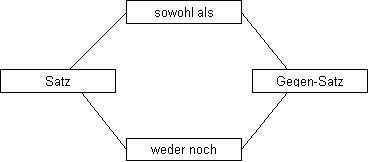
A figure with these four elements is called a Diamond. The Diamond Technique involves creating such Diamonds. After fully immersing oneself in each of the four points, one can begin to move from one Diamond point to the next.
Level II of the Diamond Technique
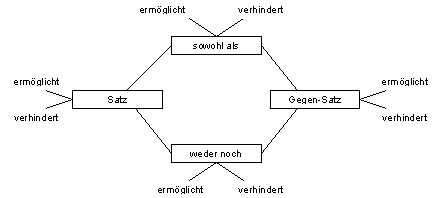
The possibilities of the Diamond Technique increase significantly when the following two questions are added:
- What does this make possible?
- What does this prevent (make impossible)?
The question about what something enables is known from Core Transformation. There, one essentially asks: What is X good for? Because many things—especially negative ones—only make sense through their function. Therefore, it's important to ask: What is the problem good for?
The question about what is prevented—what is “dis-enabled,” so to speak—is familiar in NLP from the so-called Ecology Check. When a well-formed goal has been developed, it's standard practice to ask whether there are any negative consequences of the change.
These two questions from the second level can be asked at any of the four points of the Diamond.
Summary
Start with a problem:
- Define the corresponding goal (well-formedness!)
- What do the problem and the goal have in common?
- What lies beyond the problem and the goal?
- For each of the four points, determine what is enabled and what is prevented.
- Then return to the original problem and the intended goal.
It will often be the case that both the problem and the goal are now viewed in a completely new light. Then it can sometimes be useful to start a new base Diamond with the updated view of the problem and the corresponding goal. However, in many cases, this is no longer necessary. A problem dissolution has often already occurred. Typical signs of this include:
- new perspectives and viewpoints regarding the original problem
- a much friendlier attitude toward one's own problems
- significantly increased flexibility and confidence in dealing with problems
- the problem is no longer perceived as a problem at all (but rather as an opportunity, a challenge, or even a resource)
Practice Suggestions:
- Choose a theorem for your work and go through the Diamond process with it.
- Take one of your goals and go through the Diamond with it. Create multiple Diamonds.
- Send your mission statement through the Diamond. Let your creativity unfold.
- Choose an NLP presupposition and go through the Diamond with it. Form multiple opposites and develop a Diamond fan. How do you feel afterward in relation to the NLP presupposition?
- Choose a problem and go through the Diamond with it. Create several Diamonds in a network.
Diamond Map
"The problems of today are the solutions of yesterday! The solutions of today will be the problems of tomorrow."
If you add another Diamond to the left of a base Diamond, the following image emerges:
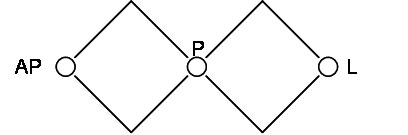
Now there is a new point on the left, referred to here as the old problem (AP). The problem (P) is no longer just a problem, but also suddenly a solution to an old problem. A new question arises: For what problem was the current problem a solution? In this way, additional Diamonds can be connected to the left.
This ambiguity of Diamond points increases even further when we look at the extensions in the other directions as well. One can also take the both-as-well or neither-nor point as the starting point for a new Diamond. The point becomes the statement, for which we seek the counter-statement and then both-as-well and neither-nor.
However, it happens that points are assigned multiple times. For example, when extending the Diamond from the both-as-well point, the counter-statement point of the old Diamond is simultaneously the neither-nor point of the new Diamond. As the base Diamond expands, each point takes on a multiple function.
The linguistic form does not have to be identical — different terms can serve as the starting point for the question of how the terms are related for the user and what connections exist.
The multiple assignments are both a strength and a weakness of the Diamond technique. The weakness lies in the danger of confusion and sometimes in the lack of conceptual alignment of terms. However, the great strength of multiple assignments lies in the high visual clarity of the complex relationship and the "relativization" of terms. The emerging network clearly illustrates that no point represents something absolute on its own.
The Diamond Technique can be seen as a special form of reframing, i.e., as the creation of a new frame. This is certainly true to a large extent. Much indicates that the effectiveness of the Diamond is based on the principles of reframing. After all, it enables the respondent to view the original problem in a completely new light and from a completely different perspective.
The Diamond Technique, however, goes beyond previous reframing methods. It does not just create a new frame, making the old image seem altered, but it also makes the frames themselves and the creation of these frames visible to the respondent. The client gains access to their own creation of meanings — and thus also to their transformation.
Practical Tips
- Especially when asking about prevention, it is important to ensure that the answer is truly positively framed for the client. (If in doubt, one must ask again.) For example, if the answer to the question of what is prevented by professional engagement is "the danger of unemployment," little is gained. No price would be visible, and the old good/bad schema would remain untouched. A real price only emerges when something like "time with family" is mentioned, which is actually of positive importance to the client.
- The Diamond unfolds its transformative power best when the points mentioned have both cognitive and emotional significance for the respondent. Neither purely intellectual engagement nor solely emotional experiences will fully harness the strength of the Diamond.
- When both a cognitive and an emotional aspect are ensured, it has proven beneficial to work with nouns, i.e., nominalizations. (This goes against the usual practice in, for example, NLP work.) The reason is not only that it makes the notation much easier and more organized, but the use of nouns and keywords also prevents getting into explanatory and off-topic conversations. The Diamond format is most effective when the practitioner can stay fully connected with themselves and their internal map. The precision and effectiveness of the counseling process are greatly enhanced by this.
- It is important to give the respondent time for their answers. Often, a format that is rushed through has little transformative effect. Those Diamond interventions that truly made a difference usually had at least one moment where the respondent paused and reflected. Such moments should never be interrupted, for example, by trying to "help" them with suggestions during their answer.