

 DE
DE ES
ES RU
RU FR
FR ZH
ZH HI
HI GR
GR


The R.O.L.E Model
from the book "Modelling with NLP" by Robert Dilts
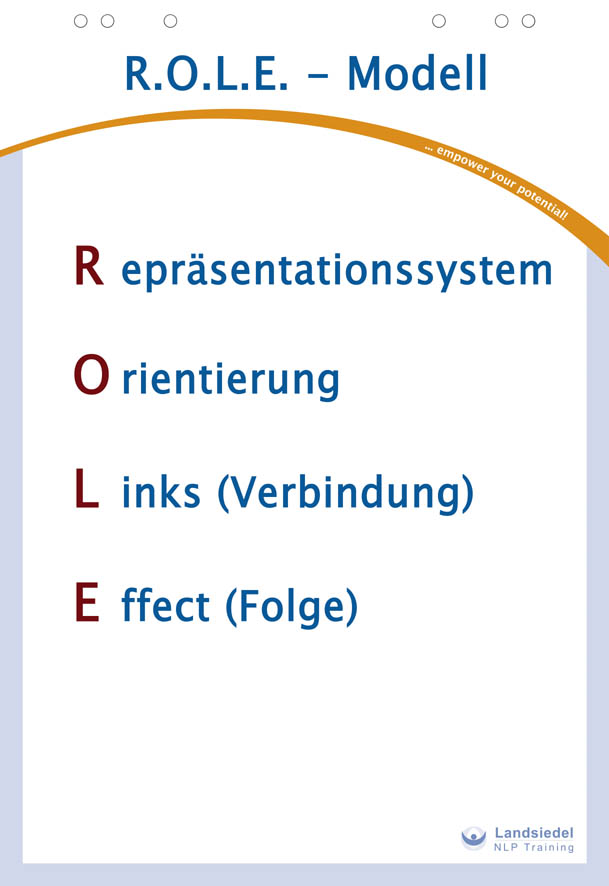
The term R.O.L.E model was introduced by Robert Dilts in 1987 to describe the four fundamental NLP elements that play a role in the modeling of cognitive strategies. The goal of the R.O.L.E modeling process is to identify the essential elements of thinking and behavior that lead to a particular response or desired outcome.
This means identifying the critical steps of the mental strategy and the role that each step plays in the overall neurological program. This role is determined by the following four factors; the four letters that make up the name of the R.O.L.E model stand for: Representational Systems, Orientation, Links, Effect.
Representational systems refer to which of the five senses is dominant for each mental step in the strategy: visual (seeing), auditory (hearing), kinesthetic (feeling/touching), olfactory (smell), gustatory (taste).
Each representational system is designed to perceive certain basic qualities of experience. These include characteristics such as color, brightness, tone, volume, temperature, pressure, etc. These qualities are called submodalities in NLP, as they are subcomponents of each representational system.
Orientation has to do with whether a particular sensory representation is externally oriented toward the outer world or internally toward remembered or constructed experiences. For example, is something you see in the external world, in your memory, or in your imagination?
Links have to do with how a particular step or sensory representation is connected with other representations. For example, is something seen in the external environment associated with internal feelings, remembered images, or words?
Is a particular feeling connected with constructed images, memories of sounds, or other feelings?
Representations can fundamentally be connected in two ways:
sequentially and simultaneously. Sequential links act as anchors or triggers, so that the representations follow each other in a linear chain of events. Simultaneous links are expressed as synesthesias. Synesthesias involve the ongoing overlap between sensory representations. Certain qualities of feelings can be linked with certain qualities of mental imagery — for example, visualizing the shape of a sound or hearing a color.
Certainly, both types of links are essential for thinking, learning, creativity, and the general organization of our experiences.
The effect concerns the result, consequence, or purpose of each step in the thought process. The function of the step could, for instance, be to create or input a sensory representation, to examine or evaluate a particular sensory representation, or to act in order to change part of an experience or behavior in relation to a sensory representation.