

 DE
DE ES
ES RU
RU FR
FR ZH
ZH HI
HI GR
GR


Sleight of Mouth
A few words can change a person’s life—for example, by transforming a limiting belief into a broader perspective that opens up more possibilities. The right word at the right time can have an incredibly positive impact. But words can just as easily confuse and limit us as they can enrich us. The wrong word at the wrong time can be very painful and damaging.
With the help of the Sleight of Mouth patterns, core beliefs can be established, changed, or transformed. These patterns can therefore be described as verbal reframings for beliefs.
Introduction to Sleight of Mouth
The term Sleight of Mouth is derived from the term Sleight of Hand – "magic tricks" or "sleight of hand illusions."
The word "Sleight" comes from an old Norse word meaning "clever," "artful," or "skillful." Sleight of Hand refers to the kind of magic performed by card magicians. This type of magic typically involves the apparent disappearance of objects, as expressed in the phrase, "Now you see it, now you don't." For example, someone places an Ace of Spades on top of a deck of cards, but when the magician picks it up, it has "transformed" into the Queen of Hearts. The verbal patterns of Sleight of Mouth have a similarly "magical" quality because they often lead to dramatic shifts in perception and in the assumptions on which certain perceptions are based.
Sleight of Mouth patterns can be used to help the conversation partner more closely examine their untested assumptions or to more carefully scrutinize the validity of claimed universal truths. This alone reduces the limiting power of any belief and opens up new perspectives and possibilities. It is often less about what one cannot do and more about what one has never even considered.
The Sleight of Mouth patterns include fourteen clearly distinguishable types of verbal reframing, which help reconnect our generalizations and mental models of the world with our experience and with the other aspects of the meta-structure (inner states, expectations, and values) of our beliefs.
The different Sleight of Mouth patterns help us by encouraging us to:
- re-punctuate and chunk our perceptions,
- identify and appreciate different perspectives and models of the world,
- discover the internal strategies we use to evaluate reality and through which we develop and update our beliefs,
- explore how we develop mental maps that shape our expectations, find causes, and give meaning to our experiences of the world,
- recognize the influence of internal states on our beliefs and attitudes,
- pace the natural process of belief change,
- better understand the effects of language and beliefs on different levels of our experience,
- become more aware of potential thought viruses and unspoken presuppositions and assumptions.
Using several examples of limiting beliefs, the individual patterns are presented below in their various dimensions.
Limiting Beliefs:
- "Person X has done something that hurt me more than once. Because this has already happened, it will happen again. Person X intends to harm me, and I am in danger."
- "Cancer leads to death."
- "I have held this belief for so long that it will be difficult to change it."
Presentation of the Individual Patterns
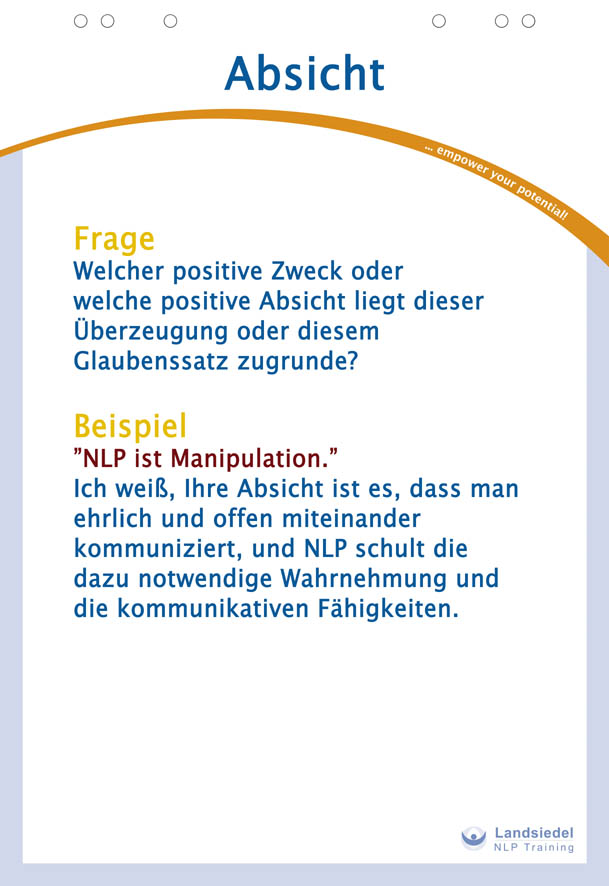
1. Intention
Question:
What positive purpose or intention underlies this belief?
- There are many ways to develop a sense of power and control when one is worried about their own safety. (Intention: to develop a sense of power and control)
- It is very important to take all possible steps to ensure that people behave ethically. (Intention: to take all possible steps to ensure that people behave ethically).
- I know that you are concerned about not giving false hope, but it could be that in doing so, you are generally preventing hope from arising.
- I greatly admire and support your effort to be honest with yourself. (Positive intention: honesty)
- It is so important to be realistic when it comes to changing one's beliefs. Let's take a completely realistic look at this belief and consider what would be required to change it. (Positive intention: to be realistic)
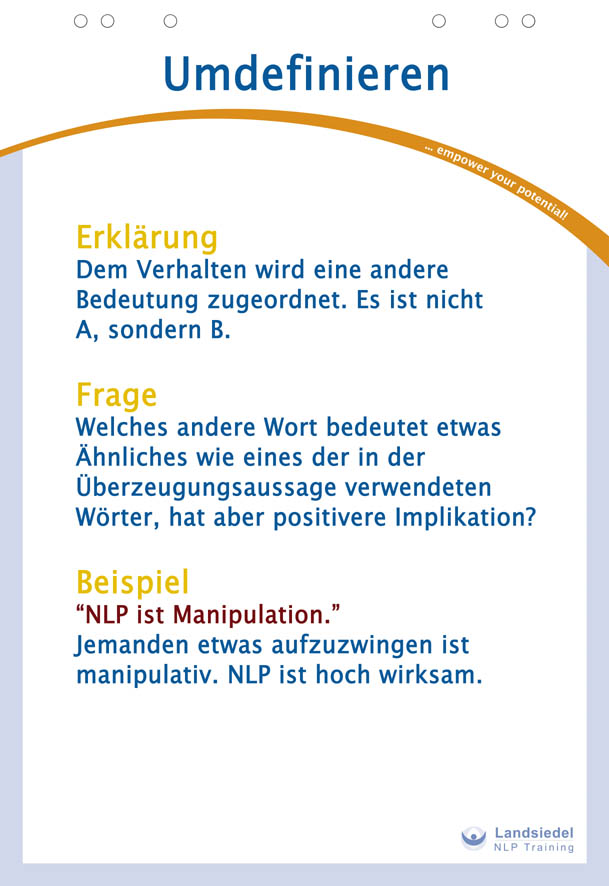
2. Reframing
Explanation:
The behavior is assigned a different meaning. The general formula for this pattern is: It's not A, but...
Question:
What other word means something similar to one of the words used in the belief statement, but with more positive implications?
- I believe that you should do everything in your power to avoid becoming a victim. ("Person X intends to harm me, and I am in danger" -> "I am a victim".)
- Such challenges are necessary to learn how to face difficulties with courage, determination, and wisdom. ("Being in danger" -> "A challenge")
- Ultimately, it is not cancer that causes death, but the failure of the immune system. Therefore, we should try to find a way to strengthen the immune system.
- Our feelings about cancer can, of course, generate fear and lead to the loss of hope, which can make continuing life much harder.
- Yes, it may be difficult to let go of something you have held on to so stubbornly. ("What you’ve held on to for a long time" -> "What you’ve held on to stubbornly"; "Hard to change" -> "Hard to let go of")
- Of course, it can initially feel strange to step beyond familiar boundaries. ("Belief" -> "Familiar boundaries"; "Hard to change" -> "Feels strange at first to step beyond")
3. Konsequenz
Explanation:
This pattern is about making the speaker aware of the consequences that such a claim may have. At a higher logical level, it’s about the unwarranted equivalence being asserted between two logically non-equivalent categories (external behavior and internal state).
Question:
What positive effect does the belief or the relationship defined by it have?
- It will be much harder to hurt you in the future because you now know how to recognize dangerous situations and ask for help. This is the first step on the transformation path from victim to hero. Now that you understand this, it will be difficult to deceive you again.
- Unfortunately, beliefs like this tend to become self-fulfilling prophecies because they cause people to give up searching for other possibilities.
- The expectation that something will be more difficult often makes the task seem easier once actually performed.
- When we truly allow ourselves to feel our worries, we can then better let go of them and focus on what we want.
4. Chunking down
Explanation:
A more specific statement that includes information implicitly present in the original statement. Chunking down leads to differentiations and distinctions between things; it narrows down the elements being discussed.
Question:
What smaller elements or chunks are implied by the belief, yet have a more nuanced and positive relationship to it than those expressed in the belief itself?
- To effectively handle the situation, you must first determine whether the danger increases with each injury or damage, or if you are still in the same level of danger today as you were at the time of the first injury.
- When you say that Person X "intends" to harm you, do you mean that Person X mentally develops an image of how they will harm you? And if so, which part of the image is the most dangerous, and how does Person X actually act in accordance with this image? What do you think is the cause of that image in Person X's mind?
- I have often wondered how much "death" each cancer cell might contain.
- Since a belief that you have only recently acquired is much easier to change, you can try to remember what it was like when you first adopted the belief and imagine you had changed it at that time. (Long time -> short time)
- If you didn't try to change the entire belief at once but instead gradually changed more parts of it, that might seem easier and even enjoyable for you. (Changing a belief -> gradual change of belief in parts)
5. Chunking up
Explanation:
A higher level of generalization, a statement that includes the old one as a special case.
Question:
What larger elements or categories are implied by the belief, which have a more nuanced or positive relationship to it than the ones expressed in the belief itself?
- Intensive emotions are always the foundation of our motivation to change. C.G. Jung said, "Without pain, there is no awareness." ("harm" -> "intensive emotions", "pain")
- Dealing with the discomfort we experience when dealing with life-threatening risks is one of the ways to become stronger and more competent. ("harm" -> "discomfort" / "danger" -> "life-threatening risks")
- Are you saying that a change or mutation in a small part of the system must always lead to the destruction of the entire system?
- The future cannot always be predicted based on the past. Knowledge can evolve very quickly if it remains connected to the processes that naturally adapt it to the current situation. (Belief -> a form of knowledge; will be difficult -> future)
- All change processes go through a natural cycle that cannot be accelerated. The question is, how long is the natural life cycle of your belief?
6. Analogy
Explanation:
With an analogy/metaphor, I tell something about one matter to make another – analogous matter – more understandable or to change it. The metaphor assumes a structural isomorphism of the elements and relationships of both matters.
Question:
Which other relationship is similar to the one defined by the belief (i.e., is a metaphor for it), but involves different implications?
- We learn to master interpersonal relationships, just as we learned to ride a bicycle as children: when we fell, we immediately stood up on our own, ignored the scraped knees, and proved our determination by making further attempts until we were finally able to keep our balance while riding. Getting angry at the bicycle for hurting us, however, doesn’t help us much in such a situation.
- Dealing with the intentions of others is somewhat like the work of a bullfighter. For our own safety, we must be clear about what draws the bull's attention to us, we need to focus its attention in ways that suit us, and we must learn to dodge it when we see it is preparing to charge.
- Cancer is like a meadow where weeds gradually take over because it isn’t properly grazed by sheep. The white blood cells of our immune system are like the sheep. When stress, lack of exercise, poor nutrition, etc., reduce the number of sheep, the grass gets overtaken by weeds. If you manage to increase the number of sheep, they will restore the ecological balance of the meadow.
- A belief is like a law. Even very old laws can be quickly changed when enough people decide to adopt a new one.
- The dinosaurs were probably quite surprised at how quickly their world changed, even though they had lived in it for such a long time.
7. Changing the Frame Size
Question:
What longer (or shorter) time frame, what larger or smaller number of people, or what broader or narrower perspective would change the implications of the belief in a positive direction?
- Dealing with the suffering of others is one of the most difficult problems our species must still solve. Unless we do this with wisdom and compassion, violence, war, and genocide will continue on both the individual and global levels.
- Everyone must learn to cope with the darker sides of human existence. Looking back on this event at the end of your life, you will realize it was just a small pothole on your life path.
- If all people had this belief, we would never find a cure. Would you want your children to believe this too?
- In a few years, you will probably hardly remember that you ever had this belief.
- You are probably not the first or only one to have this belief. As more people manage to change it over time, it may become easier for others to change this kind of belief in the future.
8. A Different Outcome
Question:
What other outcome or problem might be more relevant than the one expressed or implied by the belief?
- The outcome in question is less about how to avoid being hurt or harmed by a specific person, and more about developing the skills needed to live safely, regardless of what others think or do.
- In my opinion, it is not so much about what intentions someone may have had, but rather about what might lead someone to change their intention.
- Actually, it is less about what causes death, and more about what makes life worth living.
- It is not necessary to change the belief. It only needs to be adjusted to the current situation.
- It is not necessarily about changing beliefs, but rather about aligning your map of the world with your current situation.
9. Model of the World
Question:
What other model of the world would make this belief appear in a completely different light?
- Sociobiologists would say that the evolutionary development of Person X's hormones is the cause of your danger, not what you or they believe to be their conscious intent.
- Imagine people around the world who have had to constantly deal with the reality of social oppression, such as racism and religious persecution. They would likely welcome a situation where you were only dealing with the negative intentions and actions of a single, familiar person.
- Many medical professionals believe that we all have a few mutated cells in our bodies at all times, and that it only becomes a problem when our immune system is weakened. Therefore, mutated cells would be just one of several factors—such as diet, mindset, stress, and adequate medical treatment—that decide how long a person lives.
- You can count yourself lucky. Many people don’t even realize that their limitations are caused by beliefs that can be changed.
- Artists often use their inner struggles as a source of inspiration for their creativity. I wonder what kind of creativity might emerge from your efforts to change your beliefs.
10. Reality Strategy
Explanation:
This pattern involves questioning the perception process that underlies the statement.
Question:
What cognitive perceptions of the world were necessary to build this belief? How would you need to perceive the world for this belief to appear true?
- When you think about all the injuries or harm you’ve experienced, do you experience each situation separately or are they all connected? Do you remember them from your own associated perspective, or do you see them all in a kind of montage, as if you’re watching a documentary about your life?
- Do your memories of events that are in the past evoke the strongest feeling of danger, or do your thoughts about events that may occur in the future have this effect?
- How exactly do you represent this belief? Do you imagine cancer as an intelligent intruder? What kind of internal representations do you have, and how does your body respond? Do you think your body and immune system are smarter than the cancer?
- What makes you so sure that you’ve held this belief for so long?
- What specific aspects of what you see or hear when you think about changing this belief make it seem difficult?
11. Counterexample
Explanation:
Counterexamples serve to shake the evidence of a belief, thereby opening up new possibilities to expand the model of the world and recover omitted information. A good method is to choose counterexamples from the speaker's own history.
Question:
What example or experience is an exception to the rule defined by the belief?
- If only it were the case that we didn't need to worry that something doesn't happen just because it has never happened before. The greatest danger is likely to come from things that haven't happened yet; therefore, we should be prepared for every possibility.
- To truly be safe, we must realize that people who have the best intentions toward us and have never caused us harm can still put us in great danger. Think of all those who unintentionally kill others in car accidents. We also say, "The road to hell is paved with good intentions."
- Today, more and more cases are known where people have survived cancer and enjoyed many years of good health.
- I have often witnessed how beliefs were formed and then changed. The prerequisite was that people were given the necessary experiences and supported in the process.
- Most other mental processes seem to gradually fade away and, over time, become more prone to distortion, not stronger. So why should beliefs be so completely different in this regard?
12. Criteria Hierarchy
Explanation:
Find a higher criterion that has not been considered in the statement. This shifts attention in another direction, towards a different equivalence with greater meaning or intensity.
Question:
What previously unconsidered criterion might be more important than the one expressed in the belief?
- I have repeatedly found that it is more important to figure out what resources I need to successfully complete the chosen path, than to worry about the occasional harmful effects of the intentions of others.
- Don't you think it's more important not to become a slave to your own fears, than to try to avoid the inevitable truth that, from time to time, we will get hurt?
- Perhaps it's more important for us to focus on the purpose of our lives and our mission, than on how long our life will last.
- Personal congruence and integrity justify any effort one must make to achieve them.
- The extent to which a belief aligns with and supports one's vision or mission is more important than how long one has held the belief.
13. Apply to Self
Explanation:
This pattern involves applying the criterion of the statement to the statement itself or to the speaker. In other words: the behavior or statement of the speaker is an example of what they are accusing the other of.
Question:
How can we evaluate the belief statement itself according to the relationships or criteria defined by the belief?
- Since negative intentions can be so harmful and dangerous, we must be very clear about how we understand our own intentions and how we act on them. Are you really sure that your own judgment is based on a positive intention? If our beliefs about another person’s negative intentions justify treating them the same way they treated us, we become like them.
- It can be quite dangerous to think that we are only at risk from those who have already hurt or harmed us in the past. If our beliefs force us to relive earlier injuries over and over again, that can cause as much pain as the actions of a real person with negative intentions.
- This belief has spread over the years like cancer; and clinging to it too rigidly seems quite deadly. It would surely be interesting to see what would happen if it went extinct.
- How long have you believed that the ability to change a belief mainly depends on how long that belief has existed?
- What do you think—how difficult would it be to change your belief that long-standing generalizations are hard to change?
14. Meta Frame
Explanation:
In this pattern, we chunk up into a larger context or a broader frame of meaning.
Question:
What belief *about* this belief could shift how the original belief is perceived?
- Scientific studies show that it is only natural to fear others and their intentions until we have developed enough self-respect and trust in our own abilities.
- As long as you insist on staying within a problem frame regarding the behavior and intentions of Person X, you will inevitably suffer from the consequences of that stance. Once you're ready to shift into an outcome frame, you'll find many possible solutions.
- An overly simplistic belief like this can emerge when we lack a model for exploring and evaluating the many complex variables that contribute to the processes of life and death.
- Perhaps you hold this belief because you lack the tools needed for change—and because you benefit in some way from being the way you are now.
Sleight of Mouth Patterns
Example Statement:
"If you say mean things, then you’re a bad person."
| Pattern | Response |
|---|---|
| Intent (Absicht) | You want people to treat each other with more respect. |
| Redefine Behavior | I'm not being mean—I’m just being very direct. |
| Redefine Equivalence | Being honest doesn’t make me a bad person. |
| Consequence | What if believing that actually turns out to be quite mean itself? |
| Chunking Down | What exactly do you mean by “mean”? The words? The tone? The volume? |
| Chunking Up | I see it’s important to you how people communicate. But how do you know that saying mean things always equals being a bad person? |
| Analogy / Metaphor | A dentist might say things that sound mean, but you wouldn’t want them to lie about your teeth, right? Their job is to be truthful—even if it stings. |
| Change Frame Size | This might feel uncomfortable now, but in a year, you might be glad someone gave you that honest feedback. |
| Different Outcome | I’m saying this to help you grow, not to hurt you. |
| Model of the World | That might be how you see it—but I experience it differently. |
| Reality Strategy | How do you know someone is mean? And how do you know that saying mean things equals being a mean person? |
| Counter-Example | Couldn’t someone be a bad person and never say anything mean? Or say something mean but still be a good person overall? |
| Criteria Hierarchy | Isn’t it more important to be honest than just to be nice? |
| Apply to Self | I think that statement is mean. Do you judge everyone based on one moment and ignore all other parts of who they are? Only mean people call others mean. |
| Meta Frame | Maybe you’re saying this to feel more in control yourself. |