

 DE
DE ES
ES RU
RU FR
FR ZH
ZH HI
HI GR
GR


Self and Self-Worth
All people strive for the wholeness of their self. Virginia Satir viewed the concept of self systemically. She understood it as a constant dynamic interplay of different levels. She considered physical, intrapsychic, spiritual, interpersonal, contextual, and social factors equally.
By self-worth, she meant the beliefs and feelings we have developed about ourselves over the course of our lives.
She made the observation that most human problems are due to a low sense of self-worth. At the same time, she also discovered that most people have a very low sense of self-worth.
A person with low self-worth does not care for or appreciate themselves and expects the same from others. They almost expect to be deceived and betrayed. And through this expectation, they bring about their worst fears (self-fulfilling prophecy). To protect themselves, they hide behind a wall of mistrust and sink into isolation and loneliness. It is difficult for them to see themselves clearly, as they continue to distance themselves from both themselves and others.
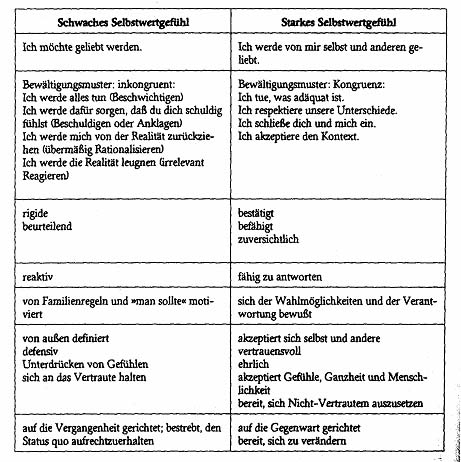
Our sense of self-worth seems to depend on how we were treated in our family of origin during the first five to six years of life.
The feedback we received during this time about ourselves and our behavior determines our current feelings about ourselves and thus also our approach to challenges and our ability to communicate.
In this way, parents can significantly influence their child's self-worth through their communication. The big problem is that most people are unaware of the nuances of their communication behavior, so good intentions from parents can be undermined by inadequate nonverbal behavior.
Such destructive interaction patterns are often passed down from generation to generation. However, Virginia Satir believed that these interaction patterns, which are learned, can certainly be unlearned as well. She was convinced that anyone can increase their self-worth, recognize destructive interaction patterns, and work on them.