

 DE
DE ES
ES RU
RU FR
FR ZH
ZH HI
HI GR
GR


Future Pace
This is an NLP technique that allows the results of a change process to be transferred into the future. The Future Pace serves to ensure the transfer and actual application of new behaviors.
Definitions of Future Pace, Future Pacing, or Bridging into the Future:
From Ötsch & Stahl ("The Dictionary of NLP")
1. First Definition
The process in which a person explores their future vision for a specific context, task, etc. Future Pace is a standard procedure in NLP at the end of change techniques.
Suppose it was about a problem X (e.g. my behavior toward a colleague), and the technique related to a situation Y (e.g. the weekly team meeting with this colleague). At the end of the NLP intervention, my future image of Y is questioned: How do I now envision the next meeting? What is there to see, hear, feel? How do I perceive myself? What will I do, etc.? The image developed here is considered a test for the quality and intensity of the intervention.
A positive future vision after an NLP intervention is an indication that the desired change can occur naturally and automatically. A negative future vision is an indication that the NLP intervention will have little impact on actual behavior in the future.
2. Second Definition
The term Future Pace is also used in the sense of a consciously constructed connection between a goal and the future. (This is also called transfer.) In contrast to the first definition of Future Pace, it involves consciously shaping future images and solidifying them over time.
Future Pace in this sense is often used to place a learned experience into a future context and connect it with future visions. The greatest enemy, one could say, is the lack of memory: we often forget our resources and goals in everyday life. With conscious Future Pace, it should be ensured that the desired change occurs not only in the counseling context but also in everyday life. Possible methods to achieve this are:
- The imagination of the goal for specific future situations
- The connection of the goal with the internal timeline
- The questioning of at least three specific application possibilities for the skills, behaviors, ..., that are contained in the goal
- Practicing the change as an internal strategy, where an external trigger is already set to activate the memory of the goal.
- The installation of an internal instance (in the unconscious) that is supposed to automatically ensure the desired change.
Future Pace after a Sale
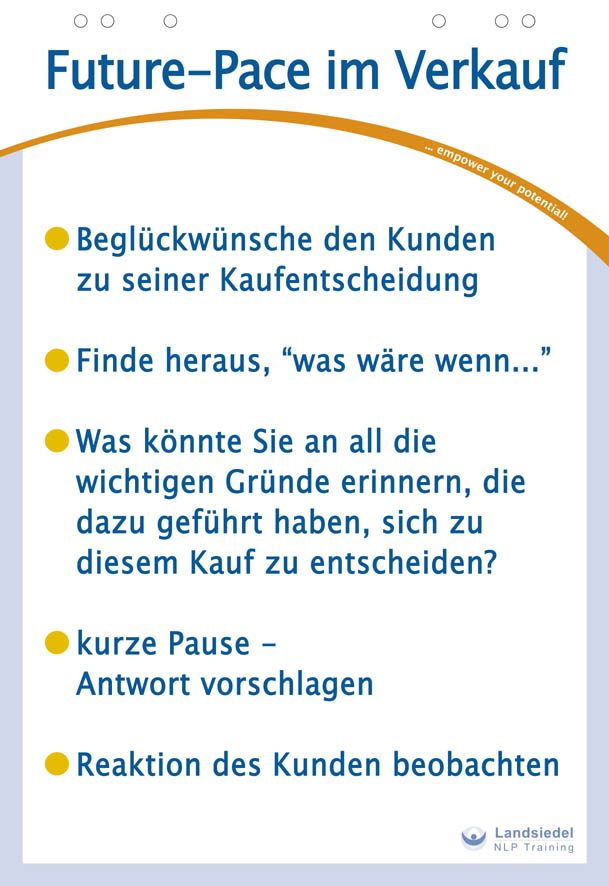
-
Congratulate the customer on their purchasing decision.
Capture their excitement, amplify it, and participate in it! Emphasize the truth. Only the customer knows the reasons that led them to make the purchase, and only they know how useful and beneficial this decision is for them. -
Find out, 'What if....
Try a typical scenario that could lead to a withdrawal from the purchasing decision:
"What if...," and put your customer in a future situation where their current resolve could waver. Check the two or three most important reasons for 'buyer's remorse."
- "What if your wife didn’t support the decision?"
- "What if a family member or one of your friends disapproved of your decision?"
- "What if you yourself started to doubt your decision?"
-
While the customer thinks about the answers to these questions, ask them the following question:
"What could remind you of all the important reasons that led you to make this purchase decision?" This creates a foundation for your customer to develop their own strategy to address signs of doubt and ambivalence in the future. This question forces them to remember the thoughts and excitement that led to the purchasing decision. -
Take a short pause, and then suggest an answer, by tying doubt or criticism to the memory of the reasons for the purchase.
"Sometimes, even the slightest sign of doubt is enough to trigger the feeling of excitement that you are experiencing right now. Isn’t it reassuring to know that any doubts that may arise will immediately remind you of all the reasons that led to this great decision? The doubt will only strengthen your conviction and certainty that you made the right choice, because only you know exactly the reasons why you did the right thing." -
Observe the customer's reaction very attentively.
From the reaction, you will recognize whether your Future Pace was successful. You will also notice that this method creates very strong rapport and further amplifies your customer's enthusiasm.