

 DE
DE ES
ES RU
RU FR
FR ZH
ZH HI
HI GR
GR


Reframing
Definition of Reframing

The term "Reframing", often incorrectly written as "Refraiming", comes from the English word "frame". Reframing literally means giving things a new frame—reinterpretation.
Reframing means:
to reinterpret or place something in a different frame in order to bring about a change in experience through this shift in meaning or perspective.
The meaning of an event, a statement, a behavior, a belief, a trigger, or a stimulus depends on the context or frame we place it in. Frame is the frame. Reframing means constructing a new frame, giving a new meaning. A picture can look and feel very different in a new frame. When a problem is reframed, the same event takes on a new meaning: new reactions and new behaviors become possible. Reframing refers to the process of reinterpretation, adopting a new perspective, a new way of perception, a new interpretation.
What is Reframing? Explained by Stephan Landsiedel
Presuppositions
Reframing is based on the following presuppositions:
- Every behavior makes sense in some context.
- Every behavior is attributed a meaning.
- Behind every behavior there is a positive intention.
Quotes on Reframing
"It is not things themselves that disturb us, but rather our interpretation of the meaning of these events that determines our reaction."
– Marcus Aurelius
"Always look on the bright side of everything – and if there is no bright side, then polish the dark side until it shines."
– Nikolaus Enkelmann
A Reframing Story
The Farmer and the Horse (From the book "Reframing" by Bandler/Grinder)
A very old Chinese Tao story tells of a farmer in a poor village. He was considered well off because he owned a horse, which he used to plow and carry loads. One day, his horse ran away. All his neighbors cried out how terrible that was, but the farmer simply said, “Who knows what it’s good for.” A few days later, the horse returned, bringing two wild horses with it. The neighbors rejoiced over his good fortune, but the farmer said again: “Who knows what it’s good for.” The next day, the farmer’s son tried to ride one of the wild horses; it threw him off and he broke his leg. The neighbors expressed their sympathy, but the farmer once more said, “Who knows what it’s good for.”
The following week, army recruiters came to the village to conscript young men. They didn’t take the farmer’s son because of his broken leg. When the neighbors congratulated him, the farmer replied again: “Who knows what it’s good for...”
Reframings appear in...
- Jokes: Almost every joke works by placing events in a certain frame and then suddenly and drastically changing that frame. In jokes, an object or situation is suddenly recontextualized or given a new meaning. Example: What do Alexander the Great and Smokey the Bear have in common?
- Fables and stories: For example, Pinocchio (his long nose is negative at first because he lies – but in the whale, it helps them escape by keeping the mouth open).
- Creative processes: An unusual event is seen in a new frame and suddenly a great invention is born:
A man wakes up at night feeling the sharp end of a rusty mattress spring poking his back. What possible use could an old mattress spring have? (Besides keeping him from sleeping.) He reinterpreted it as a stylish egg cup and founded a successful business based on the idea.
A friend of physicist Donald Glaser jokingly pointed at a glass of beer and said: "Why don't you use that to catch your subatomic particles?" Glaser looked at the bubbles in the beer and returned to his lab to invent the "bubble chamber", similar to Wilson’s cloud chamber, to detect particle paths in high-energy physics experiments.
For a sawmill, sawdust is waste – for a particle board factory, it is a raw material. The meaning of the sawdust remains the same (coarse wood dust created when sawing boards and logs), but the context is different.
Anecdote by Henry Ford:
A young and talented employee had lost several hundred thousand dollars due to a management error and now had to report to Henry Ford. He feared he would be fired and said: "I'm terribly sorry. You’ll probably fire me now." To which Henry Ford replied: "Are you joking? I just invested several hundred thousand dollars in your education and I’m sure that investment will pay off."
Types of Reframing
There are two types of reframing.
-
Context Reframing:
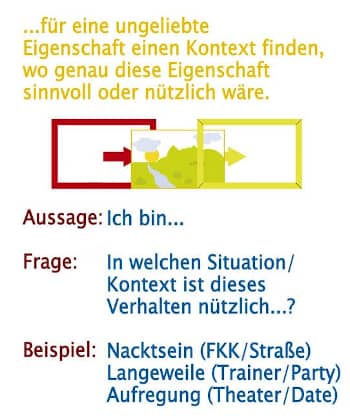
Placing an undesirable behavior in a context where it makes sense and finding a new appropriate behavior for the original “problem context”.
“An example: A father describes his daughter as stubborn. The therapist says: Imagine your daughter being harassed by a man. Wouldn’t it be very useful if she were stubborn then?”
The therapeutic aim of this intervention is to help the father develop a positive feeling toward the rejected trait.
Context reframings are indicated when the client’s problem statement includes a comparison like: “I am too X” or “He/she is too X.” This is a generalization, assuming the trait is wrong in all possible contexts. By finding a context where the trait is useful, the therapist breaks the generalization and replaces it with a context-specific statement.” (from "The NLP Dictionary" by Ötsch/Stahl)
Reframe: Find a context where X is useful. -
Meaning Reframing (=Content Reframing):
Finding a more “fitting” meaning for the problematic behavior = a different perspective on the same phenomenon.
An example: A mother is annoyed by her children’s footprints on the carpet. For her, “footprints on the carpet” mean: “No one respects me.” A new meaning could be: “Footprints on the carpet” mean: “Beloved people are in the house.”
Meaning reframing is used when the client's language includes a complex equivalence like: “I feel x when y happens” – which translates to: “x means I must feel y.” (from: The NLP Dictionary by Ötsch/Stahl)
Reframe: “What if Y now meant Z?”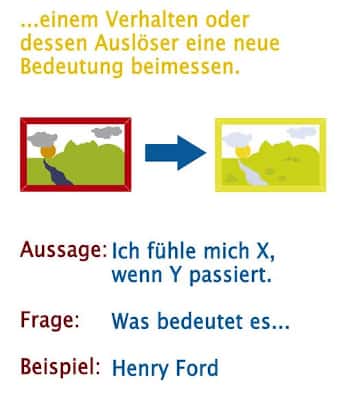

Separation of Intention and Behavior
This is an important NLP principle. Often, an intention can be very positive and good, but the behavior used to realize the intention is not. We can honor the positive intention and replace the behavior.
At the heart of reframing lies the distinction between behavior and intention: between what one actually does and what one is trying to achieve by doing it.
Examples:
- Behavior:
A woman constantly worries about the family. - Possible outward effect:
The family sees it as nagging and resents it. - Intention:
Her way of showing that she loves and cares for them. - Behavior:
A man works very hard. - Possible outward effect:
The family feels he doesn't care enough and wishes he would spend more time with them. - Intention:
He loves his family and wants to earn more money for them.
The way to get rid of unwanted behavior is not to try to stop it with willpower. This guarantees that it will persist, because You are giving it attention and energy. Find another, better way to fulfill Your intention—one that aligns more with Your whole personality. You don’t destroy gas lamps before installing electricity—unless You want to sit in the dark.
(from Neuro-Linguistic Programming: "Successful Communication and Personal Development" by Joseph O’Connor and John Seymour)