

 DE
DE ES
ES RU
RU FR
FR ZH
ZH HI
HI GR
GR


NLP Strategies
Behind human behaviors are strategies that control and guide them. In NLP, methods have been developed that allow you to learn the strategies of experts — for example, Walt Disney’s creativity strategy. In this way, processes such as motivation, learning, sales, and decision-making can also be optimized.
Table of Contents
- What are strategies?
- Walt Disney Strategy
- The TOTE Model
- NLP Notation
- Eliciting a Strategy
- Conditions for Structural Well-Formedness of Strategies
- Installing a Strategy
- Examples of Strategies
- Planning of Context Markers and Decision Points
- Streamlining of Strategies
- Redesign of a Strategy
- Installing a Strategy
- Installation with the Help of Anchors
- Interrupting Strategies
- Sources of Error when Installing a Strategy
What are Strategies?
Strategies are the ways in which we organize our thoughts and behavior in order to complete a task.
There are so-called macro and micro strategies. For example, if someone sets the goal of becoming a successful sociologist, the macro strategy would be the gradual build-up of this career: studying, earning a PhD with summa cum laude, publishing, getting a position at a prestigious university, habilitation, etc.
The micro strategies would concern the ways in which the individual successfully and efficiently learns, writes, or presents themselves. These micro strategies can be analyzed as specific processes within the sensory systems. They describe a specific internal processing of sensory perceptions, meaning: strategies are formal structures—specific procedures—that are initially entirely independent of the content itself.
Each strategy also involves specific attitudes and beliefs. In this case, for example: Success is possible and important to me. I am talented and have the abilities for such a career, etc.
Strategies are like the recipe we use to bake a cake: The key ingredients are essential, but the quantity of each ingredient (whether one egg or ten) and the order in which they are combined are crucial. It makes a difference whether we add the egg before, during, or after baking it in the oven. That is, the order in which we do things within a strategy is just as important as what we do, even if it all happens in a matter of seconds. The ingredients of a strategy are the representation systems, and the quantities and qualities are the submodalities. The recipe represents the broad outline of the strategy, while the individual steps, such as stirring the batter, are the micro-units of this strategy. The beliefs in successful baking might be: Baking a cake is possible/I can learn and do it successfully/It’s worth it, the cake will taste great.
In NLP, we examine such strategies with the goal of finding out what exactly someone does when they are successful at something, so that we can make this ability accessible to others who have not yet had it. In other words: strategies are an essential part of modeling.
We also naturally analyze strategies that are less successful, to figure out how they can be improved.
There are different types of strategies, including decision, motivation, learning, creativity, relaxation and awakening strategies, flirting strategy, partner selection strategy, just to name a few.
In NLP, the term strategies refers to mental processes that enable a person to translate their abilities in alignment with their beliefs and values into concrete behaviors. In NLP, we assume that these processes can be consciously and/or unconsciously described through a series of sensory representations (VAKOG). These VAKOG, which lead to a specific action, are typically partly internal and partly outwardly directed processes.
Walt Disney Strategy
What is the Disney Strategy? Here, Walt Disney’s macro strategy for goal setting is introduced, along with the positions of the Dreamer, the Planner, and the Critic, and a guide on how to implement this strategy.
This macro strategy comes from Walt Disney, the co-founder of the world-famous Disney Company. Disney was a person with very pronounced dreams and visions. He separated three different phases of goal setting, distinguishing them both spatially and temporally from each other. These phases or positions were: the Creative Dreamer, the Realistic Planner, and the Constructive Critic. For each of these three positions, Walt Disney had a different space that helped him, through its arrangement, enter a mental state conducive to the respective position.
- Mark three different spots in the room. Make sure that each space corresponds to the type of thinking, visualizing, or working that should take place in it.
- Go through the positions relatively quickly in the next steps to get a first impression of this strategy.
- Take the position of the Dreamer.
- Remember a time when you were creative and imaginative. Put yourself in that mood. If it's hard for you, think of someone who is often creative and consider how that person might do it. It’s important that you actually reach a state where it’s easy for you to dream and develop creative ideas.
- Leave the position of the Dreamer and take a brief moment to switch off. Set a separator.
- Now take the position of the realistic Planner.
Remember a time when it was easy for you to plan realistically and carefully, or think of someone who is very good at it.
Choose one of your Dreamer’s ideas that you want to plan now. Think about the idea.
- How could you make this idea a reality?
- What steps are necessary?
- In what order do they need to be done?
- How long will it take to reach the goal?
- What intermediate goals are conceivable?
- Leave the position of the Planner and set a separator again.
- Take the position of the constructive Critic.
Remember a time or situation when you were constructive and critical, when you noticed obstacles and objections early on and knew exactly where the strengths and weaknesses of a plan were. Or think of a person who has this skill. Where do you feel you now have access to that feeling? Put yourself in that mood. Look at the result of the Dreamer and Planner. Feel into it and develop a sense for the plan.
- What is still missing?
- What has not yet been considered?
- Can you achieve your goal with this plan?
If it is necessary to make changes or refinements, go through the different positions as many times as needed until the Critic agrees with the goal and its realization. You can also switch the order, for example, by moving from the Critic to the Planner when the basic ideas are clear, but the implementation is not yet feasible. Or you might go from the Planner back to the Dreamer because the dream is simply not achievable, and you would like more precise details about the implementation, etc. Play around a bit with this model.
The TOTE Model
The T.O.T.E model illustrates in a simple way how human learning works. The basic structure of this model explains the usual steps of a learning process: Test - Operate - Test - Exit.
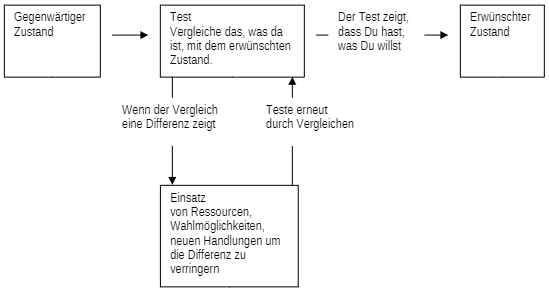
Starting point is a specific current state, and the goal is a specific desired state. We compare the current state with the desired state. If this test/comparison shows that the goal has not been achieved yet, we take this information as feedback and make some changes and improvements (operate). Next, we compare the result again with the desired state (test). If the goal is achieved, the process is complete (exit). If we still notice a difference, we operate and test again until the goal is reached. This model simply describes the basic structure of human behavior.
Example: Hammer a nail into the wall.
Someone has a hammer and a nail. The current state is that they are holding both in their hand. Their goal is to have the nail on the wall. Therefore, they hammer the nail (operate) and check again if the nail is now on the wall (goal achieved?). If this is the case, the loop ends (exit); if not,
another operate phase is added.
NLP-Notation
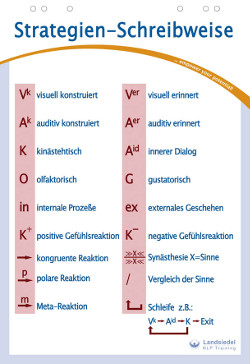
Representation Systems
V: visual (seeing)
A: auditory (hearing)
K: kinesthetic (feeling/sensing)
O: olfactory (smelling)
G: gustatory (tasting)
Superscript Notation
e: remembered
k: constructed
in: internal
ex: external
Subscript Notation
+ positive
- negative
Examples:
Aex : auditory - external
Ain : auditory - internal (inner dialogue, inner comments)
Kex : kinesthetic - external
Vk : visual - constructed
Syntactic Symbols
-> : transitions into
/ : simultaneous auditory (hearing) and visual perception (synesthesia)
Example:
Vin -> K+ -> Ain -> K-
Sequence of sensory impressions and representations
Translated: A visual image (me on a palm beach) transitions into a pleasant feeling (joy), followed by an internal comment ("Damn, I don't have time for that"), which then leads to an unpleasant feeling (frustration).
Eliciting a Strategy
A is the model, B asks questions, C notes the sequences and observes as well.
Overview
- Preparation
- Guide A into the experience
- Define the framework for the interview
- Gathering Information
- Find the overall structure of the strategy
- Ask about the sensory-specific individual steps of the strategy
- Identify the beliefs and specific submodalities related to the strategy
- Summarizing and Reviewing the Strategy
The Steps in Detail
A. Preparation
- Guide the person into experiencing what you want to analyze: for example, deciding, being motivated/creative, flirting, etc. Choose an acceptable, manageable time frame for the process, not months or years. Associate the person into the experience: "Think of a specific time when you were really able to be creative. Make this experience as accessible as if it were happening RIGHT NOW." (VAKOG)
- Set a framework for the interview, e.g., "Let’s assume I had to represent you for a day. How would I need to do this so that I could perform what you do very well just as well?" Always obtain consent for probing questions. Maintain rapport throughout the entire process.
B. Collecting Information
In general:
- Focus on the process, less on the content of the experience.
- First, identify the big picture of the strategy, and then work out the individual sequences.
- The individual steps are usually unconscious to the person. Therefore, ask Meta-Model questions to uncover the corresponding sensory-specific details and calibrate to their physiology. Pay attention to the non-verbal information your counterpart provides (e.g., eye-access cues, etc.). Eliciting a strategy is very much connected to trance for the person (inner searching processes). That means: adjust your voice and pace accordingly.
- Repeat the individual sequences to check if all the essential steps are included, and take notes on this.
- Finding the broad strategy line: A first explains the entire process.
- Inquiring about the sensory-specific individual steps of the strategy
- Now ask A to go through the entire strategy in slow motion, so to speak. A strategy is like a film that can be played forward and backward, with the individual steps repeating over and over.
- B now uses Meta Model questions to explore the sensory-specific details of the strategy and pays attention to the nonverbal information A displays.
- Eye movements, body posture
- Movement/gestures
- Facial expressions, breathing
- Ideomotor movements
Possible questions for "unpacking" a strategy:
For the start of the strategy (trigger):
- "What exactly would I have to do to do it the same way you do?"
- "Where would I need to start?"
- "What happens first?"
- "What procedure do you go through to ensure you're ready to do 'X'?"
- "How exactly do you know it's time to do 'X'?"
- "How do you know even earlier?"
For the progression of the strategy (Operate):
- "How exactly do you notice that..."
- "How exactly would I need to do it?"
- "What else exactly needs to be considered?"
- "What's happening right now?"
- "What happens next?"
- "How exactly do you do that?"
- "And what happens right before that?"
- "Do you hear, see, or feel it? Or is it all simultaneous?" (Synesthesias)
- "Does all of this happen at the same time or one after the other?"
For the end of a strategy (Test-Exit Criteria)
- "How do you know you're done?"
- "How do you know it worked?"
- "How do you know even sooner?"
- "What lets you know you're not yet finished with your strategy?"
- "How do you know you're ready to move on to something else?"
- Identifying the beliefs and specific submodalities associated with the strategy.
Typically, certain beliefs are also part of a strategy. For example, an effective decision-making strategy likely includes a belief such as: "I make the right decision."Possible questions about beliefs:
- "What would I have to believe/what would have to be important to me to be able to do exactly what you do?"
- "Which thought is essential?"
- "Is there perhaps something you are absolutely certain about internally?"
Additionally, certain submodalities can be crucial for the effectiveness of the strategy. For example, in a motivation strategy, the goal might be big, bright, clear, and warm, or the decision moment in a decision-making strategy might be experienced like a 3D movie with a stereo effect.
After summarizing the strategy using NLP shorthand, check whether all essential elements are included:
- Are all steps from the T.O.T.E. model captured?
- Is the strategy logically consistent, or are key connecting pieces missing?
- Does A also agree that all essential steps are included?
Conditions for Structural Well-Formedness of Strategies
A. A strategy must have a sensorily defined goal.
A strategy should have an operation for information gathering and feedback (feedback), with which a representation of the desired goal can be built and/or modified.
B. A strategy must include all three main representational systems (V, A, K).
Each representational system (RS) has the ability to receive and process information that the others do not have.
C. A strategy cannot reach the starting point without passing through the decision point.
- No strategy without an EXIT point: A loop can occur if the operation phase is so minimal that a significant change can happen simply by testing representations (comparison/contrast). However, this can also occur through an inadequate test.
- No two-point loop: Such a loop occurs if a person only oscillates between two RS.
- Ways to stop a strategy with an infinite loop: Counting or time! After the loop has been performed a certain number of times or has lasted for a certain period, the strategy must reach the decision point.
D. A strategy should have an external check after n steps.
n depends on the type of activity. This check is necessary to obtain the external information required when drawing, operating, playing the piano, etc.
Installing a Strategy
To install a strategy means to make a strategy (which the person does not yet have in their repertoire) available in such a way that it can "automatically" run in the future. Possible ways to do this are:
- The use of a chain anchor (where the individual links in the "chain" correspond to individual steps of the new strategy),
- The conscious practice of the strategy sequence. For example, a person is instructed to align their body with the access cues of the new strategy (e.g., to make the right eye movements),
- Interrupting existing, deeply ingrained strategies, e.g.
- a) By overwhelming with (too) many (new) sensory impressions, or
- b) By distraction (confusion)
Examples of Strategies
Spelling Strategy
- (Test) A person hears a word (auditory external stimulus),
- (Operate) constructs a visual image of the word,
- (Test) compares this image with the memory of an image of a word they have read somewhere before (visually constructed vs. visually remembered) – and (decision point) develops a feeling (kinesthetic) about the congruence or incongruence of these two images.
- (Further loop, more loops) If the test is negative [-], the process starts over (a different visual image is constructed, ....). If the test is positive [+], it will proceed.
- (Exit) The word is written down.
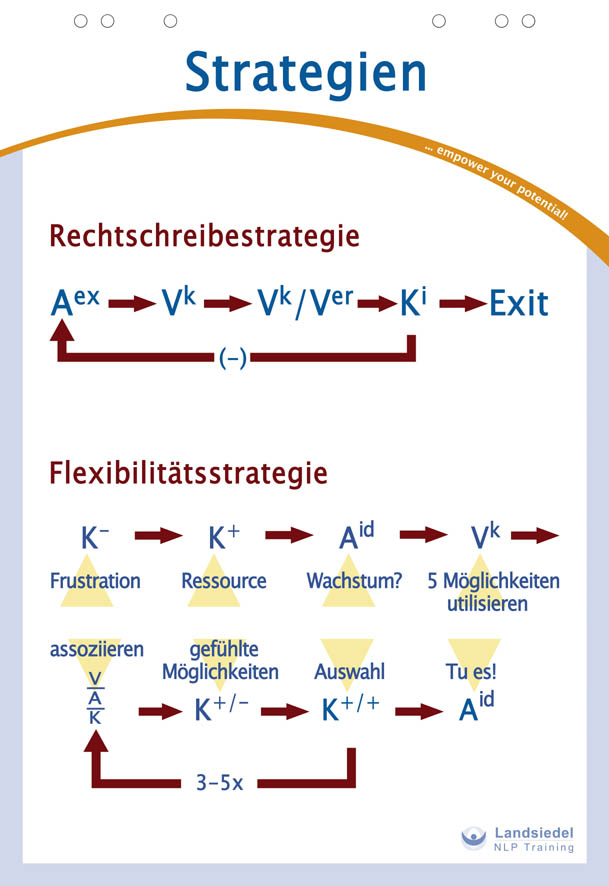
The optimal strategy for spelling in the German language is a two-step process: From visual memory to kinesthetic verification. Those who are very good at spelling see an inner image of the correctly spelled word and have a "feeling" of whether they have written it correctly or incorrectly.
The procedure described below is for installing this spelling strategy. This approach is primarily intended for one-on-one work with learning-disabled students, who often use an auditory – and thus inefficient – spelling strategy.
A. Preparation:
- 1. Gather information about the person's visual access: Ask questions about visual memory, is it normally organized? (Eye movements)
- 2. Anchor resources:
Find positive experiences where the person successfully learned something difficult, e.g. riding a bicycle.
Ability to see and evoke images: cinema screen, TV screen, imagination, photos, joy, curiosity, etc.
B. Installing the V/K Pattern
- 1. Write words on strips of paper and hold them 30-40 cm in the student's eye-level position; the student should now track the letters with their eyes, internalize the word (imagine it: colorful, with background, etc.); ask the student to take a "snapshot" and then remove the paper strip.
- 2. Have the student write the word from the snapshot; compare it internally with the image in their mind; "See if it feels right." (V/K); if it's not correct: repeat step 1; if the word looks correct and feels right: anchor it.
- 3. Repeat the process (as above) for further internalization of the V/K pattern, gradually having the student look at the word for shorter durations, bringing their eyes to the appropriate position, then moving to using the word in sentence context.
C. Future Bridging:
While the individual imagines learning new words in the future or taking a spelling test, fire the anchor.
Flexibility Strategy
- What is a typical situation where I could use the flexibility strategy effectively? AD
- Anchor the starting state in this situation. K-
- When have I already approached upcoming challenges creatively?
- Anchor the starting feeling in this situation. K+
- Chain the two anchors so that joy, etc., becomes the direct consequence of frustration. First hold Anchor No. 1, then, after resolving this, immediately press Anchor No. 2. Ensure that the two anchors do not merge. Hold Anchor No. 2 for the next step.
- What can I do now to creatively handle the upcoming challenges? AD
- Visualize five possibilities: see myself in each. Vk
- Fully associate into each possibility until the feeling in the situation is palpable (VAK).
- Choose the option with the greatest challenge feeling. K+
- Oh yes! Let's go! Do it! AD
Love Strategy
Can you remember a time when you felt loved?
Can you mentally go back to that situation and experience it again... (You induce the state)
V: What must your partner absolutely do for you to feel this deep feeling of love?
- Must they take you out?
- Must they give you gifts?
- Must they look at you in a very specific way?
Is it essential for you that your partner shows you their love in exactly this way for you to feel loved? (Decide based on the person's physiology if the desired state occurs.)
A: Is it essential for you to feel this deep feeling of love that your partner tells you in a very specific way that they love you? (Decide based on the person's physiology if the desired state occurs.)
K: Is it essential for you to feel this deep feeling of love that your partner touches you in a very specific way? (Decide based on physiology if the desired state occurs.)
Elicit the submodalities now. How exactly? Check the strategy. (Decide based on the physiology if the desired state occurs congruently.)
Decision Strategy
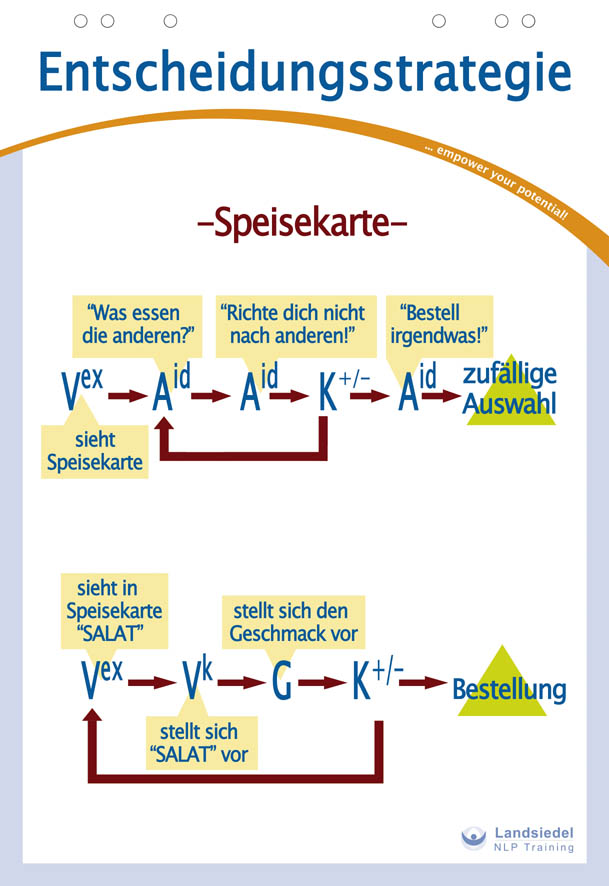
Choosing from a menu is a good example of a decision strategy. Not everyone decides equally well! The quality of one's decision-making strategy has far-reaching consequences for our life.
Typical Problems with Decision-Making Strategies
- Problems with generating alternatives:
- Difficulty constructing anything at all; everything is recalled from memory.
- The number of alternatives is too small.
- Only one possibility.
- Only an either-or alternative.
- No stopping point when generating alternatives. No EXIT.
- Problems with representing alternatives:
- The alternatives are not represented in all representational systems (RS), making it difficult to properly evaluate them.
- Inadequate data. The person would need to gather more external data.
- The alternatives are not appropriately represented for the circumstances. In Sudan, one should create a different mental image of a meal than in a gourmet restaurant.
- Problems with evaluating alternatives:
- The criteria for evaluating alternatives are unsuitable or inadequate. For example, choosing a therapist based on their shirt brand.
- The criteria are not properly prioritized, especially PRICE and other pre-selection criteria.
- Different criteria are considered independently of each other. For example, instead of evaluating one alternative at a time against all criteria, the person jumps between alternatives and applies different criteria to each. A polarity response is an example of this – someone wants to buy cheaply in a sale but finds the goods unattractive, while the ones they like are too expensive. Two parts are in conflict.
- The alternatives are not directly compared point by point.
Utilisation of Strategies
Utilisation can most meaningfully be described as the process of applying an existing strategy that has been evoked.
Pacing a strategy that has been identified: Our most important means of utilizing a strategy is to package and represent the content of the present situation or task in such a way that it matches the sequence and steps of the strategy evoked in the client
Exercise:
- Evoke a creative strategy in a person by identifying their inner processes during a time of creativity. Find out through questions and observation which sequence of representational systems led to the creative outcome.
- The person should identify an area of their life or a past or present event in which they feel "stuck" or blocked, or where they would like to have more behavioral choices.
- Use the creative strategy you recruited as a resource for this situation. Have the person relive the experience either through a current experience on the spot or through imagination and memory, within the framework of their creative strategy. Guide them through the creative strategy by having them reconsider the situation through the representational sequence they apply when they are being creative. Through this process, the person will automatically generate or create a range of new options.
Re-definition of Anchors
Essentially, an anchor is any representation (internally or externally generated) that triggers another representation, a quadruple, or a series of representations or quadruples (i.e., a strategy). Any part of an experience can be used as an anchor to trigger another part of the experience.
Anchors and access signals are the two most important tools in the utilisation of strategies. With them, we can systematically trigger the appropriate representations at the right place within a strategy. Access signals can be imagined as self-established anchors.
Planning of Context Markers and Decision Points
Old results and the corresponding strategies, which have become inappropriate for a majority of situations, may still be effective in a few specific contexts. In such cases, the programmer installs a decision point, where some representation serves as a context marker. This marker indicates in which situations which strategy is appropriate. If this step is omitted, ambiguity or overlap between the two contexts can cause a disruption, where the person might trigger both strategies simultaneously. The person won't know which strategy to apply. By reacting to both strategies, they become immobilized. Something tells them to do one thing, but something else seems more appropriate or feels better.
The representation that serves as a marker can take any form. It could be a specific sound threshold, a particular word or class of words, a positive or negative kinesthetic feeling, or an image or distinction perceived in the environment. The purpose of the signal is to distinguish which context is suitable for which strategy.
Streamlining Strategies
The process of streamlining is necessary for strategies that are too cumbersome or inefficient to achieve the desired result.
For example, reading strategy: People who have an auditory-digital step in their reading strategy must subvocalize the words before they make sense to them (before they trigger the relevant stored experience). The strategy looks like this:
The strategy of the speed reader moves directly from seeing the written word to triggering the internal quadruple.
For most people who subvocalize or mentally pronounce words, the synesthesia pattern becomes so strong that they actually cannot capture the text by simply seeing it – they must imagine the words.
Those who already possess the Ve - <A, V; K; O> synesthesia pattern as a natural resource benefit the most from this training. The effectiveness of speed reading courses depends on whether they train the reader to create a Ved synesthesia pattern, as the reader has no time to subvocalize the words internally.
Redesigning a Strategy
The goal of redesigning strategies is to create strategies that ensure a specific result efficiently and effectively. The programmer must recognize:
- What information (both for input and feedback) needs to be gathered in which representational systems.
- What tests, distinctions, generalizations, and associations are required during the processing of this information.
- What specific operations and outputs need to be evoked by an individual or organization in order to achieve the result.
- What the most efficient and effective sequence is in which all tests and operations should take place.
Installing a Strategy
There are two basic methods for installing a strategy sequence that you have designed:
- Anchoring strategy steps and applying them.
- Having the client practice the strategy sequence (a form of self-anchoring).
It's best to use both methods: While the person is being "guided" through the strategy, fire the anchor that you have set up beforehand.
Goal of Installation
- Each step of the strategy must automatically trigger the next one.
- The strategy sequence must be linked to the appropriate context – the sequence is anchored to a stimulus (a context marker).
Effectively installing a strategy requires, first, breaking or interrupting the existing strategy at the right point.
Installation with the Help of Anchors
There is a fundamental difference between anchoring within the context of utilization procedures and anchoring in the context of installation. In utilization, you anchor to control the content of specific strategy steps. In installation, you must control the strategy step itself. In this case, you won’t anchor a specific content but the act of using a particular representation system for a specific step. You establish the anchors so that they create access to using specific representation systems or a sequence of representation systems.
A. Anchoring an Entire Strategy Sequence
If a strategy sequence already exists, it can be anchored with a single anchor so that it can be inserted as a whole into a new sequence that is being designed.
It can also be inserted into a situation where it was not previously available as a resource; it will then be bound to contextual stimuli that characterize this situation, allowing for a different behavioral choice within this context. It is installed as a resource in situations where the client wants choices in their goal setting.
In such cases, the strategy is usually taken from a context in which it naturally occurs and installed into a context where it did not occur before or has not occurred yet. In this operation, it is important to separate the strategy sequence as such from the "trigger" (the triggering stimulus) that previously initiated this sequence in the context from which you are taking it.
Step 1 shows that a specific external, visual stimulus in context A naturally initiates the strategy sequence Aid .... Ke. This entire sequence is now anchored. In step 2, the strategy unit is anchored in context B, where a specific external auditory stimulus previously initiated a Ki - Vi loop. The person now has access to the strategy from context A in context B as a resource.
Example:
Anchoring a person's motivation strategy
The person is to remember a time when they motivated themselves to do something they didn’t particularly like. The steps of this strategy are now evoked through questioning and observation. Each individual step is anchored with the same kinesthetic anchor on the person’s knee. Then, a behavior is proposed that the person does not particularly enjoy (e.g., walking across the room while carrying a chair over their head or picking up a pencil that was thrown on the floor). The person is repeatedly asked to establish the fact that they truly dislike this behavior. The motivation strategy is then triggered by "firing" the anchor. If the strategy was anchored well, the person will automatically have access to the strategy sequence for motivation and apply it to the current context.
B. Anchoring Individual and Unconnected Strategy Steps
Individual representation steps can be taken from strategy sequences that are unrelated to each other, anchored, and then anchored together in a sequence to form a new strategy.
The anchors used to trigger each strategy step can be kinesthetic in nature (e.g., touches on different parts of the body). However, they can also be carried out in other representation systems, such as internal or external visual stimuli. Words are, of course, also anchors; their advantage is that they are culturally standardized to a certain degree. Therefore, the programmer can also use verbal anchors to arrange representations in a sequence (informally, this would be called "giving instructions").
You can increase the effectiveness of your anchoring procedures by pairing or combining multiple anchors for a specific strategy step. When installing a strategy sequence, anchors from different representation systems can be paired to enhance their effectiveness.
Rehearsals:
The basic method of rehearsals is that the programmer instructs the client to practice the transitions while going through the various strategy steps, with the programmer providing a variety of different contents for this purpose.
Interrupting Strategies
Sometimes, an existing strategy follows well-worn paths or is unusually ingrained. If the result of this old strategy interferes with your attempts and leads to behaviors that prevent the achievement of meta-results, then it's best for the client if you interrupt the existing strategy.
There are three basic ways to interrupt a strategy:
- by overload
- by diversion, and
- by "spinning out" the strategy
- 1) Overload occurs when more information flows into a strategy or strategy step than it can process. "Overwhelmed by emotions, dazed by the smell, etc."
The behavioral result of overload is that the person’s strategy cannot complete its cycle. When a strategy is completely interrupted, the individual is left without the next behavioral step and will jump to the next one offered by the situation. People in such a situation have a strong tendency to respond to any anchor for reactions that is offered to them from the situation. You can use this phenomenon for installing a new strategy when you time your anchors correctly. - 2) A strategy is distracted when a certain input takes the representation sequence away from the ongoing strategy. A person lost in thought will be interrupted when a sound or movement directs their attention to the external environment. The stimulus does not overwhelm the person's strategy, it rather overrides the current sequence and directs the behavior elsewhere.
Strategies can be interrupted and distracted by moving your hands in front of a person’s eyes, thus disturbing their eye position. You can quickly and effectively pull a depressed person out of their negative state by asking them to sit up straight, hold their head high, and breathe deeply into their chest. - 3) Interrupting by "spinning out" a strategy
A strategy "spins out" when its end is anchored with its beginning, causing the strategy to loop continuously (like the snake in the proverb eating its own tail). Since the strategy cannot complete itself, it is forced to continue in a loop. Most strategies include a test – which could be called a meta-test – that allows the program to shift to a completely new strategy if the strategy operations prove ineffective after some time. This is where "spinning out" comes into play.
Sources of Error When Installing a Strategy
If a strategy isn't working, check the following points:
- Calibration of the strategy (The chain is only as strong as its weakest link)
- Smooth transitions between the strategy steps
- Check for congruence (Clarify personal history, ensure no step anchors multiple reactions - context markers)
- Well-formedness