

 DE
DE ES
ES RU
RU FR
FR ZH
ZH HI
HI GR
GR


Perceptual Positions 1-2-3
Position 1
In this position, you are fully in your own body, so to speak, seeing through your own eyes and hearing through your own ears. In this position, you cannot distinguish between description and evaluation.
Position 2
This position is also described in NLP as the 'referential index shift.' In this process, you identify with someone else. You could say that here you perceive the world with the senses of the other person. You have adopted the other person's perceptual filters and begin to experience their bodily sensations as well. This is one of the ways to perceive the other's intention behind their behavior. To the extent that you are able to do this, you can dramatically improve your communicative competence. This enables you to understand and address the other person on deeper levels. This is also the fundamental process in modeling.
Position 3
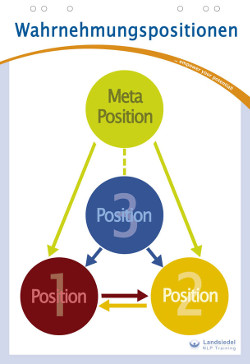
This is a higher logical level. Sometimes, this position is compared to that of a director, who views the situation from the outside with calmness, has all his sensory channels wide open, and is highly flexible. An external observer or witness. No evaluations, purely descriptive. The third position is defined as a resource state, where our senses are maximally available, and we have optimum flexibility to process the information from the 1st and 2nd positions. This position is ideal for rewatching a difficult situation and improving one's own behavior and/or installing a new behavioral automaticity for future situations.
For our behavioral and experiential flexibility, it is crucial that we are able to take all three perceptual positions easily and appropriately.
There is a 90-minute online seminar recording on this topic in our Online Academy with our trainer Joerg-Friedrich Gampper, which you can watch in full right now. Simply click the "Watch Video" button to learn more.
Exercise for Position 1-2-3
- Recall a difficult situation with a peer, with whom you have often struggled to communicate as you would ideally like to.
- Go into Position 1 and fully associate yourself, remembering what you thought, said, saw, heard, and felt.
- Then go into Position 2 and see yourself from the outside with the other person's eyes, hear what you just said from the outside, and see how you look from the outside. Then say what B said and move as B moved. Get a sense of what it feels like to BE B!
- Then go into the 3rd Position and view the whole situation in a dissociated body posture from the outside, describing the situation like a behavioral researcher or a Martian, etc. With the new insights about B and the situation as a whole, go back to Position 1 and change your behavior accordingly. Then continue into Position 2, and so on, until you are satisfied with the situation.
- Then TEST the result in reality!
- The three positions should be marked on the ground as a circle!
Sometimes, it may be necessary to introduce additional resource states along with the 3rd Position and only then return to Position 1 from there. The practitioner can anchor the resource state, which is taken outside of the 3rd Position.
Integration of the Perceptual Positions
Many limitations and difficulties that people encounter are not caused by getting stuck in one of the three perceptual positions, but rather by the fact that our representational systems are distributed across different perceptual positions. This 'split' is the result of an attempt to solve a problem and can sometimes become a permanent personal style. The integration of our perceptual positions results in increased personal congruence and allows us to fully embody all three positions, thereby fully utilizing the benefits of each position, which leads to greater insight and wisdom.
Teil I
- 1. Identify a difficult situation involving another person.
- 2. Elicit the current perceptual position and sketch it.
Visual: What exactly do you see? Do you see yourself and the other person, or just the other person? Where exactly do you see this scene? From where are you viewing the scene? Do you see directly from your eyes, or is your perspective slightly shifted? If the client sees themselves and the other person, you can ask whether the viewpoint is closer to themselves or to the other person. Do you see yourself and the other from eye level, or lower or higher?
Auditory: What do you hear? Whose voices do you hear and where do they come from? Where exactly are you hearing them from? Are there inner or external commentary voices? Where exactly are you hearing these voice(s) from? What exactly does the commentary voice say? Pay attention to personal pronouns: He, She, they, I, You, We, You (plural).
Kinesthetic: What exactly do you feel? Whose feelings are these? Where are the feelings located? Are they neutral or resourceful observer feelings, or do they belong in Position 1 (Self) or Position 2 (Other)?
Part II: Observer Position
- 3. Integration of the Observer Position
If the client is predominantly in Position 1, then the Self-Position can also be integrated first. Pay attention to how the state changes with each instruction towards integration and/or how spontaneous submodality shifts occur, and how these affect the perception of the situation. Additionally, one can observe changes in beliefs. How does your experience of this situation change when you make this shift in your perception position?
Visual: Now take a position from which you can see both yourself and the other person, ensuring that both are at eye level and equidistant. Look directly through your eyes.
Auditory: Now hear the voices of both you and the other person coming directly from the places where they originate, and listen to the voices through your ears as an observer. Let your commentary come from your vocal cords. Use the personal pronouns HE, SHE in your commentary. The comments should refer to yourself and the other person.
Kinaesthetic: Let all feelings that are not observer feelings flow to where they belong. Now ask your unconscious to let all feelings that do not belong to the observer flow to the Self or the Other. Support the client with auditory and visual anchors.
And now you can notice how, in place of the old feelings, new resourceful observer feelings emerge. Have both the Self and the Other moved toward more resources? What else has changed in your perception?