

 DE
DE ES
ES RU
RU FR
FR ZH
ZH HI
HI GR
GR


NLP Introduction and Overview
NLP is a modern communication tool and an instrument for changing one's own personality. It can be applied in therapeutic settings as well as in business and many other contexts. Here you will find an overview of NLP contents, presuppositions, founders, history, learning stages, and definitions of NLP.
- What does NLP mean?
- Definitions of NLP
- Overview Graphic: NLP Founding and Roots
- History of NLP
- The Prince and the Magician
- Model of Learning Stages
- Presuppositions of NLP
What does NLP mean?
NLP stands for Neuro-Linguistic Programming. Here, the three components of the name are explained:
Neuro, Linguistic, Programming.

Neuro
Refers to our nervous system. Every behavior is driven by neural processes. We perceive the world through our five senses. The information is passed through our nervous system within the body. Our nervous system mainly includes the brain and the spinal cord. From there, our thinking, feeling, and behavior are directed.
Linguistic
We use language to communicate with other people. At the same time, communication also takes place within ourselves. That means we have external and internal communication.
Programming
Our learned patterns of behavior and thinking can be changed through targeted interventions. We can program ourselves for the behavior we desire. Change doesn't have to be left to chance — it can happen in a systematic way.
Definitions of NLP
Here you will find classical definitions as well as simplified ones that give you an initial idea of what NLP is.
NLP stands for Neuro-Linguistic Programming and is a communication and motivation model developed in the United States in the 1980s. It was created by linguistics professor John Grinder and mathematician and Gestalt therapist Richard Bandler by modeling the methods of exceptional therapists. Today, NLP can be applied in nearly all areas of life — leadership, therapy, sports, health, sales, public speaking, and relationships.
NLP offers a wide range of tools to help you become more aware of your emotions, thoughts, and behavior — and to develop them in a purposeful and constructive way. In addition, NLP provides many opportunities to discover and strengthen personal talents and abilities. At its core, NLP is a method for gaining deeper awareness of how we and others perceive, communicate, and respond — including our automatic thinking and behavior patterns. It taps into our inner (often unconscious) potential to help us expand or change these patterns. The approach is grounded in years of research into the structure of subjective experience (how people perceive the world and respond to it), communication (how people express themselves and interact through language), and behavioral patterns (how people store what they've learned and repeat it automatically). NLP places particular emphasis on identifying the strategies used by successful individuals — making them understandable, teachable, and accessible to anyone willing to learn. The insights and principles of NLP contribute to improving communication between people and offer a wide range of techniques for setting goals and finding effective solutions.
"The NLP Practitioner Directory" by Trageser and von Münchhausen, 2003.
NLP is the art and science of personal excellence, efficient communication, and peak performance. It's considered an art because each person brings their unique personality and style to everything they do — something that can't be reduced to techniques or words. It's also a science, as there's a clear methodology for identifying the patterns used by exceptional individuals across all kinds of fields to achieve remarkable results. This process is called modeling, and the patterns, skills, and techniques uncovered through it are increasingly being used in coaching, education, and business — to enable more effective communication, personal development, and accelerated learning.
NLP is a hands-on skill set that helps us achieve what we truly want in life — while also creating real value for others. It is about exploring what separates excellence from mediocrity.
"Introducing NLP: Psychological Skills for Understanding and Influencing People" by Joseph O'Connor and John Seymour, 1994
Overview Graphic – Origins and Foundations of NLP
This graphic shows the founders of NLP, the disciplines it draws from, and the original experts who were modeled

Areas of Application

History of NLP
This section offers a brief overview of how NLP emerged, the key figures involved, and how it evolved over time.
The story of NLP begins in the 1970s, when two American researchers — Richard Bandler and John Grinder — crossed paths. At the time, John Grinder was an assistant professor of linguistics at the University of California in Santa Cruz. Together, they set out to explore what sets high performers apart — specifically, how certain individuals achieve exceptional results in their fields while others struggle. They chose to study these successful individuals as models, analyzing the mental and behavioral patterns that helped them reach their goals.
Bandler and Grinder became especially well known for modeling four extraordinary figures:
- Dr. Milton Erickson, one of the most influential hypnotherapists in the world;
- Virginia Satir, a groundbreaking family therapist;
- Fritz Perls, the father of Gestalt therapy;
- and Gregory Bateson, a brilliant and multifaceted philosopher and anthropologist.
After identifying the patterns of these masters of communication, they began teaching and developing them further in workshops and seminars for students.
Today, NLP is practiced around the world and is used in a wide range of fields — including therapy, relationships, sales, sports, and education.
The Prince and the Magician
A beautiful, yet not entirely simple story that illustrates the basic idea behind NLP's concept of truth: The world is our subjective construction.
Story of the Prince and the Magician
A beautiful yet thought-provoking story that captures a core idea in NLP: The world we experience is a subjective construction.
Once there was a young prince who believed in everything — except three things.
He didn't believe in princesses, he didn't believe in islands, and he didn't believe in God.
That's because his father, the king, had assured him that none of these existed. And since there were no princesses, no islands, and no sign of God in his father's kingdom, the prince trusted him. One day, the prince left the royal palace and wandered into a neighboring land.
To his surprise, he saw islands from every shore he went to— and on those islands, he saw strange and bewildering creatures he didn't dare to name. While searching for a boat, a man in a formal tailcoat approached him on the beach.
"Are those real islands?" asked the prince.
"Of course," the man replied.
"And those strange creatures?"
"Those are real princesses."
"Then God must exist too!" exclaimed the prince.
"I am God," said the man, bowing deeply.
The prince hurried back home, as fast as he could.
"I've seen islands, I've seen princesses, I've seen God!" he told his father accusingly.
The king remained calm. "There are no real islands, no real princesses, and no real God."
"But I saw them!"
"Tell me — what was God wearing?"
"God was dressed formally, in a tailcoat."
"Were the sleeves of his coat turned back?"
The prince remembered that they were. The king smiled. "That's the uniform of a magician. You were tricked."
The prince returned to the neighboring land and went to the same shore, where the man in the tailcoat once again approached him.
"My father told me who you are," said the prince. "Last time, you fooled me. But now I know those islands and princesses aren't real — because you're a magician."
The man smiled gently.
"No, my boy. Your father is the one who cast a spell on you. His kingdom is full of islands and princesses. But you can't see them — because you've been enchanted."
The prince returned home, lost in his thoughts.
When he saw his father, he looked at him closely.
"Father, is it true? Are you not really a king, but a magician?"
"Yes, my son. I am only a magician."
"Then the man on the shore was God?"
"No — he was another magician."
"But I want to know the truth — the truth beyond all this magic."
"There is no truth beyond magic," said the king.
The prince grew quiet.
"Then I'll end my life," he whispered.
The king conjured death, and death appeared, waiting at the door. The prince trembled.
He remembered the unreal islands and the beautiful, unreal princesses.
"Alright," he said. "I can bear it."
"You see, my son," said the king, "you are beginning to become a magician yourself."
from: John Fowles, The Magus, Munich 1969, p. 607f.
Model of the Learning Stages
The model of the learning stages describes the developmental steps through which our learning takes place.

| Unconscious Incompetence At this stage, we don't even know what we don't know. We haven't yet realized that a certain skill or knowledge is missing, because we never thought about it. |
Example: Someone rides in a car regularly but hasn't yet thought about getting a driver's license. |
| Conscious Incompetence Now we realize there's something we can't do — and that we'll need to learn and practice if we want to master it. |
Example: You've decided to get your license and are behind the wheel for the first time. |
| Conscious Competence You've learned the skill, but it still takes effort. You have to stay focused and apply what you've learned intentionally. |
Example: While driving, you're fully focused and thinking about every move you make. |
| Unconscious Competence The skill has become second nature — you use it naturally and without thinking about it. |
Example: Driving feels so easy that you can carry on a conversation while doing it. |
Core Assumptions in NLP
NLP is built on a set of practical assumptions. These are not objective facts, but they make communication with others — and one's own life — easier.
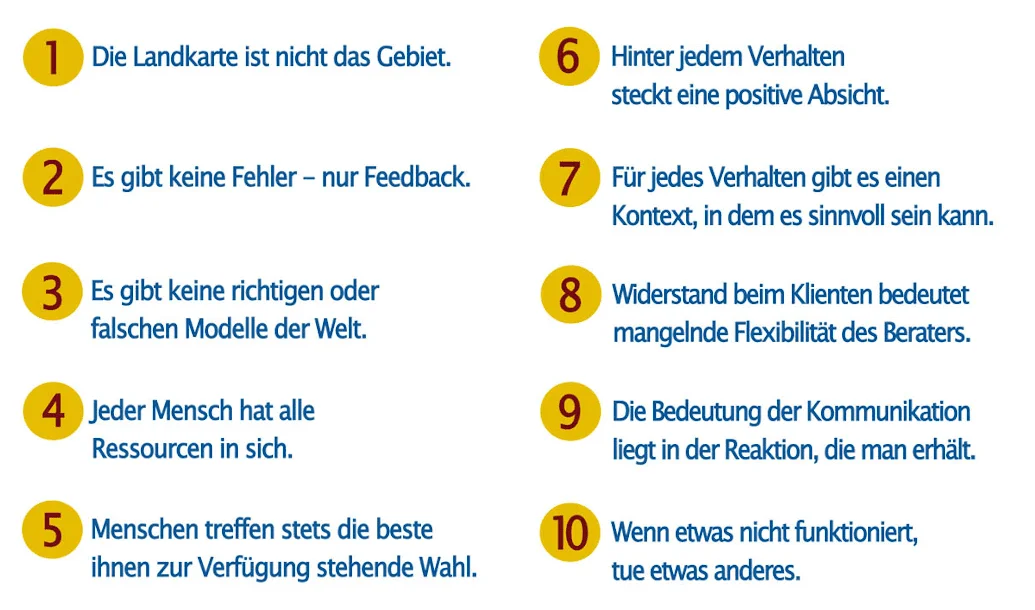
- The Map Is Not the Territory
We all have different ideas about the world. None of these ideas fully or accurately represent reality. We don't react to the world or reality itself, but to how we perceive it. - There's no such thing as failure in communication — only feedback.
Every outcome can teach us something new. Feedback shows us whether our approach is working and gives us a chance to adjust and try again. - There's no right or wrong way to see the world.
We all wear different "glasses" — each shaped by our experiences, beliefs, and background. - People already have all the inner resources they need to create change.
NLP helps bring these resources to the surface — so they can be accessed when they're needed most. - People make the best possible choice available to them in any given moment.
Most unhelpful behavior isn't driven by malice — it comes from a lack of better options. If people knew a more effective way to meet their needs, they'd choose it. - Behind every behavior — even problematic symptoms — lies a positive intention.
Every behavior has a positive intention behind it. Even if the behavior causes problems, it usually starts to solve something important. - Every behavior can be useful — in the right context.
If someone repeats a behavior, it is likely that it worked for them in the past. NLP helps expand their toolkit, so they're not stuck with just one option. - Client resistance means the coach needs to adjust.
When someone pushes back, it's not personal — it's often a sign that connection is missing. Rebuilding rapport is the key. - The meaning of your communication is the response you get.
We communicate to get a desired reaction. If you don't get your wanted reaction, the message hasn't landed. Instead of blaming the other person, try a different way of getting through. - If something doesn't work, change your approach.
Flexibility is power. Every reaction — even an unwanted one — is a valuable clue for your next step.
Video: Core Assumptions in NLP
What are the key assumptions behind NLP? In this video, Stephan Landsiedel — NLP trainer and coach from Kitzingen — shares insights into common beliefs that are often debated or challenged. At the heart of it all is one powerful message: Behind every intention — no matter how it looks on the surface — there's something positive.
Working with Beliefs
Often, the biggest obstacles to success aren't out there — they're inside us. Sometimes these blocks operate under the surface, but just as often they show up as familiar thoughts when we start something new:
"I'm too young... too old. I don't have the money. I'm not qualified enough. I don't know the right people. I come from a simple background. I don't deserve this. I'm not good enough..."
Beliefs like these shape how we see ourselves and the world — they're the foundation of our personal reality.
Learn how these beliefs affect your life, how they originated, and how you can change them — in yourself and in others.
You'll learn to replace limiting beliefs with more empowering ones using practical tools like Sleight of Mouth , the Dickens Pattern, the New Behavior Generator, and more.
Working with Values
Freedom. Love. Honesty. Success.
Our values are what drive us from within — they shape our decisions, our priorities, and the way we live. They can inspire greatness, but they can also fuel conflict.
Wars are waged, terrible suffering endured, and people destroyed — all because of values. And yet, most people are not even aware of their own values, let alone those of their partners, friends, or clients. Conflicts often arise when we don't have a clear order of our values— especially when two core values pull us in opposite directions, like choosing between career and family. In this session, you'll explore how values are formed, uncover your personal value hierarchy, and reflect on potential value conflicts and personal rules that guide your behavior.
You'll also practice how to uncover someone else's values — whether in a coaching session, a team setting, or a private conversation. When you start living in alignment with your values, you'll tap into a new level of inner strength and clarity.
Advanced Hypnosis Techniques
Advanced methods of clinical hypnosis are practiced: trance inductions and trance phenomena, post-hypnotic suggestions, ideomotor signals, self-hypnosis, advanced methods of creating metaphors, and the use of trance elements in everyday communication processes.
Meta Programs
Meta programs are individual perceptual filters that shape how we perceive the world — and they show up in our behavior. By learning to recognize these patterns in yourself and others, you'll gain a powerful tool for understanding motivation, decision-making, and communication styles.
Advanced Life Design
Using advanced Time Line techniques, you'll continue designing your life consciously, work through unresolved emotional patterns, and set a clear path for your future.
Modeling
Learn how to replicate human peak performance at an advanced level. This block connects the beginnings of NLP with its modern applications. You will learn how to decode the thought and behavior patterns behind extraordinary performance — and how to apply these insights for personal or professional growth.
At the end of the Master Practitioner training, you'll have a comprehensive command of all key NLP techniques. Your knowledge will be assessed through a mix of theory and practical application.
To earn your certification, you'll also complete a small independent project — either of your own choosing or based on a suggestion from the trainer.
With your Master Practitioner certificate in hand, you'll be eligible to continue your path with the NLP Trainer training.