

 DE
DE ES
ES RU
RU FR
FR ZH
ZH HI
HI GR
GR


NLP Modelling
Introduction to Modelling
Modelling is the original discipline of NLP. If we think back to the history of NLP, all these strategies and techniques emerged from observing peak performances of outstanding experts, breaking them down into small chunks, and finally describing them in a way that enables others to replicate them.
One can say with Dilts:
"NLP is the process through which the relevant behavioral components of those individuals who are exceptionally gifted in communication are discovered and organized into a working model.
.... NLP has developed techniques and criteria that allow for the identification and description of patterns in verbal and nonverbal behavior.
.... The goal of the NLP modeling process is not to produce the one correct or true description of the thinking process of a particular person, but rather to create an instrumental map that allows us to apply the modeled strategies in any useful way."
According to Walker:
"In modeling, the attempt is made to conceptually represent a process in such a way that it is possible for third parties to practice this process."
Modeling can be carried out in many ways. The spectrum ranges from unconscious and informal modeling (which we constantly do with others) to sophisticated, complex modeling strategies for peak performances in various fields. Modeling is a natural process. Children intuitively model their parents and other people, thus learning complex behaviors, attitudes, and perspectives in an unconscious way.
In modeling, it is crucial to focus on which level or chunk size of skills one wants to concentrate on. Sometimes simple imitation or mirroring is enough when it comes to simple behavioral skills. However, this is ineffective when it comes to complex cognitive and linguistic skills.
The most commonly used methods in NLP for elicitation are:
- the recalling and re-experiencing of a specific experience or
- performing a task that requires or triggers a specific skill, strategy, resource, or problem state.
For example, if a person is an excellent speaker, one might ask them:
- (a) to think of an occasion when they gave a speech, or
- (b) to stand in front of a group and speak.
Different terms are often used: the English "modeling", modeling process, model creation, or the German "Modellieren".
What can modeling be applied to?
- Improving metacognition:
To better understand something so it can be taught, for example. - Improving performance:
So that something can be repeated until it is refined and perfected, for example: athletes. Top experts are examined closely in this process. - Achieving a specific result:
For example, spelling, overcoming phobias or diseases. Successful cases or examples are examined here. - Transfer to other content:
Processes that are useful in one area of life or context can be transferred to another area.
Three Fundamental Perspectives in Modeling

In successful modeling, a particular phenomenon or occurrence is viewed from multiple perspectives. Here, the three perceptual positions from the NLP Practitioner are very helpful.
The first position represents one's own perspective - the situation is fully associated with oneself.
The second position is the perspective of the other - one views oneself and the situation dissociated from oneself.
In the third position, one is a detached observer and takes an external perspective.
- Modeling from the first position means trying something yourself and exploring how "we do something." We see, hear, and feel from our own perspective.
- Modeling from the second position means "stepping into the shoes" of the person being modeled and trying to think and act as much as possible like that other person. This can provide important intuitive insights into meaningful but unconscious aspects of the thinking and behavior of the modeled person.
- Modeling from the third position would mean stepping back and observing as an uninvolved witness how the person to be modeled interacts with others (including ourselves). In the third position, we suspend our personal judgment and focus solely on what our senses perceive, like a scientist observing a specific phenomenon through a telescope or microscope.
- The fourth position would involve an intuitive synthesis of all these perspectives to get a sense of the entire "gestalt."
Implicit and Explicit Modeling
Skilled performance can be described as a function of two basic dimensions:
Awareness (knowing) and Competence (doing). It is possible to know or understand an activity but be unable to perform it (conscious incompetence). It is also possible to be good at an activity but not know how you do it (unconscious competence). Mastery of a skill means having both the ability to "do what you know" and to "know what you do."
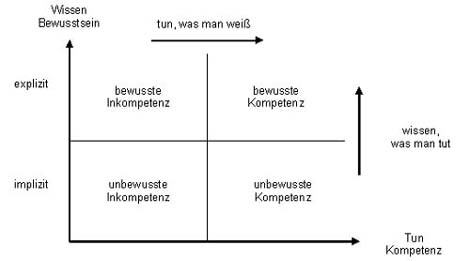
Cognitive and behavior-specific competencies can be modeled either implicitly or explicitly. Implicit modeling means primarily stepping into the second position with the person to be modeled in order to personally gain an intuitive sense of what subjective experience they are having. Explicit modeling means stepping into a third-person perspective to describe the explicit structure of the role model's experience so that it can be transferred to others.
| Implicit | Explicit |
|---|---|
| Experience - Intuition - Self-application (making subjective experience from the second position understandable) unconscious, right hemisphere | Intuition - Structure - Transfer to others (defining the structure of subjective experience from the third position) conscious, left hemisphere |
| General - the whole | Specific - parts |
| Synthetic | Sequential |
| State | Strategy |
| Associated | Dissociated |
| Inductive, intuitive, analog | Deductive, cognitive, digital |
| Child | Adult |
| External - internal | Internal - external |
| Area | Map |
Basic Phases of Modeling (from Dilts: Modeling with NLP)
The following basic phases of the typical NLP modeling process reflect the journey from implicit to explicit modeling, which was originally embedded in Grinder's initial suggestion to Bandler:
Preparation
Preparation for modeling involves (1) selecting a person who has the skill you want to model, and (2) determining the following:
- the context in which the modeling should take place
- where and when you want access to the person being modeled
- what kind of relationship you want with the person being modeled
- in what state you will be during the modeling process
It also involves setting up the appropriate conditions, anchors, and "lifelines" that will allow you to fully commit to the project.
Phase 1: Unconscious Entry
In the first phase of the modeling process, involve the person to be modeled in an example of the desired performance or skill within an appropriate context. Begin the "modeling" by stepping into the second position to intuitively get a feel for the skills the person displays. This is done without looking for specific patterns. Instead, simply take on the posture and physiology of the model and try to internally identify with him or her.
Sometimes it is better to adopt the micro-muscle movements of the person instead of mirroring their obvious actions. The obvious behavior of the model is the surface structure. Micro-muscle movements and changes in the second position will allow you to reach the underlying deep structure. (Additionally, obvious mirroring can sometimes distract the person you are trying to model.)
This is the phase of "unconscious entry." Do not try to consciously understand what the model is doing just yet. Building filters can cause you to miss important information. You do not yet know what is important and what is not. In this phase, it is often useful to start from a state of "not knowing yet." This is a state in which all previous mental maps and assumptions about your current experience are set aside. When someone enters a state of "not knowing," they attempt to let go of all previous assumptions and form a fresh, unbiased view of a particular situation or experience.
When you realize that you have developed a good intuitive sense of the person you are modeling in the second position, bring yourself into a context where you can apply the skill being examined. Begin trying out the skill within this context, "as if" you were the person you have modeled. Then, try to achieve the same results by being "yourself."
This will give you a so-called double description of the skill you are modeling. If you evoke similar reactions to the model, the first modeling phase is complete.
Phase 2 - The Subtraction Process
The next step in the modeling process is sorting out what is essential to the behavior of the model from what is irrelevant. (For example, you do not necessarily have to sit in a wheelchair and wear a purple pajama like Milton Erickson to achieve similar therapeutic results with hypnosis as he did.) In this phase, you begin to explicitly formulate the strategies and behaviors you have modeled. Since you are able to evoke similar reactions to the person you are modeling, you will also want to use your own behavior in the first position as a reference point. (That is, performing the skill as "yourself" rather than "as if" you were the person you modeled.)
Your goal is to clarify and define the specific cognitive and behavioral steps required for the desired results in the selected context(s). At this stage, you will also gradually and systematically remove parts of each of the behaviors or strategies you identified to see what truly makes a difference.
Anything you remove that does not make a difference to the responses you get is not essential to the model. If you remove something that makes a difference to the results you achieve, you have discovered something essential to the model. This approach is called the "Subtraction Process." Its purpose is to reduce the modeled steps to their simplest and most elegant form and distinguish the essential from the "superfluous."
When you have completed this phase, you will have your current "minimal model" of how you can reproduce the model's skills within yourself (i.e., in your first position). You will also have your intuitive insights from your second position about the model's skills, which you developed by putting yourself in his or her place. Additionally, you will have a perspective from the third position, with which you can recognize the difference between how you reproduce the model's skills and the unique way that person displays the skill. This is called a triple description in NLP.
Phase 3 - Design
In the final phase of modeling, a context and a method are designed through which others can learn the modeled skills and be able to achieve the results that were attainable for the person serving as the model. For this design, you should synthesize the information you obtained from all three perceptual positions.
Instead of simply imitating the individual steps the modeled person went through, it is generally more effective to create corresponding reference experiences for the learners, with which they can discover and develop the specific "circuit" they need to successfully master the skill. To acquire the skill, it is not necessary to have them go through the same modeling process you did.
Different learners will have different conscious and unconscious competencies as "starting points." You should definitely take this into account in your design. For example, if a particular process you modeled requires visualization, some learners may already be able to do this quite well, while for others, it may be a completely new concept. Some learners may be able to combine multiple steps of the process into one, while others may need to break a particular step into smaller sub-skills.
Again: The guiding principle is the "usefulness" of your design for the learners for whom the model is intended.
Identifying Features in the Modelling Process
The key features or distinctions that are considered during the NLP Modelling process are:
- Physiology
Observing body structure, posture patterns, gestures, symmetry, movement styles, eye movements, and other access cues, such as verbal patterns like tone of voice and speaking speed (the B.A.G.E.L. model). - Cognitive Strategies
Observing preferences for specific sensory representation systems, submodalities patterns, and habitual cognitive sequences (the R.O.L.E. model). - Meta-Program Patterns
Observing general organizational patterns like time perception and management, relationships with close ones, goal orientation, etc. - Beliefs and Value Systems
Observing all expressed values, rules, attitudes, and assumptions related to the modeled behavior or skill. - Meta-Patterns
Observing the interaction between the person being modeled and others with whom they interact in the situation being modeled. Pay attention to all communication patterns and relationships between the modeled person and others involved.
Of course, some of these distinction criteria will be more relevant for modeling certain skills than others.
For example, simple behavioral modeling will most likely focus on certain patterns in physiology. On the other hand, modeling simpler cognitive skills will generally place more emphasis on representation systems and submodalities. Modeling a complex behavioral skill would require more focus on interactive meta-patterns and so on.
The following list shows which NLP distinction categories generally apply to the skill level at the center of a particular modeling project:
- simple behavioral - specific physical cues and actions
- simple cognitive - representation systems and submodalities
- simple linguistic - Meta-Model patterns and predicates
- complex behavioral - S.C.O.R.E. model distinctions and perceptual positions
- complex cognitive - S.O.A.R. model distinctions, meta-program patterns, and logical levels
- complex linguistic - communication matrix distinctions and Sleight of Mouth patterns.
The R.O.L.E Model
For information on this, please refer to the following page: R.O.L.E Model.
The B.A.G.E.L Model
For information on this, please refer to the following page: B.A.G.E.L Model.
Sequence of Steps in a Modelling Process
- Conduct a needs analysis to determine the specific topics, contexts, and skills to be addressed.
- Select the individuals to be modeled.
- Create modeling scenarios and carry out modeling procedures so that the skills or performances under study can be elicited and the necessary information gathered.
- Identify relevant patterns in the behavior, strategies, beliefs, etc., of the individuals who were modeled.
- Organize the patterns that have been discovered into a descriptive and instructional structure—that is, into a model.
- Experimentally test and refine the model by applying it in relevant contexts to see whether it leads to the desired results.
- Develop effective procedures and tools for implementation or intervention so that the main elements of the model can be taught to or applied by others.
- Measure the results obtained by applying the model.
Summary of the Steps in the Modeling Process
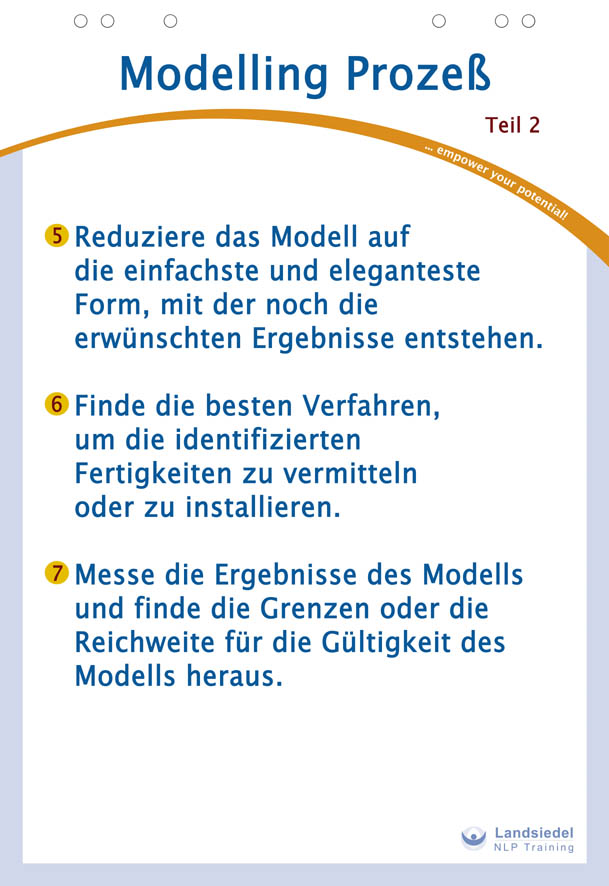
We can summarize the basic phases of the NLP modeling process in the following sequence of steps:
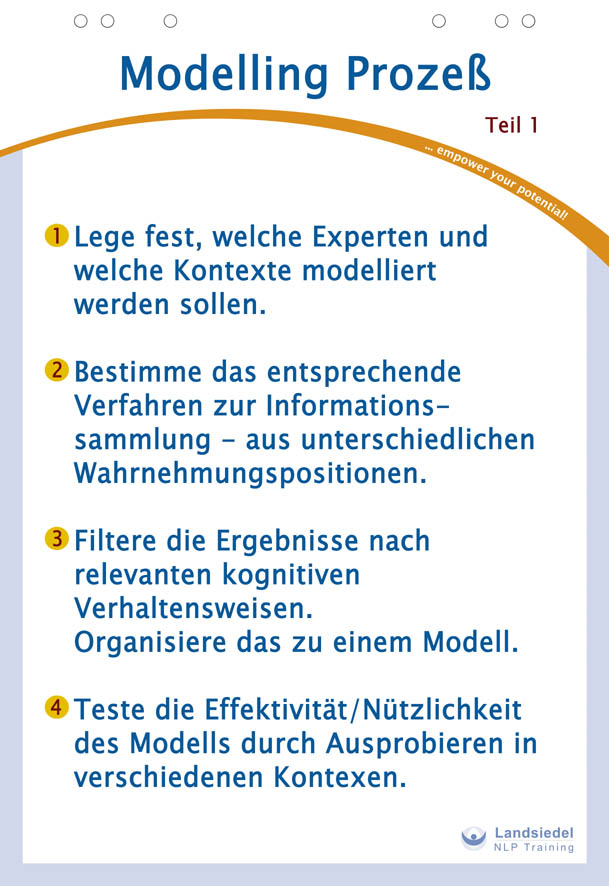
- Determine which experts and which contexts, in which they apply the skill to be modeled, you want to model.
- Identify the appropriate procedure for gathering information in the relevant contexts – from different perceptual positions. Start from intuitive insights gained from the second position, then attempt to achieve the same results from your own first position. Take a third position and observe how your method of achieving the goal differs from that of the modeled person.
- Filter the results of the information gathering for relevant cognitive and behavioral patterns. Organize the patterns into a logical, coherent structure or "model."
- Test the effectiveness/usefulness of the model you have constructed by applying it in different contexts and situations, and focus on achieving the desired results.
- Reduce the model to the simplest and most elegant form that still produces the desired results.
- Identify the best methods for teaching or "installing" the explicit skills identified during the modeling process.
- Determine the most suitable tools for measuring the results of the model, and discover the limits or the scope of its validity.
Robert Dilts' Modelling Strategy
- Determine the desired skill or ability to be modeled, as well as the person(s) who possess this ability.
- Create a situation or context in which you receive at least three different specific examples from the people you want to model, showing how they demonstrate the desired skill.
a) Identify the critical factors in each example using the following perception filters:
- Access cues
- Language patterns - Meta-model, predicates, etc.
- Physiology
- Representation systems, strategies, and submodalities
- Meta-program patterns
- Beliefs and values
- Logical levels
- Find at least one counterexample – that is, another person or other people (including yourself) who are not able to demonstrate the skill appropriately, or situations in which the model was not able to demonstrate the skill appropriately. Determine the critical factors of the counterexample(s) by using the same filters as in step 2a.
- Compare the critical factors in the three successful examples with the critical factors in the counterexample(s). Pay attention to the significant differences.
- Modify all significant critical factors of the counterexample(s) so that they match the significant critical factors of the successful examples, until you achieve the desired behavior or results in the individuals or situations that make up the counterexample(s).
If changing these factors in the person(s) or situation(s) does not lead to the desired behavior or result, find other more suitable or stronger examples to model and repeat the process starting from step 4 until the desired behavior or result is achieved. - Now, begin to modify the critical factors that contributed to achieving the desired behavior or result, one at a time.
a) Find the limit by determining how far you can modify the factor before it changes the outcome.
b) Principle of elegance: Find the minimum number of factors necessary to achieve the desired behavior or results.
Lesson Content