

 DE
DE ES
ES RU
RU FR
FR ZH
ZH HI
HI GR
GR


Pathways to the Unconscious – NLP and Hypnosis
Table of Contents
- Introduction
- Prejudices and Objections Against Hypnosis
- Why Learn Hypnosis?
- Clarifications of Terms
- History of Hypnosis
- Principles of Hypnosis
- Basic Principles of Hypnosis
Introduction
Open the doors to your unconscious potential by learning and applying the Milton Model of language. Hypnotic language patterns allow you access to trance states and thus to levels of consciousness that would otherwise remain closed to you.
Whenever John Grinder and Richard Bandler lead a hypnosis seminar together, one of them will eventually say, “Actually, every communication is hypnosis,” and the other will reply, “I must disagree. Nothing is hypnosis – there is no such thing as hypnosis.” In a certain sense, they both mean the same thing, and each of them is correct. If one understands hypnosis as something that changes the state of consciousness, then every successful communication is hypnosis.
Prejudices and Objections Against Hypnosis
The topic of "hypnosis" stirs up emotions like no other. Numerous prejudices and objections against hypnosis are voiced by laypeople who have already seen so-called stage hypnosis on television and now let their imaginations run wild.
- The hypnotist exerts control over a person who has become will-less (puppet theory). Hypnosis is to be understood as an imaginative therapeutic method, where the patient's ability and willingness to imagine plays a key role. They always have insight into their behavior and influence the course of communication by reporting on their imaginations or cognitions. The will is by no means turned off.
- Myth of the magical. Most people are unaware of the phenomena that occur under hypnosis and their explanations. Therefore, unknowing people attribute them to magic. In fact, there are now many scientific studies on the various hypnosis phenomena.
- I can't be hypnotized. Anyone who wants to be can, in principle, be hypnotized. It only requires the right induction method. As a hypnotist, your main task is to find out what a person naturally responds to.
- I was still fully awake and could hear everything. If you hear and see nothing, you're dead. Under hypnosis, everything is usually seen and felt more intensely.
- Hypnotizability has something to do with character strength (weak-willed and easily influenced). However, there is no empirical evidence for this. The level of intelligence also has no influence on hypnotizability. Research shows, however, that hypnosis is related to certain mental abilities such as absorption (the ability to fully immerse oneself in an activity), imagination, and likely also creative abilities.
Why Learn Hypnosis?
Duration: 3:44 minutes
This section is about the benefits hypnosis can bring us and why it makes sense to engage with it.
- Hypnosis and hypnotic language can be used in any part of daily life and at any time.
- Unfolding one's own personality, flexibility, expanding life possibilities, in play, work, love, and sales.
- We all have experiences with altered states of consciousness, such as sleeping, riding a bike automatically, going to the basement and not remembering what we intended to do.
- Clinical use, e.g., quitting smoking, weight loss, wisdom tooth removal, anxiety management, pain reduction.
- If it is true that unconscious processes essentially follow learned and automated patterns, then it makes perfect sense to aim for changes directly at this level.
Further information on learning hypnosis.
Definitions
The terms hypnosis and trance are defined and explained in more detail.
- A trance state is a different state of consciousness than the usual one. Typically, the client is rather immobile and directs their attention inward, focusing on an internally recalled or generated experience. The trance state has nothing to do with sleep, but it cannot be physiologically distinguished from meditation and relaxation. However, hypnosis should not be equated with relaxation, as trance phenomena can be produced without physical relaxation, and the ability to be hypnotized, unlike relaxation, cannot be trained. Nevertheless, the trance state is not unique and does not differ completely from everyday trances in the waking state, such as highway hypnosis or becoming absorbed in a good book.
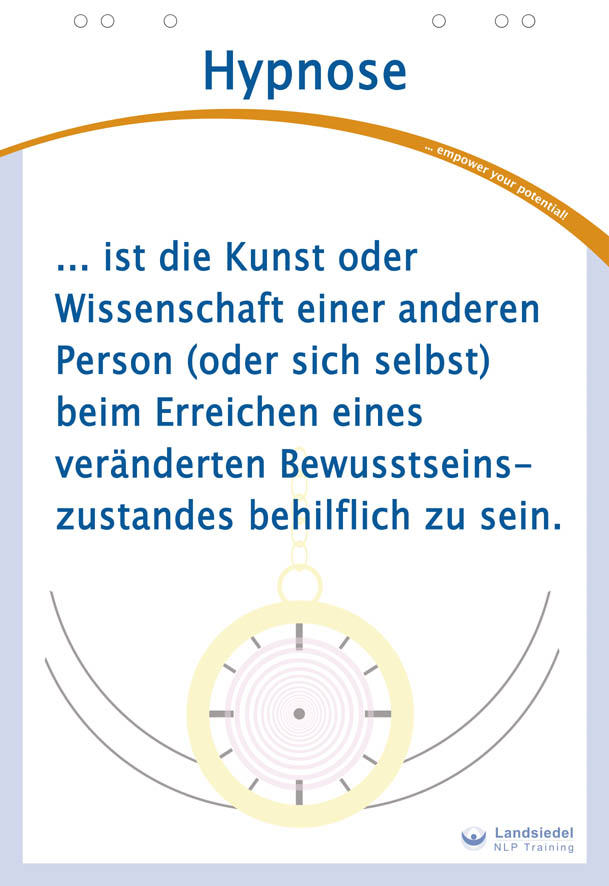
- Hypnosis is the art or science of helping another person achieve an altered state of consciousness. We do this all the time, but the systematics of the method are crucial. One of the main tools is language.
Duration: 4:47 minutes
- Transderivational Search is the process of searching for meaningful content from one's own memory and imagination related to something said, heard, or seen, e.g., "Everyone knows times when they feel that all the things they have worked for are worthless. Everything they have believed in so far...."
Definitions of "Altered States of Consciousness"
- Any state of consciousness that differs from your usual state.
- A state of consciousness where your attention is so intensely focused on an object or process that all other perceptions are excluded.
- Activity of the non-dominant brain hemisphere.
- A state of consciousness where the attention is directed inward.
History of Hypnosis
Duration: 5:15 minutes
This section offers a brief journey through the history of hypnosis. Hypnosis is one of humanity's oldest rituals. It has been practiced for thousands of years.
- Early Cultures
Hypnosis has been used for thousands of years in different cultures and for various purposes. Example: Temple sleep in ancient Egypt. - Exorcism
The Catholic priest Johann Joseph Gassner (1727–1779) once believed that the devil was trying to possess him and then applied the exorcism rites of the Catholic Church – similar to hypnotic suggestions – successfully on himself and later on others.
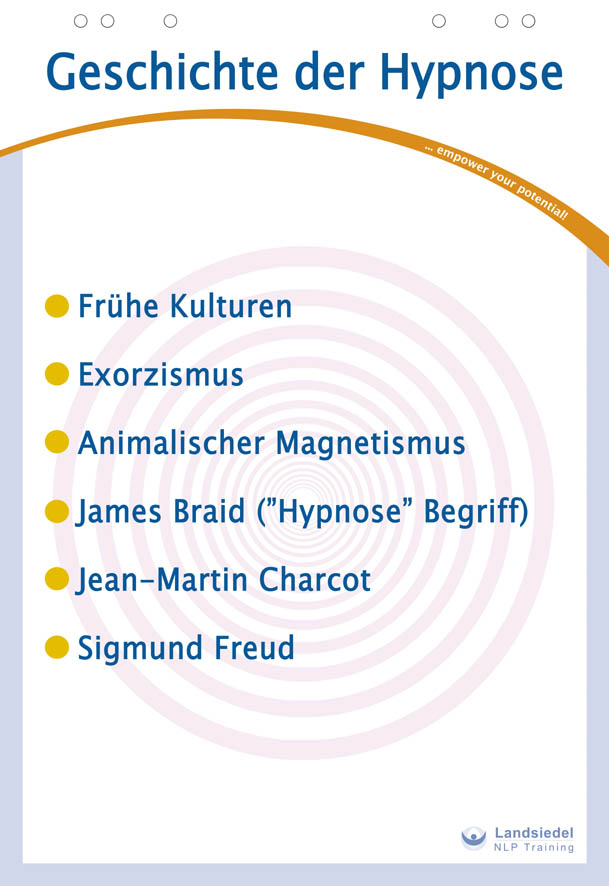
- Animal Magnetism
The German Franz Anton Mesmer (1734–1815) is considered a pioneer of modern hypnotherapy. According to his theory, illnesses were caused by an animal magnetism in the body. A commission could not confirm this.
However, his great therapeutic successes are undisputed and are attributed to suggestive influence. Although incorrect, this approach represents the first scientific attempt to understand hypnosis. - James Braid
(Scottish physician and surgeon, 1795–1860) coined the term “hypnosis.” Since Braid, the cause of healing has been attributed not to the magnetizer and their magnetic powers, but to the patient. - Charcot
(French neurologist, 1825–1893) successfully used hypnosis with patients suffering from hysteria. - Freud
later became critical of hypnosis, which is why it was less popular during his career.
Principles of Hypnosis
Presentation of the principles of the indirect form of hypnosis as represented by Dr. Milton Erickson. The principles typical of Ericksonian hypnosis are:
1. Utilisation
Hypnotic suggestions should not be imposed on the client or force them to do anything. Instead, they aim to activate or modify the natural mental mechanisms and associations already present in the patient (Erickson, Rossi & Rossi, 1978). This means allowing a client who seems inclined to move to actually move, or incorporating existing fears into the process. The goal of utilization is to elicit a “yes” attitude in the client and thus avoid resistance or even use it therapeutically. Utilization is a powerful tool for building a trusting therapeutic relationship (rapport).
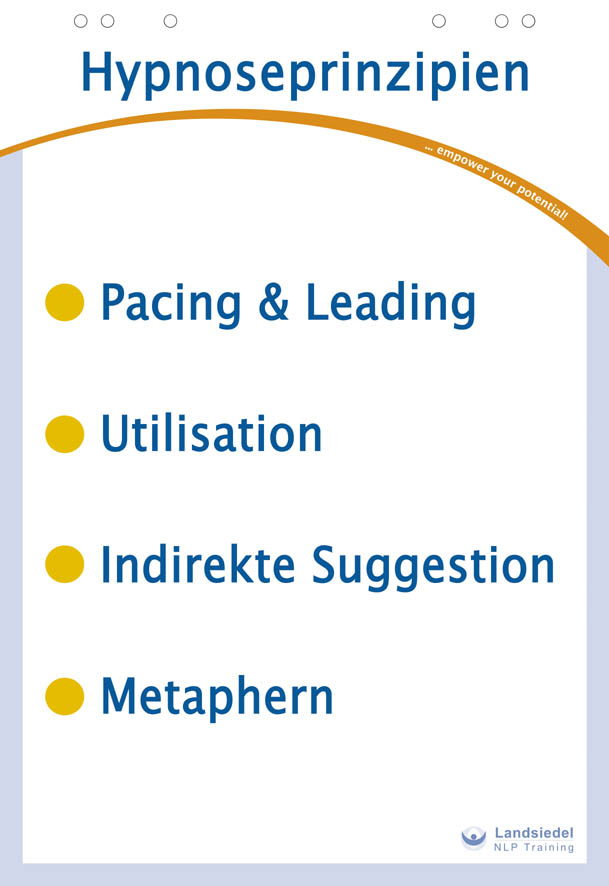
2. Indirect Suggestions
This approach prevents resistance from arising before it even begins. “The verbalizations used for induction and during therapy are not directly given as commands, but in a special form of communication. The patient always experiences recognition and can continue to develop or maintain a positive attitude.” (Kossak, 1989, p. 134). The idea behind indirect forms of suggestions is to ease the client's experience of new response possibilities and to trigger automatic unconscious search processes, independent of the conscious will (Erickson & Rossi, 1981). Erickson's indirectness was the real novelty, but Erickson could do everything: direct or indirect, helpless or authoritative, depending on what seemed appropriate to him.
3. Pacing and Leading
(Pacing & Leading): Following consists of, among other things, describing or even copying the client's specific behaviors (posture): “You are sitting comfortably in your chair, with your legs crossed, and you are waiting...”. This builds a positive attitude. After a certain period of following, the therapist can switch to leading. The therapist now applies the interventions and intentions they have planned, always coordinating with the patient's following: During induction, the therapist initially follows the patient's breathing rhythm by adjusting their own breathing during communication/suggestion. Once the patient shows signs of relaxation (slightly slower and deeper breathing), the therapist slightly slows their own breathing rhythm, encouraging the patient to breathe even slower and more deeply, leading to a deeper state of relaxation.
4. Metaphors
Erickson frequently told his clients stories, fairy tales, wordplays, symbols, or anecdotes with many layers of meaning. By telling a complex story or metaphor, the conscious mind is distracted and an unconscious search for meaning and resources is activated. In an effective metaphor that shows a solution to the problem, the relationships between the elements of the story are the same as the relationships between the elements of the problem. If this is the case, a metaphor can be understood and implemented in the unconscious (O'Connor & Seymour, 1994).
He placed great emphasis on ensuring that the analogy was not consciously recognized. If he noticed that a client was getting close to the real meaning of his words, he quickly switched topics. In this way, he created amnesia through distraction.
The advantages of metaphorical communication are clear: Stories are not threatening. They captivate the conscious attention and promote the independence of the clients. They can assign a specific meaning to the message contained in an anecdote. The conclusions they draw from it largely depend on their personal background. Sometimes, stories can also cause confusion and increase a person's willingness to enter hypnosis.
The directive aspect is only implicitly contained, allowing resistance to change to be bypassed.
Basic Principles of Hypnosis
Possible Perceptions in Altered States of Consciousness:
- Feeling of lightness in the head, neck, and the entire body
- Head buzzing; a calm, pleasant sensation
- Slowed heartbeat and breathing
- Tingling or pulsing in fingers/toes
- Dissociated body sensation
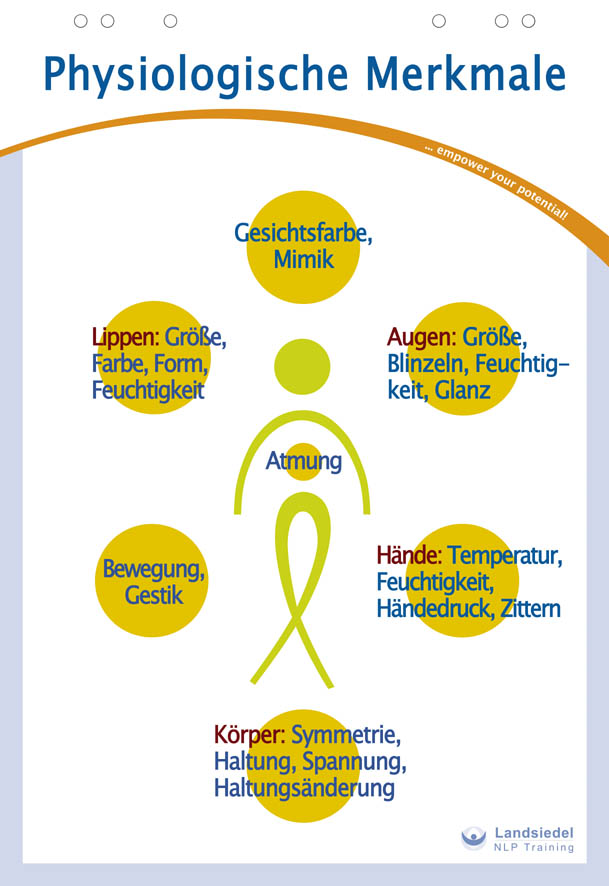
Possible external signs of altered states of consciousness (Trance signals):
- Muscle tone:
Relaxation of muscles, especially in the areas of the face, neck, shoulders, and hands. - Enlargement of the pupils (“staring” gaze)
- Breathing: Slowing down, becoming calmer and more regular, more abdominal breathing
- Pulse: Slowing down (possibly visible at the neck or temples)
- Reflexes such as blinking or swallowing slow down or disappear
- Eyes water
- Change in skin color on the cheeks and neck
- Body movements slow down; the body appears motionless.
Internal signs of altered states of consciousness are:
- Decrease in stress hormones
- Decrease in breathing and heart rate, as well as blood pressure and metabolic rate
- More alpha waves in the right hemisphere of the brain
- Change in blood composition
- Restriction of attention
- Change in body perception
- Visual thinking
- Trance logic
Lesson Content