

 DE
DE ES
ES RU
RU FR
FR ZH
ZH HI
HI GR
GR


The Meta-Model of Language
Become aware of the magic of your language. It is not only the foundation for clear communication, but also for rapid and targeted change. With this NLP technique, master one of the leading language tools of our time. Become a master of spoken language.
Table of Contents
- What is the Meta-Model?
- The Recovery of Lost Information
- Introduction to Meta-Model Violations
- Language Patterns of the Meta-Model
- Overview Table of Meta-Model Patterns
- Beware of the Meta-Model Monster!
What is the Meta-Model?

Misunderstandings in communication happen every day. They are a part of daily life. Often, they are based on a false assumption: people trust that they have clearly communicated a particular matter. In reality, that is often not the case. In a conversation, participants rely on their own personal background of experiences. This becomes problematic when the listener has a different background than the speaker. If important information is omitted—information the speaker assumes is “obvious”—this can lead to a sender-receiver problem.
Commonly observed language patterns that lead to misunderstandings are deletions, generalizations, and distortions. The Meta-Model provides a way to question these unclear elements in conversation and respond to them. It consists of a series of questions that help uncover more about the underlying deep structure of statements from their surface structure.
Goal: Through the Meta-Model, lost information can be recovered and connections can be better understood.
Recovering Lost Information

When we speak, we often leave out information, generalize, or distort. As a result, a sent message often no longer fully corresponds to the message actually intended. This leads to misunderstandings in communication. Therefore, it becomes necessary to recover the information that has been lost.
When we share our experiences with others, we make a series of choices from the totality of those experiences—some conscious, but mostly unconscious. Within the so-called "deep structure," which would linguistically encompass all the experiences of an event, we select only certain parts that then form the so-called "surface structure," which is what we actually express verbally to others. This allows us to communicate without having to repeat every single perception and experience in detail. In the same way, we assign specific value to our experiences and determine their meaning in our lives.
Very often—especially when we have problems—this selection process occurs in a way that limits our experience and our options for action. In other words, during this filtering process, we lose important information about ourselves and our experiences. As already described, we filter information according to certain patterns and "construct" our own private verbal model of the world.
The verbal results of this filtering process are often referred to as meta-model violations. In other words: meta-model violations are sentences in which parts of the sentence or meanings are missing, or experiences are expressed in a generalized or distorted manner. This is because the processes people use to filter their linguistic representation of the world are the same ones that limit their internal representation of the world.
The Meta-Model provides ways to question these processes. Gaining information here means obtaining a more precise and complete description of the content presented by the speaker through specific questions. This process helps to restore the connection between the speaker’s language and their full experience.
Introduction to Meta-Model Violations
Using pointed paragraphs, the three processing patterns—deletion, generalization, and distortion—are presented and explained.
Deletion
I am a deletion. I like to keep most information to myself—basically the black hole of language. And everyone fills the hole in their own way. I prefer to leave everything out, because it's all too much anyway. Short and to the point is my motto.
This is very important for my human, since they don’t have the capacity to process all the events happening around them. I mean, is it really vital to know how many plants are in the room or what the nervous system is signaling while these important remarks are being listened to? All that information would just be overwhelming. They need clarity and brevity.
My favorite style is the telegram style—cheaper and enough. That way I can delete endlessly. Just imagine I said, instead of the nice and short “I’m doing well”, something like “This morning I listened to some nice music, then went outside to exercise and meet kind people, had good conversations and now I’m feeling pretty satisfied!” That would bore everyone. Precision is the key! The process doesn’t matter, the result counts. Well, I can also drive my human to despair—especially when I’m used around others and my human actually values understanding. When they get hit with buzzwords like respect, discipline, or the essentials, and have to figure out the rest for themselves. Then they curse me. But luckily, there are Meta-Model questions!
Generalization
I am a generalization. I am either black or white, always or never, everyone or no one — there’s nothing in between for me. Why should there be? In the end, it’s always the same anyway. You just have to follow the rules and nothing can go wrong.
For my human, I am essential. Because once is enough — if they’ve touched a hot stove once, they’ll never do it again. With my help, they will follow all the rules obediently because they learn that what must not be, cannot be. Rain always comes from above, and life has to be organized. You must use me, you really have no choice.
But like black and white, I am not always helpful for my human... especially when others feel irritated and lectured by their unshakable life rules. When, with my help, they hold on to beliefs and opinions that only make them think the worst of themselves or prevent them from seeing anything new — because it just “can’t be.” Who even decides what’s allowed and what’s not? In any case, Meta-Model questions definitely help here!
Distortion
I am a distortion. I am the rose-colored glasses of lovers, the dark cloud through which the grumpy view the world, and I am an individual mirror in your house of mirrors through which you humans perceive the world and yourselves….
And I’m important because I know why something is the way it is and not another way. That really helps my human when they need orientation or when they’re searching for explanations. With me, they can skillfully shift responsibility and feel relieved — they can be the poor victim, or become the caretaker for others….
And I am the opinion my human has about something — but one that isn’t explicitly stated. And that can obviously lead to difficulties. I pretend I know what others are thinking. And you enjoy the Meta-Model, don’t you? Because you're smart enough to make use of it and apply it. That’s the right way to learn and grow. And there are countless ways to do that — one of them being the Meta-Model questions.
Language Patterns of the Meta-Model
The classification of the language patterns presented below is based on the original: “The Structure of Magic I: A Book About Language and Therapy” by Richard Bandler and John Grinder. In other publications on the Meta-Model, different but equally well-founded classifications can sometimes be found. In the true spirit of NLP, there is no “right” or “wrong” here.

Deletion
Simple deletions indicate that a speaker has left out certain elements of their representation of an experience and does not share them with the listener. Regardless of whether this omission was intentional or unintentional, the result is that the listener lacks this information. If the listener notices the deletion, they can question it and gradually uncover more parts of the deep structure.
The most important deletions relate to the following elements:
| People: | Who did something? |
| Object: | To whom or what was something done? |
| Place: | Where did something happen? |
| Time: | When did something happen? |
| Method: | How was something done? |
| Options: | What alternatives were there? |
| Quantity: | How often? How much? |
These pieces of information are the minimum needed to reconstruct the context in which the experiences occurred that led to the incomplete model.
-
Deletion in the Verb
A part of the sentence related to the verb is missing.
A verb can be combined with various components. Some of these components are necessary for the sentence to sound correct to us. Other components are not necessary but may still be of interest to the listener.
Example: <She> gives <me> <tomorrow> <in the city> <the bicycle>.
For the verb "to give," only three pieces of information are required for context: who gives something, what is given, and to whom it is given. The remaining two details — when and where — are not necessary. It would also be grammatically correct to say: <She> gives <me> <the bicycle>.
Deleted material can be questioned using the following question words:
About what? With what? Toward whom? What exactly? With whom? With what? About what exactly? How much?
| Example | Question |
|---|---|
| I am happy. | What are you happy about? |
| Peter is afraid. | What is Peter afraid of? |
| My brother laughed. | What did he laugh about? |
| I bought a bicycle. | From whom did you buy a bicycle? |
-
Deletion with Nouns
A part of the sentence is missing that would complete the sentence with this noun.
| Example | Question |
|---|---|
| Susanne has no idea. | No idea about what? |
| He has no time. | No time for what? |
| I have a problem. | A problem with whom (what)? |
| The dog is very afraid. | Afraid of whom / what? |
-
Deletion with Adjectives
Adjectives characterize nouns, e.g., tall, blue, round, brave, etc. Adjectives fundamentally indicate a deletion. What is always deleted is at least the person who characterizes the noun in that particular way.
| Example | Question |
|---|---|
| He is respected. | Respected by whom? |
| This man is successful. | Successful at what? |
| The news is sad. | Who does it make sad? |
| This noise is disturbing. | Disturbing for whom? |
-
Deletion with Adverbs
Adverbs describe how something is done. They characterize verbs. In this type of deletion, a part of the sentence related to an adverb is missing.
| Example | Question |
|---|---|
| He behaved appropriately. | Toward whom did he behave appropriately? |
| Obviously, this is a problem. | Obvious to whom? |
| Regrettably, nothing can be changed anymore. | Regrettable for whom? |
| He argued in a hostile manner. | Hostile toward whom? |
Adverbs where deletions can occur include words like “clearly” and “obviously”, or those ending in –ly (e.g., typically). These deletions can be identified if you can place an “it is” in front of the adverb and the newly formed sentence still conveys the same meaning as the original.
-
Deletion in Comparisons
What’s missing is the object or standard to which the comparison refers. Comparatives and superlatives (intensified adjectives) indicate a comparison between two experiences or objects. Often, the basis of comparison is not mentioned by the speaker. The Meta-Model question to recover the deleted material (i.e., the basis of comparison) is: Compared to whom? Compared to what?
We distinguish three different levels of comparisons:
- Positive Comparisons = Comparisons in which two qualities are compared on the same level, e.g.: tall, as tall as, small, as small as, than, as old as, etc.
- Comparative Comparisons = Comparisons that describe differences, e.g.: taller, taller than, smaller, smaller than, older, older than.
- Superlative Comparisons = Comparisons that describe the highest degree, e.g.: the tallest, the tallest of all, the smallest, the smallest of all, the oldest, the oldest of all.
| Example | Question |
|---|---|
| The tie was expensive. | Expensive compared to what? |
| Carl Lewis is the fastest. | Fastest in relation to what? |
| The tasks are more difficult. | More difficult than what? |
| I prefer that. | Prefer that over what? |
-
Deletion through the Use of Modal Operators
This includes word groups such as: may, can, should, it is not possible, be capable of, be unable to. There are modal operators of necessity (must), possibility (can), permission (may), and recommendation (should).
Modal operators are verbs that modify another verb. They often also indicate generalizations that the conversation partner has used in forming their model of the world. For this reason, they are sometimes also classified under generalizations.
Our goal is to ask about the consequence or the result.
| Example | Question |
|---|---|
| I have to do my homework. | What will happen if you don't? |
| We must not be late. | What will happen if you are? |
| You should listen to me now. | What happens if I don’t listen to you? |
| We can’t make it. | What’s stopping us? |
| No one can become rich in a year. | What makes it impossible to become rich in a year? |
| One is not allowed to have more than one wife. | What’s stopping you from having more than one wife? |
| I am unable to solve this problem. | What is preventing you from solving this problem? |
Distortion
In the process of distortion, experiences are transformed in various ways. Most often, they are twisted in a way that significantly limits a person’s ability to act.
Distortions arise when new events or facts are perceived through the lens of old conclusions or beliefs. As a result, the relationships between individual facts or events cannot be perceived impartially and are instead connected in ways that seem logical, but are often limiting.
-
Nominalizations
In our language, it is very common to turn a process into an event. For example, we say “I’m happy about my decision.” The word “decision” originally reflects the process “to decide on something.” This process has been turned into a nominalization and now describes only a result. However, what is described here as a result is in fact an ongoing process that can still be changed or influenced. The linguistic formulation using the nominalization, however, does not allow for such a view. In other words: nominalizations are an expression of the fact that a process is perceived as something static.
By questioning, the deleted information can be recovered and nominalizations can be turned back into process words. This leads to an expansion or completion of the speaker’s model of the world and can initiate a process of transformation.
| Example | Question |
|---|---|
| My decision not to take the job is weighing heavily on me. | What is stopping you from deciding differently? What is stopping you from changing your decision? What would happen if you reconsidered and took the job? |
| I am full of hope. | What are you hoping for? |
| My conviction has not changed. | What are you convinced of? |
| The frustration is simply too much for her. | What is she frustrated about? What exactly is she experiencing? |
If you have trouble recognizing nominalizations, think about whether you can put the corresponding thing into a wheelbarrow. You can put a chair in, but you can’t put in a decision, conviction, hope, trust, or love — because they are nominalizations.
Nominalizations point to two limitations in the speaker’s model:
- a) Many elements of the original experience have disappeared from the sentence — they have been deleted.
- b) Processes have been turned into objects, i.e., distorted.
This is why nominalizations can be found in literature sometimes under deletions and sometimes under distortions:
How do you de-nominalize?
To transform a nominalization back into a process, you can check whether there is a similar-sounding verb, adjective, or adverb, and use it in a counter-question:
Example: Life is hard.
Question: Who is living in such a way that what is hard for whom?
-
Presuppositions
Presuppositions are sentences that assume one or more other sentences to be true in order to make sense. The goal here is to question the hidden presupposition, thereby uncovering and putting it into perspective.
| Example | Question |
|---|---|
| If you're gross to me again, I won't go out with you. | What exactly did you find gross? |
| You've made progress by now. | How do you know I wasn't doing well before? |
| If you become smart, you'll understand my decision. | What makes you assume I'm not smart? |
| What caused your attitude to change? | What makes you believe that my attitude has changed? |
| You're just as selfish as your father. | What makes you assume my father is selfish? |
-
Cause – Effect
The speaker assumes that an external event or their conversation partner is causing their internal state. This gives the impression that the speaker has no choice and must experience the feeling.
| Example | Question |
|---|---|
| You make me angry. | How exactly do I make you angry? |
| The wink from the strange woman distracts me. | How exactly does the wink cause you to be distracted? |
| You force me to face the consequences. | How exactly am I forcing you? |
| You depress me. | How exactly do I depress you? |
| I'm sad because you forgot me. | If I hadn’t left you, would you not be sad? |
| I don’t want to get angry, but she keeps criticizing me. | Do you always get angry when someone criticizes you? |
In reality, it is impossible for one person to create feelings in another. You respond with emotions to interactions with others, but you generate your feelings yourself. In such cases, responsibility for emotions is shifted outward, where it is no longer under one’s own control. Question such statements so that responsibility for the reaction is taken back and owned personally.
-
Mind Reading
It often happens that the person we're talking to believes they know exactly what we are thinking or feeling — without having any direct indication at all.
| Example | Question |
|---|---|
| I know exactly what you're thinking right now. | How do you know what I’m thinking? |
| If you loved me, you’d do what I expect from you. | How do you know that I know what you expect from me? |
| I know what’s best for you. | How exactly do you know that? |
| You never think of me. | How do you know that I never think of you? |
Mind reading can involve interpreting unconscious signals and then verbalizing them. While you might often be right, you can also be completely off! So why make a vague assumption when you could simply ask instead?
-
Lost Performative (Lost Speaker)
A statement about a rule that sounds as if it applies universally. However, the information about who or what this rule refers to — or who it affects — has been lost.
| Example | Question |
|---|---|
| It is wrong to kill other people. | Who says that? |
| That’s just not something you do. | Who claims that? |
| Working too much makes you sick. | How do you know that? |
With such statements, your conversation partner presents you with an assumption that holds true in their model of the world. Don’t automatically adopt someone else’s rules—first check whether they are valid for you as well.
Generalization
We generalize certain statements because exceptions often don’t seem important, and we don’t want to say every time: “Usually it’s like this, but the exceptions are a) …, b) …, and c) ….” We often skip that and just say things like: “It’s always bad weather when I want to go for a walk!”, “You never listen to me!”
The problem, however, is that generalizations severely limit our experience. We lose detail and richness. Sometimes it’s precisely the exceptions that are crucial and can lead us to new insights.
-
Lack of Referential Index (or simply Missing Reference)
The reference to a specific individual experience is missing, making the statement seem as if it applies to all experiences. The noun groups are unspecific, or nouns are replaced by pronouns. A noun group is considered unspecific if the “who” or “what” has been deleted to the point where it’s no longer clear whom or what the speaker is talking about.
Example: Specific experience: Sandra left me.
Generalization: Women don’t like me.
| Example | Question |
|---|---|
| Nobody pays attention to what I say. | Who exactly doesn't pay attention to what you say? What exactly are you saying? |
| We don’t want to get lost in details. | Who exactly shouldn’t get lost in which details? |
| One should not lie. | Who should not lie? |
| Let’s stop. | Who exactly is supposed to stop? |
-
Generalized Referential Index
Statements are made about all elements of a category. Although the universal quantifier is not mentioned, it can still be questioned in the same way.
| Example | Question |
|---|---|
| Women are sweet. | All women? |
| Siamese cats are very pure. | All Siamese cats? |
| Men are pigs. | All men? |
-
Universal Quantifiers
There are maps that show a portion of an area but claim to depict the entire area. Statements that are meant to apply forever (at all times), everywhere (in all places), or to everyone (all people) contain universal quantifiers. The universal quantifiers include: always, everyone, all, everywhere, all, never, nothing, no, and nobody.
You can respond to universal quantifiers in two ways:
a) By inserting additional universal quantifiers into the speaker’s sentence, exaggerating it in a way that makes the speaker realize the generalization is not valid and contradicts the questioner.
Example: I can’t trust anyone.
Question: Is there really absolutely no one you could ever trust?
b) You can also directly ask about the original experience (and directly ask for a counterexample).
Example: I can’t trust anyone.
Question: Who abused your trust? Who can’t you trust? Are there some people you can trust?
| Example | Question |
|---|---|
| No one pays attention to me. | Really NO ONE? Absolutely nobody? |
| It’s impossible to trust anyone. | Have you ever experienced being able to trust someone? |
| All people are bad. | Really all of them? No exceptions whatsoever? |
| I never make a mistake. | Really never? Can you imagine any circumstances under which you’ve made a mistake? |
-
Symmetrical Predicates
They always describe processes between two people. In this case, the counterpart is also always involved. If Hans argues with me, then I am always arguing with Hans as well. A dispute always involves two people.
| Example | Question |
|---|---|
| Hans always argues with me. | Do I always argue with Hans? |
| My husband doesn’t touch me anymore. | Do you touch your husband? |
| She never shakes my hand. | Do you shake her hand? |
-
Asymmetrical Predicates
This refers to activities in which only one person is actively involved. For these predicates, the counterpart is not necessarily true, although it often is.
| Example | Question |
|---|---|
| The beautiful woman doesn’t smile at me. | Do you smile at the beautiful woman? |
| My father no longer sees me. | Do you see your father? |
-
If (not) X, then (not) Y
If I don’t do X, then Y happens. In this case, claims are made about causal relationships that don’t necessarily have to be true.
| Example | Question |
|---|---|
| I have to perform well so that others like me. | If others perform well, do you like them? |
| If I don't love others, then no one loves me either. | If you love other people, do they always love you back? |
-
Complex Equivalence
An verifiable experience is linked with an interpretation, as if one automatically means the other. In this case, two syntactically similar sentences are stated in quick succession, either first the experience and then the interpretation, or vice versa.
Possible responses to complex equivalences:
Is it always like this?
Does X always mean Y?
Do you know of a case where X did not mean Y?
What does it mean for you to have or experience X?
If not X, then not Y?
If X, then not Y?
| Example | Question |
|---|---|
| You don't care about me because you don't look at me when I talk to you. | Does 'I don't look at you' always mean 'I don't care about you' for you? |
| My boss doesn't take me seriously. He always smiles in a way that makes me feel mocked. | Does your boss never take you seriously when he smiles? When you smile at your boss, does it mean that you don't take him seriously? |
| You don't bring me flowers anymore. You don't love me anymore. | So do flowers mean love, and no flowers mean no love? |
-
Incomplete Verb Specification
Verbs are used that describe the action only in very general terms. In fact, almost all verbs used are incomplete. Even when I say: "Ina kissed Mario on the lips", there is still much more that could be said, such as how long, how intensely. Therefore, these incompletely specified verbs are sometimes also classified under deletions.
| Example | Question |
|---|---|
| We got together. | How exactly did you get together? |
| My sister always overlooks me. | How exactly does your sister overlook you? |
| Klaus went to Bremen. | How exactly did Klaus go to Bremen? |
| My cat demands attention. | How exactly does your cat demand attention? |
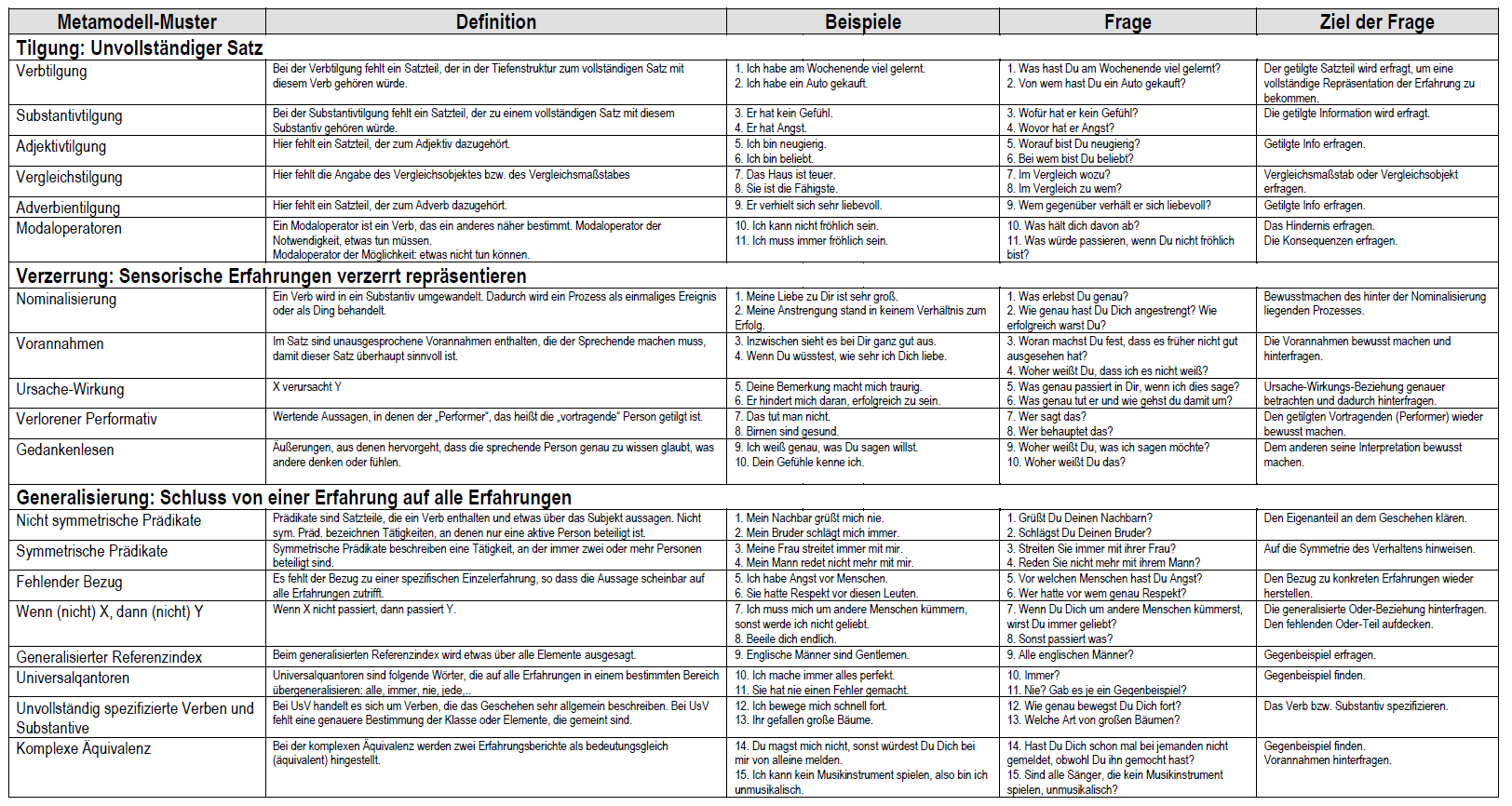
Overview Table of Meta-Model Patterns
Click on the image to enlarge.
Beware of the Meta-Model Monster!
The Meta-Model is extremely helpful for delving into the deep structure of a behavior or problem. Various questioning techniques are available for this purpose — but not every question is effective. In NLP training, 22 questioning techniques are taught, and sometimes all of them seem perfect. Therefore, it is important to choose the questions thoughtfully and not become the Meta-Monster. Those who master the Meta-Model know when to apply which question and which questions are unnecessary.
Lesson Content